


From Voice to Verse: Why ElevenLabs is Betting on the Soundtrack of Your Life

Imagine it is a rainy Tuesday afternoon. You are staring at a blank document, trying to find a rhythm for your work, but your usual playlists feel stale. You open an app, type lo-fi jazz with a hint of cosmic synth and a steady heartbeat rhythm, and thirty seconds later, a unique composition begins to play. It is not a song you found; it is a song you summoned. This is the immediate, almost magical promise of ElevenMusic, the new iOS app from ElevenLabs that quietly transitioned from a beta listing to a full release on April 1, 2026.
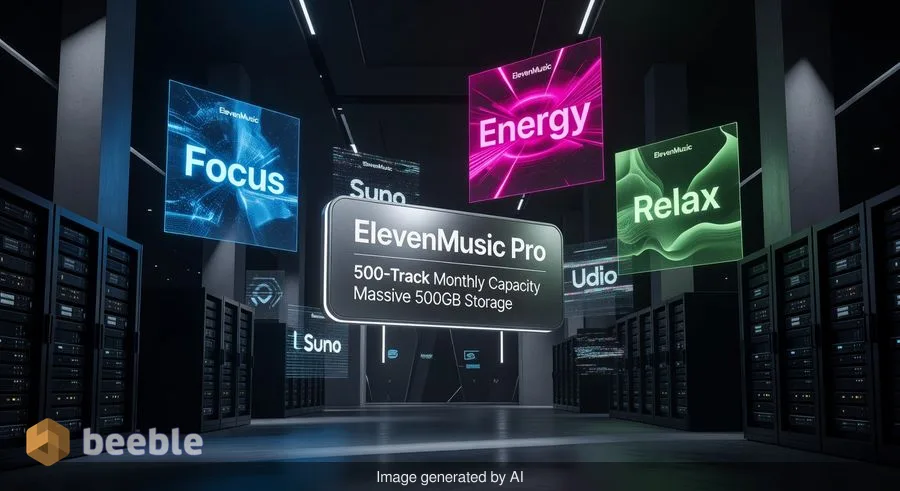
For the casual user, the experience is seamless. The interface does not ask you to understand sampling rates or MIDI sequences. Instead, it offers a familiar, intuitive layout reminiscent of Spotify or Apple Music, complete with trending charts and "mood" stations like Focus and Chill. But through this user lens, we are seeing something much more significant than just another creative toy. We are witnessing the moment generative AI stops being a technical curiosity and starts becoming a ubiquitous consumer utility.
The Strategic Pivot: Beyond the Voice
Historically, ElevenLabs built its reputation on the most robust text-to-speech models in the industry. If you have listened to an AI-narrated audiobook or a viral deepfake meme lately, you have likely encountered their work. However, zooming out to the industry level, the company is facing a classic software dilemma: the commoditization of the "black box." As voice synthesis becomes a standard feature offered by every major cloud provider, a company specialized only in voices risks becoming a legacy service.
Consequently, the move into music is a pragmatic attempt to build a more multifaceted ecosystem. By launching ElevenMusic, ElevenLabs is signaling that it wants to own the entire auditory experience, not just the spoken word. Paradoxically, by making the technology easier to use, they are making their proprietary models harder to replace. They are moving away from being a mere API provider—the digital equivalent of a restaurant waiter bringing data from the kitchen to the table—and becoming the entire dining experience.
Under the Hood: The Engineering of Emotion
Technically speaking, generating music is orders of magnitude more complex than generating speech. While a voice model needs to master the nuances of phonemes and inflection, a music model must juggle melody, harmony, rhythm, and timbre simultaneously, ensuring they all align over time. If a voice model makes a mistake, it sounds like a typo in a novel; if a music model misses a beat, the entire "recipe" is ruined.
In everyday terms, ElevenMusic hides this complexity behind a natural language prompt. When you ask for a "Late Night" track, the underlying architecture isn't just searching a database. It is predicting the next sequence of audio tokens based on patterns learned from millions of hours of human-composed music. The app allows for remixes, which, from a developer's standpoint, is an elegant way to handle user input. Instead of starting from scratch, the model uses an existing song as a blueprint, modifying specific parameters to match your new prompt. This reduces the "digital friction" often associated with creative tools, allowing even the least musical among us to feel like a conductor.
The Spotify-fication of Generative AI
One of the most observant details of ElevenMusic is its social architecture. The app features live stations, pre-created albums, and daily mixes. This is a direct challenge to the fragmented landscape of AI music, where tools like Suno and Udio have largely lived on the web or within Discord servers. ElevenLabs has opted for a streamlined mobile-first approach, recognizing that most digital interactions today happen in the palm of a hand, not behind a desktop monitor.
Curiously, the inclusion of a Pro tier—priced at $9.99 per month—reveals the company’s long-term business logic. By offering 500 tracks a month and a massive 500 GB of storage, they are encouraging a form of digital hoarding. This is the "ecosystem lock-in" strategy: once you have built a library of 200 custom-made songs that perfectly fit your morning commute, the cost of switching to a competitor becomes much higher. Your creative history becomes a proprietary asset held within their cloud.
The Messy Closet of AI Creativity
As we embrace these tools, we must also consider the technical debt of our own creativity. In the past, writing a song required an instrument, a recording device, and hours of practice. Now, it requires a prompt. While this democratizes expression, it also risks creating a bloated sea of "good enough" content. When everyone can generate seven songs a day for free, the value of a single melody begins to shift.
At its core, ElevenMusic is a reflection of how software is rewriting our daily routines. We are moving from a world of "search and find" to a world of "prompt and create." This shift is profound. It changes our relationship with the media we consume; music is no longer a static product we buy from an artist, but a dynamic service we generate for ourselves.
Reclaiming the Human Ear
Ultimately, the release of ElevenMusic invites us to look at our devices with a more critical eye. Is this tool an extension of our creativity, or is it a replacement for it? The app is undeniably impressive—the way it handles different moods like "Cosmic" or "Energy" feels like a seamless extension of our own emotions. Yet, as the line between human-made and machine-generated continues to blur, the most valuable skill for a user won't be the ability to write a perfect prompt, but the ability to listen with intention.
As you experiment with these new sounds, take a moment to observe your own habits. Does having an infinite jukebox of custom tracks make you more creative, or does it simply fill the silence? In a world where code can compose a symphony in seconds, the most resilient form of human expression might just be the choice to put the phone down and listen to the world as it is, unprompted and un-curated.
Sources:
- ElevenLabs Official Product Documentation and Release Notes (April 2026).
- App Store Listing Metadata for ElevenMusic (Version 1.0.4).
- Industry Analysis: "The Commoditization of Audio Foundation Models," Tech-Analyst Quarterly.
- Comparative Study: UX Design Patterns in Generative AI Applications (2025-2026).



See you on the other side.
Our end-to-end encrypted email and cloud storage solution provides the most powerful means of secure data exchange, ensuring the safety and privacy of your data.
/ Create a free account
