


Germany is Betting €125 Million That You Don’t Need Another ChatGPT Clone

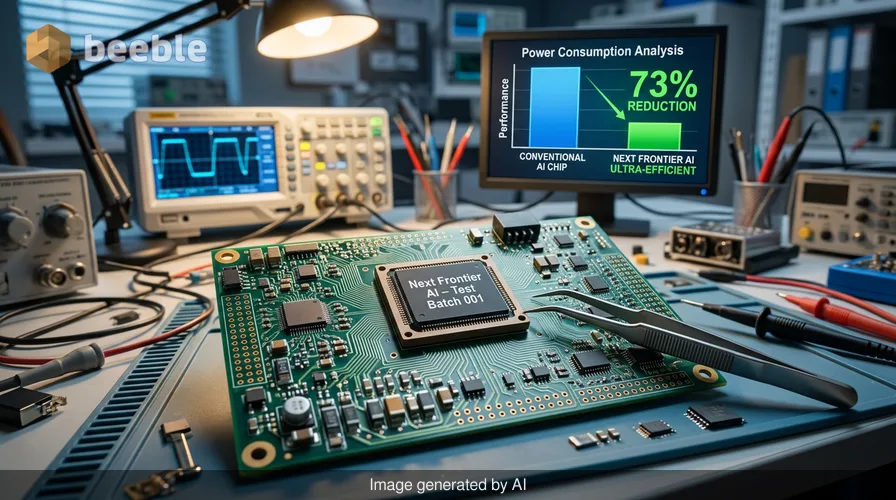
While it is tempting to view the global AI race as a simple game of who has the deepest pockets, the reality is that raw capital is only one part of the equation. Most analysts look at the €125 million price tag of Germany’s new “Next Frontier AI” initiative and compare it to the tens of billions poured into American firms like OpenAI or Anthropic. At first glance, the math doesn't seem to add up. However, the German federal innovation agency, SPRIND, isn't trying to out-spend Silicon Valley in a war of attrition; it is trying to change the rules of the game entirely.
Looking at the big picture, the European approach is moving away from the “bigger is better” philosophy that has dominated the last three years of AI development. Instead of building massive, power-hungry models that vacuum up the entire public internet, this new push focuses on creating a new paradigm of artificial intelligence. It is a strategic pivot that recognizes Europe might have missed the first wave of consumer chatbots, but it cannot afford to miss the foundational shift in how industry and privacy-conscious organizations will use these digital engines in the future.
Breaking Down the €125 Million Gauntlet
The initiative is structured as a high-stakes competition rather than a traditional government grant. This is a crucial distinction. Historically, European tech funding has been criticized for being slow and bogged down by paperwork that favors established corporations over agile startups. SPRIND is attempting to break that cycle by running a 24-month, three-stage sprint designed to filter for only the most resilient and scalable ideas.
In the first stage, up to ten teams will receive €3 million each. This is essentially the “prove it” phase, where researchers and entrepreneurs show that their theoretical math can actually function in a digital environment. Those who survive move to the second stage, where six teams get €8 million each to build out their architecture. Finally, the top three teams will receive a robust injection of €15.5 million each to bring their product to the edge of commercial viability.
| Stage | Number of Teams | Funding per Team | Objective |
|---|---|---|---|
| Stage 1 | Up to 10 | €3 million | Concept Validation & Prototype |
| Stage 2 | Up to 6 | €8 million | Technical Scaling & Architecture |
| Stage 3 | Up to 3 | €15.5 million | Market Readiness & Final Development |
For the average user, this might look like a modest sum, but under the hood, the goal is to use this public money as a catalyst. SPRIND’s head of challenges, Jano Costard, has been transparent about the fact that this €125 million is merely the first step. The intent is to de-risk these new technologies enough so that private investors—who are often risk-averse in Europe compared to their American counterparts—will feel comfortable pouring in the subsequent billions needed for global competition.
Why the World Doesn't Need Another Chatbot
If you have used ChatGPT, Claude, or the recent DeepSeek V4 from China, you are familiar with the current state of Large Language Models (LLMs). They are incredibly impressive but also prone to “hallucinations,” expensive to run, and often opaque in their decision-making. Germany’s “Next Frontier” push is specifically looking for what comes next.
To put it another way, if today's AI is a tireless intern who is great at writing emails but occasionally makes up facts, Germany wants to build the digital equivalent of a master engineer—something precise, reliable, and specialized. The competition explicitly avoids simply copying the Transformer architecture that powers current AI. Instead, it seeks new paradigms that could handle industrial data, complex manufacturing logistics, or highly sensitive medical information without needing a warehouse-sized supercomputer to function.
This shift is partly a response to the volatile nature of the current market. As China moves quickly with models like DeepSeek, and US companies lock down the consumer market, Europe’s best chance for technology sovereignty lies in its own backyard: the massive amount of specialized data sitting in its factories, hospitals, and engineering firms. This is the interconnected web of industrial know-how that hasn't yet been fully “digitized” by AI.
The Industrial Backbone Meets the Digital Brain
Europe’s heavy industry has long been the invisible backbone of modern life, and that is where this AI push is likely to have its biggest impact. While American AI excels at understanding what you want to buy or how you want to summarize a meeting, European AI could become the leader in how we build things.
Practically speaking, this means developing AI that understands physical laws, chemical reactions, and mechanical tolerances. Imagine an AI that doesn't just write a marketing slogan for a new car but can actually help design the most aerodynamic chassis while ensuring the supply chain for every single bolt is optimized for carbon neutrality. This requires a level of precision that current consumer-focused AI simply wasn't built for.
Furthermore, there is a systemic focus on privacy. European regulations, often seen as a hurdle by tech giants, are being treated here as a foundational feature. By building AI that is privacy-focused from day one, Germany hopes to attract global companies that are currently hesitant to feed their proprietary secrets into US-based clouds. In everyday life, this could eventually translate to AI services that live on your local device rather than in a remote data center, keeping your personal life more transparent to you and opaque to advertisers.
Cutting Through the Red Tape with "EU Inc"
One of the most disruptive parts of this announcement isn't the money itself, but the admission that the European system needs an overhaul. For years, the story has been the same: a brilliant researcher at a university in Berlin or Paris develops a breakthrough, realizes they can’t get the funding or the corporate structure they need in Europe, and moves to Palo Alto.
SPRIND is pushing for public funding to become more streamlined and less cumbersome. This coincides with a wider debate about “EU Inc,” a proposed single company law that would allow a startup to operate across all EU member states as easily as a US startup operates across different states. Essentially, the goal is to make the European market feel less like a collection of 27 different rooms and more like one massive workshop.
As a result, this competition is as much about cultural change as it is about technological advancement. It is an attempt to prove that Europe can move at “startup speed” while maintaining its commitment to social and ethical standards. Whether or not this succeeds will depend on whether that initial €125 million can actually ignite the spark for the “billions in additional funding” that Costard mentioned.
What This Means for You
From a consumer standpoint, the success of “Next Frontier AI” won't result in a new app on your home screen tomorrow. Instead, it will likely show up in the efficiency and cost of the products you use. If European manufacturers can use home-grown AI to streamline their production, it could lead to more resilient supply chains and cheaper, higher-quality goods.
Ultimately, this is about choice. Right now, the global AI landscape is a duopoly between the US and China. If Germany’s gamble pays off, the average user will eventually have a third option: AI that is built on European values of privacy, industrial precision, and data sovereignty. It’s a long shot, but in a world where AI is becoming the digital crude oil of the economy, it’s a bet that Germany feels it has no choice but to make.
Rather than waiting for the next big thing to be imported from overseas, we should start observing how the tools we use everyday handle our data. The push for a “European OpenAI” isn’t just a matter of national pride; it’s a quest to ensure that the logic governing our future digital lives is as diverse as the world it aims to serve.
Sources:
- SPRIND (Federal Agency for Leap Innovations) Official Challenge Documentation, 2025/2026.
- European Commission White Paper on Artificial Intelligence and Sovereignty.
- Euronews Next Industry Analysis: "The Race for European Frontier AI."
- Market Data on AI Private Equity Investment Trends in the EU, Q1 2026.



See you on the other side.
Our end-to-end encrypted email and cloud storage solution provides the most powerful means of secure data exchange, ensuring the safety and privacy of your data.
/ Create a free account
