


Google Maps Evolves: How Gemini AI and Immersive Navigation are Redefining the Journey

For over a decade, digital navigation has followed a predictable pattern: you input an address, and a blue line guides you there. However, the era of the static map is coming to an end. Google recently unveiled a significant overhaul to Google Maps, integrating its Gemini AI models to create a more conversational, intuitive, and visually rich experience.
This update introduces two primary pillars: a natural-language search feature called “Ask Maps” and a major expansion of “Immersive Navigation.” Together, these features aim to transform Maps from a simple directory into a proactive travel assistant that understands the nuances of human intent.
Ask Maps: Conversational Intelligence for Real-World Problems
The most striking addition is “Ask Maps,” a feature powered by Google’s Gemini AI. Unlike traditional search, which relies on keywords like “EV charging” or “tennis courts,” Ask Maps allows users to pose complex, multi-layered questions.
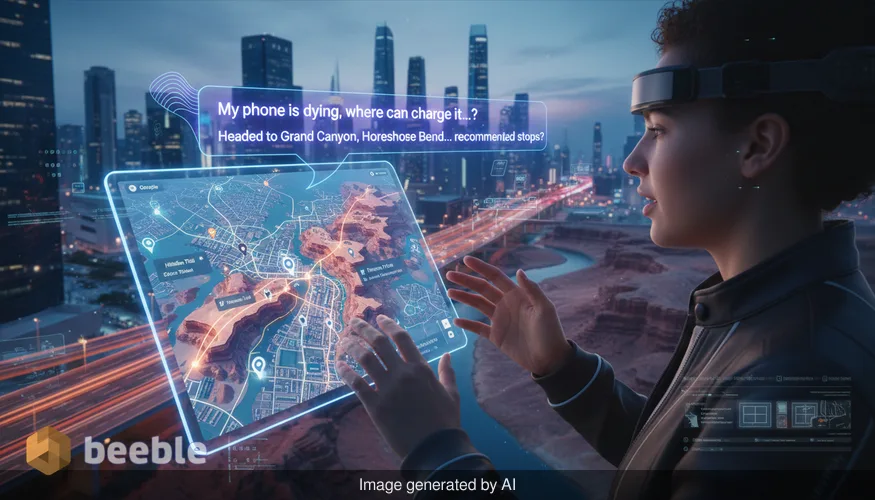
Consider the common traveler’s dilemma: you are in an unfamiliar city, your phone battery is at 5%, and you need a place to charge it—but you don’t want to stand in a long line for a latte just to get an outlet. With the new update, you can simply ask: “My phone is dying, where can I charge it without having to wait in a long line for coffee?”
The AI doesn't just look for the tag “coffee shop.” It cross-references real-time data on foot traffic, business types (like libraries or tech hubs), and user reviews to find a location that fits your specific constraints. It understands context, such as the urgency of a dying battery versus the desire to avoid crowds.
Beyond Directions: AI-Powered Trip Planning
Ask Maps also functions as a sophisticated trip planner. Instead of manually searching for individual stops on a long drive, users can provide a broad itinerary. For instance, a user planning a Southwest road trip might ask: “I’m headed to the Grand Canyon, Horseshoe Bend, and Coral Dunes—any recommended stops along the way?”
Maps responds with a curated list of suggestions that go beyond standard tourist traps. By analyzing millions of data points and “tips from real people,” the AI can suggest hidden trailheads, specific times to avoid crowds, or even logistical advice like where to secure free entry tickets. It effectively turns the collective knowledge of the Maps community into a personalized concierge.
Immersive Navigation: A 3D Window Into Your Route
While Ask Maps handles the “where” and “why,” the updated Immersive Navigation handles the “how.” Google has expanded its Immersive View technology to cover more cities and more specific driving scenarios. This isn't just a 3D map; it is a digital twin of the world that uses AI and computer vision to simulate traffic and weather conditions.
When using Immersive Navigation, the traditional flat map is replaced by a high-fidelity 3D representation of the route. This allows drivers to see complex intersections before they arrive, identifying exactly which lane they need to be in.
Perhaps more importantly, the voice guidance has been humanized. Instead of hearing “In 500 feet, turn left,” the app might say, “Turn left at the yellow building” or “Turn right after the Starbucks.” This natural voice guidance mimics how a human passenger would give directions, reducing the cognitive load on the driver and making navigation feel more instinctive.
The Practical Impact: What This Means for Users
These updates represent a shift toward “contextual computing.” The map is no longer just a tool you use when you are lost; it is a tool you use to optimize your day.
- For EV Owners: The AI can now better predict where you should stop based on charger availability and the amenities nearby that fit your personal preferences.
- For Urban Explorers: Finding niche locations—like a public tennis court with lights for night play—becomes a single-step query rather than a multi-tab research project.
- For Commuters: The enhanced 3D lane guidance reduces the stress of navigating multi-lane highway interchanges in heavy traffic.
How to Get Started and What to Watch For
As these features roll out, users should look for the Gemini icon or the updated search bar within the Google Maps app. To make the most of the new tools, keep these tips in mind:
- Be Specific: Don’t be afraid to use long sentences. The more context you provide to Ask Maps, the better the AI can filter results.
- Check Data Usage: Immersive Navigation is visually intensive. If you are on a limited data plan, you may want to use the standard 2D view for routine commutes and save the 3D view for unfamiliar territory.
- Verify Real-Time Info: While Gemini is powerful, always double-check the “Open” status of businesses, as AI-generated summaries rely on the latest data provided by the venues.
The Future of the Digital Twin
Google’s move to integrate Gemini into Maps is part of a broader trend of making AI helpful in the physical world. By combining massive datasets with generative intelligence, Google is creating a “digital twin” of the planet that doesn't just show us where things are, but helps us understand how to interact with them. As these features evolve, the line between the digital map and the physical world will continue to blur, making every journey—no matter how complex—a little more manageable.
Sources
- Google Official Blog: The Keyword - New AI features for Google Maps
- Google Developers: Maps Platform and Gemini Integration
- TechCrunch: Google Maps adds Gemini-powered search and Immersive View updates
- The Verge: Google Maps is getting more AI-powered features



See you on the other side.
Our end-to-end encrypted email and cloud storage solution provides the most powerful means of secure data exchange, ensuring the safety and privacy of your data.
/ Create a free account
