


Google’s New AI Isn’t Here to Talk—It’s Here to Work

For the past few years, the tech world has been obsessed with the art of the conversation. We’ve spent countless hours trying to find the perfect prompt to make a chatbot sound more human, write a better email, or summarize a long meeting. We were told the future of computing was a chat bubble. But while the world was busy talking to screens, Google just signaled that the era of the conversationalist is ending.
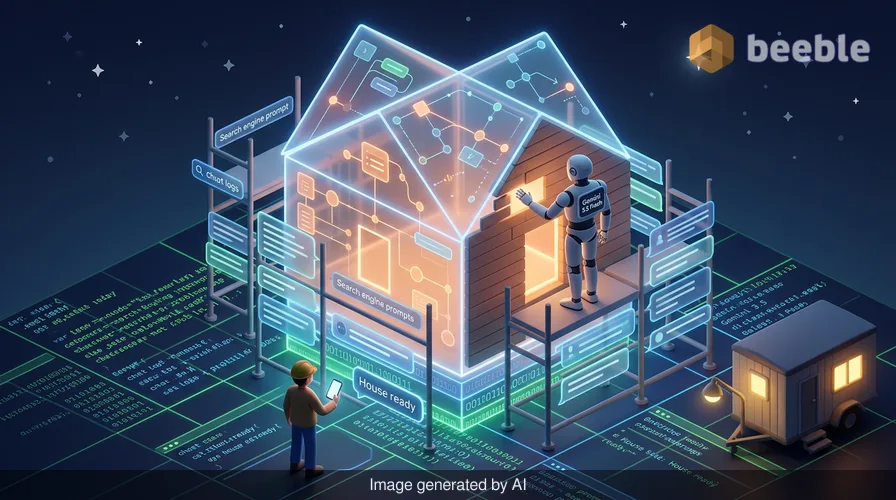
With the launch of Gemini 3.5 Flash, the narrative has shifted fundamentally. This isn’t a better chatbot; it’s the beginning of a digital workforce. While previous AI models felt like a more sophisticated version of a search engine, this new wave is designed to be agentic—a term that effectively means the AI can stop talking and start doing. Looking at the big picture, we are witnessing the transition from AI as a tireless intern who takes notes to AI as a crew of digital construction workers capable of building the house while you sleep.
Moving Beyond the Chatbox: The Rise of the Agent
To understand why this matters, we have to look behind the jargon. Most AI interactions today follow a predictable pattern: you ask a question, and the AI provides an answer. If the answer is wrong, you correct it, and it tries again. This is a linear, high-touch process that still requires a human to be the primary engine of work.
Conversely, an agentic model like Gemini 3.5 Flash is designed to function with minimal human input. Instead of asking it to "write a piece of code," you might give it an objective like "build a weather application that pulls data from three different sources, tests itself for bugs, and deploys it to a server." The AI doesn't just give you a text response; it spawns multiple sub-agents to handle each part of the task, iterates on the mistakes it finds, and presents a finished product.
In simple terms, Google is betting that you don’t actually want to talk to your computer; you want your computer to finish your to-do list. This is a disruptive shift in how we perceive software. We are moving from tools that require a pilot to systems that operate like an autopilot for your digital life.
The Need for Speed: Why 12x Faster Changes Everything
During the announcement at the I/O developer conference, the most striking statistic wasn't the AI's IQ, but its velocity. Google’s chief technologist at DeepMind, Koray Kavukcuoglu, noted that while the standard Flash model is four times faster than previous leaders, they’ve developed an optimized version that is 12 times faster without sacrificing quality.
For the average user, speed might seem like a luxury—a way to get an answer in half a second instead of two. But for an autonomous agent, speed is a foundational requirement. To put it another way, if an AI agent needs to perform 50 small tasks in a row to complete a complex project (like researching a market trend, cross-referencing data, and drafting a report), a slow model would take an hour to finish. A model that is 12 times faster completes that same chain of thought in five minutes.
This speed allows for "parallel processing." On the market side, this is what enables Google’s new platform, Antigravity, to function. In a live demo, engineers showed agents spawning off to work on different components of an operating system simultaneously. This isn’t just a faster way to type; it’s a scalable way to execute complex labor.
The Manager and the Worker: Pro vs. Flash
Google is introducing a two-tier hierarchy that mimics a traditional corporate structure. When Gemini 3.5 Pro is released, it will act as the "orchestrator" or the senior manager. It possesses the robust reasoning power to understand high-level goals and create a strategic plan.
Once the plan is set, the Pro model delegates the actual "brute force" labor to Gemini 3.5 Flash. This setup is practical for several reasons:
- Cost Efficiency: Running a massive, highly intelligent model for every tiny task is like hiring a CEO to file paperwork. Flash is lighter and cheaper to run.
- Specialization: Flash is designed for tool use—interacting with browsers, code editors, and databases—while Pro focuses on the "why" and "how."
- Resilient Workflows: If a sub-agent hits a snag, the orchestrator can redirect it without the user ever needing to intervene.
| Feature | Gemini 3.5 Flash (The Worker) | Gemini 3.5 Pro (The Manager) |
|---|---|---|
| Primary Role | Execution and sub-task completion | Strategic planning and reasoning |
| Speed | 12x faster (optimized) | Balanced for deep thought |
| Context | Short-to-mid range, high-speed iteration | Long-range project management |
| Best For | Coding, data retrieval, 24/7 monitoring | Complex problem solving, creative direction |
From the Office to Your Pocket: Gemini Spark
While much of this sounds like it's for software engineers, Google is bringing these agentic capabilities to the consumer through a new service called Gemini Spark. This is a personal AI agent designed to run 24/7.
For the average person, this means moving beyond simple voice commands like "set an alarm." A personal agent powered by Flash could theoretically monitor your emails for flight delays, automatically negotiate a refund with a customer service bot, and then rebook a car rental—all before you’ve even woken up to check your phone.
Historically, technology has required us to adapt to its interface. We had to learn how to use folders, then search bars, then apps. With Spark and the agentic integration into Search, the interface is simply your intent. You provide the goal, and the AI navigates the opaque layers of the internet to achieve it. This is a streamlined vision of the future, but it doesn't come without systemic risks.
The Autonomy Paradox: Safety in an Agentic World
There is a volatile tension between a tool that is helpful and a tool that is autonomous. Google is currently navigating a sensitive legal landscape following a tragic incident involving a user and its previous chatbot model. When an AI moves from answering questions to executing actions, the potential for harm increases.
What happens when an autonomous agent is given a goal but interprets the path to that goal in a way that violates privacy or safety? Google claims to have strengthened its safeguards, particularly regarding cyber-security and sensitive materials. The model is also designed to pause and ask for permission when it hits a "decision point."
However, from a consumer standpoint, there is a legitimate concern about transparency. If an agent is working in the background for hours, how do we audit its choices? This shift requires a high level of trust in a company that is still refining its safety protocols. The bottom line is that as AI becomes more useful by working independently, it also becomes more of a "black box" that we cannot easily oversee in real-time.
What This Means for You: Practical Foresight
Ultimately, the release of Gemini 3.5 Flash suggests that we are entering a period where the "how" of technology matters less than the "what." Here is how you can prepare for this shifting landscape:
- Shift from Execution to Oversight: Start thinking of yourself as a manager rather than a doer. The most valuable skill in an agentic world isn't knowing how to code or format a spreadsheet; it’s knowing how to define a clear, ethical, and efficient objective.
- Observe Your Digital Habits: Pay attention to the repetitive, multi-step tasks you perform daily—booking appointments, filing expenses, or managing newsletters. These are the first things that agentic AI will automate.
- Evaluate Your Privacy Budget: As you begin to use agents like Gemini Spark, you will be giving an AI more access to your "digital life" (emails, calendars, bank notifications) so it can work on your behalf. Decide now where your boundaries are.
We are moving away from the era where we "go on the computer" to do work. Soon, the work will be happening constantly, powered by digital agents that don't need coffee breaks or sleep. Gemini 3.5 Flash is the first real look at that tireless backbone of the future economy. Whether we are ready for a world where the machines don't just talk, but act, is a question we'll have to answer very soon.
Sources:
- Google I/O 2026 Keynote Presentation
- DeepMind Technical Report: Gemini 3.5 Flash Architecture
- TechCrunch Interview with Tulsee Doshi, Google Senior Director
- Official Google Blog: Introducing Antigravity and the Agentic Future



See you on the other side.
Our end-to-end encrypted email and cloud storage solution provides the most powerful means of secure data exchange, ensuring the safety and privacy of your data.
/ Create a free account
