


Google's new map of human DNA is less about discovery and more about debugging

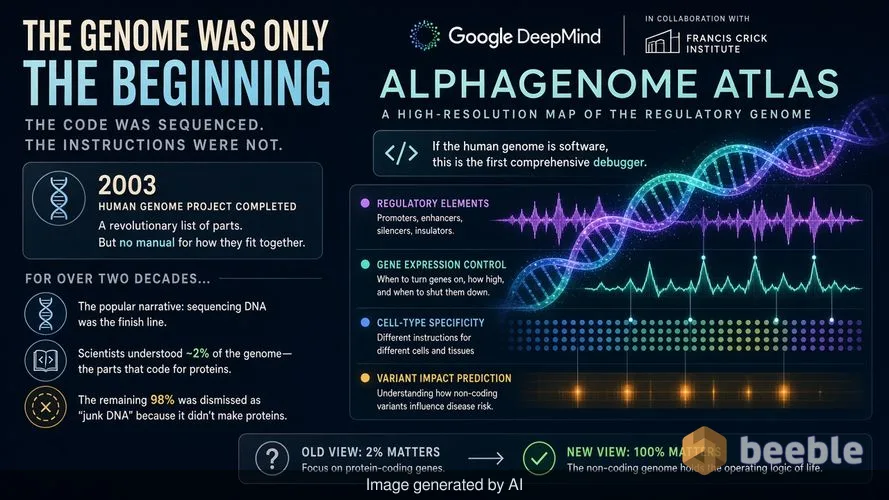
While the 2003 completion of the Human Genome Project seems like the final word on biological discovery, the reality is that it only provided a list of parts without a manual for how they fit together. For over two decades, the popular narrative suggested that sequencing a person's DNA was the ultimate finish line for modern medicine. Science had the alphabet, so the thinking went, and therefore it understood the story. In truth, scientists spent the next twenty years staring at a massive volume of code where they only understood about two percent of the words. The remaining 98 percent was often dismissed as junk DNA because it did not directly produce proteins.
Google DeepMind recently released the AlphaGenome Atlas to address this massive gap in knowledge. This project is a collaboration with the Francis Crick Institute and serves as a high-resolution map of the regulatory elements that govern our biology. If the human genome is a complex piece of software, AlphaGenome Atlas is the first comprehensive debugger. It focuses on the non-coding regions of our DNA, the silent instructions that tell a cell when to turn a gene on, how high to crank the volume, and when to shut it down entirely.
The silent 98 percent of your code
To understand why this matters for the average user, think of your DNA as a giant house. The two percent of the genome we already understand is like the physical objects in the house: the refrigerator, the lamps, and the furnace. We know what these things do. However, for twenty years, we were unable to find the light switches or the thermostat. The non-coding DNA contains the switches. When a switch breaks, the furnace stays off in the middle of winter, even if the furnace itself is in perfect condition.
Most chronic diseases, including Type 2 diabetes, heart disease, and many forms of cancer, do not usually stem from a broken furnace. They stem from a faulty switch in the non-coding regions of the DNA. Because there are millions of these switches, finding the one responsible for a specific disease is like trying to find a single loose wire in a skyscraper. Historically, researchers had to test these switches one by one in a lab, a process that is slow, expensive, and prone to failure.
DeepMind changed this approach by applying the same AI logic that solved protein folding with AlphaFold. The AlphaGenome Atlas uses a transformer-based model called Enformer to predict how changes in DNA sequences affect gene expression across different tissues. Instead of guessing, scientists now have a predictive map that suggests which genetic variations are likely to cause a malfunction. This is a foundational shift from descriptive biology to predictive engineering.
Moving from what to when
The industrial logic behind this project is simple. Biology is the invisible backbone of modern life, yet our tools for managing it remain primitive compared to our tools for managing silicon. While AlphaFold told us what a protein looks like, the AlphaGenome Atlas tells us when and where that protein appears in the body. This distinction is vital because a protein that is helpful in the liver might be toxic if it appears in the brain.
Under the hood, the AI analyzes the physical distance between different parts of the DNA strand. DNA is not just a long, straight ribbon. It folds and loops in three-dimensional space so that a switch located very far away on the string can actually touch the gene it controls. AlphaGenome Atlas maps these loops with unprecedented precision. For the average person, this means that a genetic test in the year 2026 provides far more than a list of ancestry percentages. It provides a functional report on how the machinery of the body is likely to react to aging, diet, and environment.
Practically speaking, this data is decentralized and open-source. Google decided to make the atlas available to the global scientific community. This move is less about altruism and more about scaling the ecosystem. By providing the map for free, Google ensures that its AI tools become the industry standard for every biotech startup and university lab in the world.
The industrial shift in drug discovery
On the market side, the cost of developing a new drug is currently astronomical. It takes roughly ten years and billions of dollars to bring a single compound to the pharmacy shelf. A primary reason for this high cost is the high failure rate. Most drugs fail in clinical trials because they either do not work as expected or they cause unforeseen side effects.
AlphaGenome Atlas acts as a tire pressure gauge for the pharmaceutical industry, identifying slow leaks before the car leaves the garage. If a drug company knows exactly which genetic switch they need to flip, they can design molecules that are much more specific. This reduces the risk of the drug interacting with the wrong part of the cellular machinery. In everyday life, this leads to a resilient supply chain of medicine where treatments are developed faster and with fewer side effects.
The bottom line for investors and consumers is that the era of the blockbuster drug is ending. The blockbuster model relied on one-size-fits-all pills like Lipitor or Prozac. The new era is built on precision. We are moving toward a time when a doctor looks at your specific AlphaGenome map and prescribes a dose that is calibrated to your unique regulatory switches. This is a tangible improvement in safety and efficacy.
How this changes your pharmacy visits
From a consumer standpoint, the impact will be felt first in the treatment of rare diseases. Many children suffer from conditions that doctors cannot name because the mutations occur in the dark matter of the DNA. The AlphaGenome Atlas allows clinicians to match a child's symptoms to a specific broken switch in their genome. What used to be a five-year diagnostic odyssey could soon become a one-week computer scan.
Curiously, this also has implications for common medications. Many people do not respond to standard antidepressants or blood thinners. This happens because their genetic switches for metabolism are tuned differently. As this technology moves into the clinic, the guesswork of medicine disappears. You will not have to try three different medications to find the one that works. The data will indicate the correct choice on day one.
There is, of course, a level of skepticism required when a tech giant like Google becomes the primary cartographer of human life. While the atlas is open, the compute power required to run these models remains concentrated in the hands of a few companies. The opaque nature of AI decision-making means we must trust that the model is accurate. We are essentially handing the keys to our biological operating system to an algorithm that even its creators cannot fully explain in plain English.
Understanding the biological logic gate
Looking at the big picture, the AlphaGenome Atlas represents a transition of biology into a branch of information technology. We are no longer just observers of nature. We are becoming editors. The atlas identifies specific logic gates in our cells. If Input A (a specific protein) meets Logic Gate B (a DNA switch), then Output C (a biological function) occurs.
By mapping two billion of these potential interactions across hundreds of different cell types, DeepMind created a searchable database of human life. This is not just a scientific achievement. It is a streamlined industrial tool. It allows researchers to simulate experiments on a computer before they ever touch a petri dish. This digital-first approach to biology is how we will eventually tackle complex systemic issues like aging and neurodegeneration.
Practical foresight for the genetic era
The arrival of the AlphaGenome Atlas suggests that your biological data will soon be as important as your financial data. As these maps become more accurate, the pressure to share your genetic profile with insurers or employers will grow. You should observe your digital habits and consider how much biological information you are willing to trade for the promise of personalized health.
Ultimately, the most important takeaway is that your DNA is not a static blueprint of your fate. It is a dynamic, shifting system of switches and signals that responds to the world around you. The AlphaGenome Atlas is simply the first tool that is powerful enough to read the fine print of that system. This map proves that the complexity of the human body is manageable, provided we have the right software to interpret it.
Sources: Google DeepMind Research Blog, The Francis Crick Institute Technical Reports, Nature Genetics Journals.



See you on the other side.
Our end-to-end encrypted email and cloud storage solution provides the most powerful means of secure data exchange, ensuring the safety and privacy of your data.
/ Create a free account
