


Grounded Innovation: Why Europe’s Agricultural Drones are Stuck in Regulatory Limbo

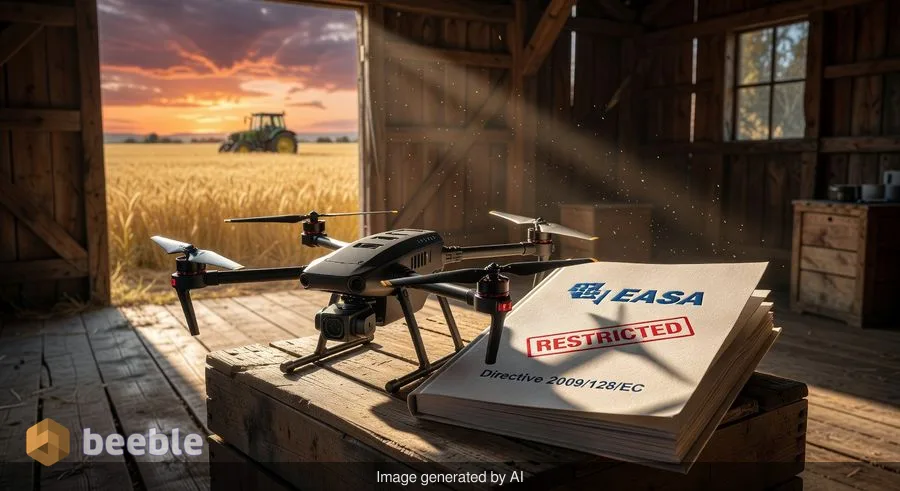
Despite the global agricultural drone market being projected to exceed $6 billion by the end of 2026, European farmers find their high-tech ambitions largely tethered to the ground by a complex web of safety and environmental protocols. While the rest of the world treats aerial automation as a foundational pillar of modern food security, the European Union remains caught in a paradoxical loop: championing the 'Green Deal' while effectively banning the very tools designed to make it a reality.
If you walked through an agricultural trade show two decades ago, the air would smell of diesel and the sights would be dominated by the sheer physical scale of iron—massive tractors, towering combine harvesters, and heavy-duty ploughs. Today, these expos feel more like Silicon Valley product launches. You will see AI-driven livestock monitoring systems and rows of sleek, carbon-fiber drones. Yet, for the average European grower, these machines are often more of a museum exhibit than a practical field tool. Looking at the big picture, the gap between what is technologically possible and what is legally permissible has never been wider.
The EASA Framework: A Safety Ceiling
To understand why your local vineyard isn't yet being tended by a swarm of autonomous flyers, we have to look under the hood of the European Union Aviation Safety Agency (EASA) regulations. Most drone operations fall into two main buckets: 'Open' and 'Specific.' The 'Open' category is straightforward—it is for the hobbyist filming a sunset or a photographer capturing a wedding. It requires minimal paperwork because the risk to the public is low.
However, agricultural drones are not toys. They are heavy, they carry payloads, and they operate over vast areas. This pushes them into the 'Specific' category. For a farmer, this means navigating a SORA (Specific Operations Risk Assessment), a process so bureaucratic it often requires hiring a specialized consultant just to prove that a drone flying over an empty wheat field won't collide with a commercial airliner. Essentially, the regulation treats a 25kg crop-sprayer with the same systemic caution as a small manned aircraft, creating a barrier to entry that is rarely scalable for small to mid-sized family farms.
The Pesticide Paradox
Curiously, the biggest roadblock isn't even about aviation safety; it is about what the drone carries. The use of drones in agriculture often involves the targeted application of fertilizers or pesticides—a practice known as precision spraying. In theory, this is a win for the environment. By using a drone as a tireless intern to spot-treat only the plants that are sick, farmers can reduce chemical usage by up to 30%.
Practically speaking, however, this innovation hits a hard wall in the form of Directive 2009/128/EC. This aging piece of legislation established a framework for the sustainable use of pesticides and included a blanket ban on aerial spraying. When the law was written, 'aerial spraying' meant a crop-duster plane dumping chemicals from 50 feet up, where the wind could carry them for miles. Applying that same logic to a drone hovering three feet above a leaf is like banning a precision laser because you are worried about the splash damage of a sledgehammer.
A Global Relay Race with a Dropped Baton
On the market side, the contrast between Europe and its global peers is stark. In Japan and China, drone-led agriculture is not a futuristic dream; it is a daily reality. These nations have streamlined their certification processes, recognizing that automation is the only way to manage aging rural populations and volatile climate patterns.
European manufacturers are in a strange position. They produce some of the most robust and intuitive hardware on the planet, yet they often find more success exporting their tech to North America or Southeast Asia than selling it to their neighbors. It is a global relay race where Europe has the fastest runners but has somehow managed to drop the baton at the regulatory exchange point. This creates an opaque environment for investors, who are hesitant to fund disruptive European AgTech when the domestic market is so heavily restricted.
| Feature | EU Regulation Status (2026) | Impact on Farmer |
|---|---|---|
| Visual Line of Sight (VLOS) | Strictly required in 'Open' | Limits range to what the eye can see. |
| Aerial Spraying | Prohibited (with rare exceptions) | Prevents 30-50% reduction in chemical use. |
| SORA Certification | Mandatory for heavy drones | High administrative costs and delays. |
| Cross-Border Ops | Partially harmonized | Difficult to move equipment between member states. |
What This Means for You
You might wonder why a city dweller or a casual consumer should care about the flight paths of agricultural drones. The answer lies in the invisible backbone of our food supply chain. When farmers are denied tools that increase efficiency and reduce chemical dependency, the results are tangible: higher food prices and a slower transition to sustainable farming.
In simple terms, if a farmer has to use a heavy tractor to spray a whole field because they aren't allowed to use a drone to spray five specific plants, they are burning more fuel, using more chemicals, and compacting the soil. Those costs—both environmental and financial—eventually show up at your local grocery store.
The Bottom Line
Ultimately, the future of European agriculture depends on shifting from a 'No, but maybe' mindset to a 'Yes, and' approach. We are seeing some movement; a few member states are beginning to grant derogations for drone spraying in steep vineyards where tractors cannot go, but these are small cracks in a very large dam.
For the average user and the forward-thinking investor, the takeaway is clear: keep an eye on the upcoming revisions to the Sustainable Use of Pesticides Regulation (SUR). Until the EU aligns its environmental goals with its aviation laws, the drone revolution will remain grounded. As a consumer, it is worth reflecting on how the 'invisible' rules of heavy industry and aviation safety dictate the price and quality of the salad on your plate. The technology is ready; the question is whether the bureaucracy is ready to let it fly.
Sources:
- European Union Aviation Safety Agency (EASA) - Easy Access Rules for Unmanned Aircraft Systems.
- European Parliament - Directive 2009/128/EC on the sustainable use of pesticides.
- Eurostat - Agricultural production and technology adoption reports 2024-2025.
- International Society of Precision Agriculture - Global market trends and regulatory impact studies.



See you on the other side.
Our end-to-end encrypted email and cloud storage solution provides the most powerful means of secure data exchange, ensuring the safety and privacy of your data.
/ Create a free account
