


Hardware Has Never Been More Permanent, Yet Its Performance Has Never Been Less Fixed

We used to buy a graphics card with the understanding that its peak performance was a fixed point in time. When you unboxed a GPU in 2010, you knew exactly how many frames per second it could produce in your favorite shooter. That number stayed the same until you physically swapped the card for a newer, more expensive model. Hardware was a static purchase, a piece of silicon frozen in the moment of its manufacture. Today, that relationship between the consumer and the machine is fundamentally different. Software has become a retroactive upgrade path that can redefine the capabilities of a card you bought years ago.
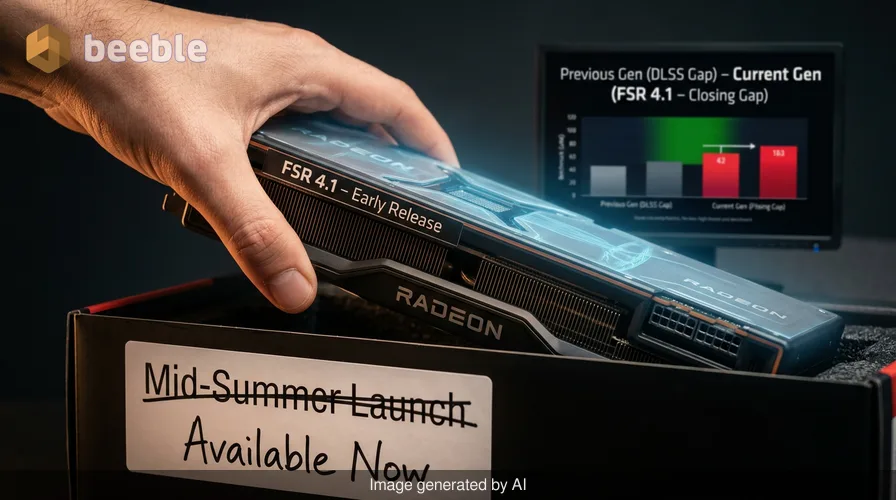
AMD is leaning into this shift with the early release of FSR 4.1. Originally slated for a mid-summer launch, the upscaling suite is now available for Radeon RX 7000 series owners. This update moves the RX 7800 XT and the 7900 XTX into a new era of image reconstruction. By utilizing machine learning, AMD is finally closing the performance gap with Nvidia's DLSS. This move changes the value proposition for thousands of PC gamers who were previously limited by the raw rasterization power of their hardware.
The era of the static silicon box is over
The traditional gaming upgrade cycle is an expensive ritual. For decades, the industry relied on the consumer's desire for more pixels and smoother movement to sell new boxes every few years. This created a predictable, if costly, rhythm for the audience. You bought the hardware, you played the games it supported, and you eventually hit a wall where newer titles were unplayable. We now live in an era of "living hardware" where the purchase is just the starting point.
Behind the scenes, this shift is driven by the limits of physics. Transistors can only get so small before heat and power consumption become insurmountable problems. Consequently, the industry has turned to AI to do the heavy lifting that raw electricity no longer can. FSR 4.1 is the latest example of this philosophy. It uses temporal upscaling and machine learning to guess what the next frame should look like, effectively tricking the human eye into seeing a high-resolution image that the hardware never actually rendered. This process makes an aging GPU feel like a fresh purchase through a simple driver update.
Software as a retroactive hardware upgrade
Zooming out to the industry level, the release of FSR 4.1 for RDNA 3 cards is a strategic play to maintain relevance in a market dominated by Nvidia's proprietary tech. For a long time, AMD relied on open-source solutions that worked on almost any card but often lacked the visual clarity of its competition. FSR 4.1 changes the internal logic of how these cards handle data. It focuses on better stability for moving objects and a reduction in the shimmering effect that plagued earlier versions.
In everyday terms, this means that a person who bought a mid-range RX 7000 card in 2024 just received a performance boost for free in 2026. This is a radical departure from the planned obsolescence that defines much of modern consumer electronics. It creates a sense of loyalty between the brand and the user. The hardware becomes a vessel for continuous improvement rather than a ticking clock. This dynamic is especially resonant for budget-conscious gamers who cannot justify a thousand-dollar upgrade every two years.
Machine learning models for tight memory spaces
The announcement also highlights a specific focus on the handheld market. Devices like the Steam Machine and the Xbox ROG Ally X use RDNA 3.5 APUs, which have much less memory bandwidth than a dedicated desktop card. AMD is developing lightweight AI models specifically for these constrained environments. This technical hurdle is the reason handheld users have to wait a bit longer for their version of the update.
Handheld gaming is often a conversation between the player and the battery. If a device has to work too hard to render a scene, the battery dies in an hour. By using FSR 4.1, these devices can render at a lower internal resolution and use the AI to upscale the image to 1080p. This consumes less power while maintaining visual quality. This streamlined approach allows a portable device to act like a much larger machine. It is the architectural foundation that makes high-end portable gaming possible.
The console DNA hidden in the PC ecosystem
There is a deep irony in the fact that many PC gamers are now using the same technology that powers the PlayStation 5 Pro. Sony’s PSSR 2 is built on the foundation of AMD’s machine learning research. Paradoxically, the high-end console market and the PC market are merging at the code level. The boundaries between these platforms are becoming transparent as they all share the same upscaling logic.
Through this audience lens, the choice of platform is less about power and more about the ecosystem. If your PC and your console both use the same AI reconstruction, the visual difference between them shrinks. The hardware is no longer the primary differentiator. Instead, the value lies in the software features, the library access, and the ease of use. AMD is essentially democratizing high-end rendering by bringing PS5 Pro-level tech to the standard Radeon owner. This is a massive shift in how we perceive the "premium" experience in gaming.
Why the oldest cards have to wait until next year
While the RDNA 3 news is positive, the RDNA 2 community faces a longer wait. AMD has scheduled FSR 4.1 support for older cards like the RX 6800 in 2027. This delay reveals the difficulty of retrofitting new AI logic onto older architectures. RDNA 2 lacks the dedicated AI accelerators found in the newer cards — which means the software has to be entirely rewritten to run on generic compute units.
This delay is a blow to Steam Deck owners. The original Steam Deck uses an RDNA 2-based chip, and as games become more demanding, the lack of modern upscaling is becoming a bottleneck. The Deck was a disruptive force in gaming because it made a massive library portable, but its hardware is now showing its age. Without FSR 4.1, owners are forced to choose between blurry images or low frame rates. This is the moment where the "forever hardware" dream hits a physical wall. The software can only do so much when the underlying silicon lacks the specific pathways needed for modern AI tasks.
Reclaiming value in an age of planned obsolescence
At its core, the evolution of FSR is a response to the rising cost of entry for hobbyist gaming. As GPU prices remain high, the audience is looking for ways to extend the life of their current machines. We are seeing a shift in consumer behavior where the software update is more anticipated than the hardware launch. People are no longer just buying a product; they are buying into a service of ongoing optimization.
This shift requires a change in perspective. We should observe how our media consumption habits are dictated by these invisible algorithms. When a game looks better on your screen today than it did yesterday, it is not because of a miracle. It is because a team of engineers found a way to use math to bypass the limitations of your physical card. This realization should encourage us to reclaim conscious choice over our hardware. We do not always need the latest model if the one we own is still learning new tricks. In a world that constantly asks us to buy more, the most radical act is finding more value in what we already have.
Sources: AMD Adrenalin Software Documentation, Radeon Technology Group Official Briefing, Steam Hardware Survey Data (2026), Microsoft Gaming Hardware Report.



See you on the other side.
Our end-to-end encrypted email and cloud storage solution provides the most powerful means of secure data exchange, ensuring the safety and privacy of your data.
/ Create a free account
