

How a Greek digital wallet explains the shifting boundaries of modern childhood

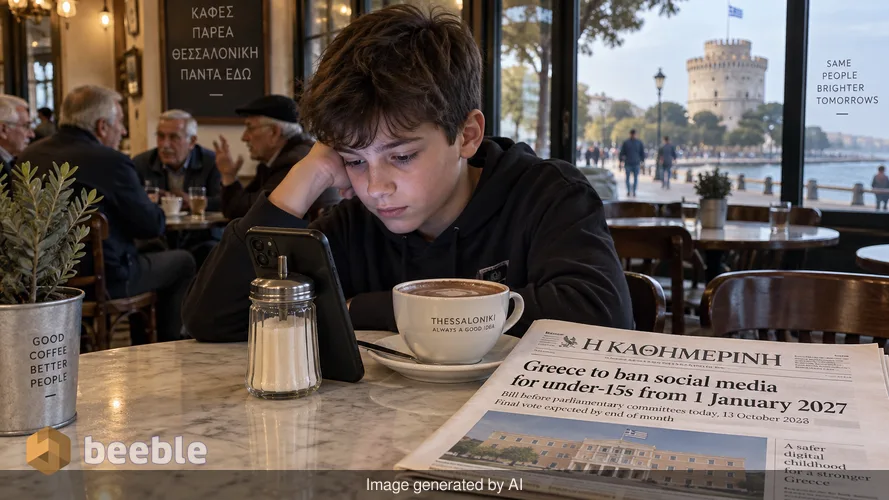
A twelve-year-old boy sits in a Thessaloniki cafe, his phone propped against a sugar shaker. His eyes move with the mechanical precision of a scanner, flicking through short-form videos while his hot chocolate grows cold and develops a thin skin. He is physically present in the smells of roasted beans and the chatter of elderly men in the corner, yet his attention is elsewhere. This is the atomized reality of the modern minor. His social life exists in a sequence of ephemeral scrolls, a digital fast-food diet that provides quick hits of dopamine but lacks the deep emotional nutrition of the physical world. Greece has decided to intervene in this specific, quiet moment of disconnection.
The Greek government is moving to establish a firm boundary between the vulnerability of childhood and the relentless demands of the attention economy. Starting 1 January 2027, children under the age of 15 will face a ban on accessing social networking services like Instagram, TikTok, and Facebook. This legislative move is a response to a systemic shift in how children grow up, shifting the burden of protection from the individual parent to the state and the technology platforms. The bill comes before parliamentary committees today, 13 October 2026, with a final vote expected by the end of the month.
The architecture of a digital buffer
At its core, the new framework is a structural attempt to reclaim the mental space of the young. Minister of State Akis Skertsos, alongside Health Minister Adonis Georgiadis and Digital Governance Minister Dimitris Papastergiou, presented the plan as a necessary safeguard against the risks of cyberbullying and the erosion of concentration. The law is not a suggestion. It is a regulatory wall. By setting the age limit at 15, Greece is defining the point at which a minor possesses the psychological resilience to navigate the hall of mirrors that is a social media feed.
Technically, the implementation relies on the Gov.gr Wallet and a specific Kids Wallet. These tools will facilitate the use of digital age tokens. To put it another way, a platform like TikTok will receive a mathematical confirmation that a user is over 15 without ever seeing the child's name, birth date, or address. This preserves privacy while ensuring compliance. The Digital Governance Ministry insists that this technology minimizes data collection. Platforms are free to use other technical solutions, provided they meet the strict standards of European law. This flexibility prevents the state from mandating a single, monopolistic technology across the entire internet.
The sociological breakdown of the feed
Zooming out, this legislation addresses the pervasive sense of urban alienation that technology often exacerbates. Historically, the Greek square or the neighborhood cafe served as a third place where social hierarchies were learned and navigated in real time. Today, these spaces are often silent, filled with people who are physically adjacent but digitally distant. Sociologists refer to this as the atomization of society. When a child spends four hours a day in a curated feed, their habitus—the deeply ingrained habits and dispositions they carry—is formed by algorithms rather than community interactions.
Digital communication is a fast-food diet for the developing brain. It is accessible and immediate, but it often lacks the visceral feedback of face-to-face disagreement or the quietude of boredom. By removing these platforms from the daily routines of those under 15, the government is attempting to reintroduce a period of slow growth. The goal is to protect the health and development of minors from algorithms designed to keep them constantly connected. This intervention recognizes that the attention economy is too powerful for a child to resist through willpower alone.
Supervision and the European context
Greece is not acting in a vacuum. This initiative is a local application of the European Digital Services Act (DSA). Specifically, it draws on Article 28, which demands a higher standard of protection for minors on online platforms. The National Telecommunications and Post Commission (EETT) will act as the primary coordinator for these new rules. They will work with the National Council for Radio and Television (ESR) and the Hellenic Data Protection Authority (HDPA) to monitor how platforms handle the new age checks.
Enforcement starts with the user. A complaint from a parent or a report from a local authority can trigger an investigation. If a platform is based in another EU member state, the EETT will coordinate with the regulators in that country. This cross-border cooperation ensures that a company cannot simply ignore Greek law because its headquarters is in Dublin or Amsterdam. The burden of proof is now on the platform to show that its age-verification methods are accurate and difficult to circumvent. This represents a major shift in digital power dynamics.
The paradox of digital protection
Paradoxically, the use of a digital wallet to ban digital access highlights how deeply technology has integrated into the functions of the state. We are using the very tools of the digital age to limit the influence of the digital age. This creates a transparent layer of governance where the state acts as a gatekeeper to protect the psychological well-being of its citizens. Culturally speaking, this law marks the end of the wild-west era of the internet in Greece. It suggests that the digital world is no longer a separate, lawless territory but a public utility that requires strict zoning.
On an individual level, this change will transform the mundane routines of Greek families. The dinner table might become a place where the youngest members are forced to engage with the present moment because the digital escape hatch is locked. There is a profound irony in the fact that it takes a state mandate to return a child to the simplicity of their own thoughts. However, in an era of liquid modernity where everything is transient and shifting, these regulatory anchors are becoming necessary for mental stability.
Takeaways for a shifting digital diet
As the January 2027 deadline approaches, the success of this measure will depend on how technology companies adapt and how parents support the change. It is helpful to view this transition not as a loss of freedom, but as a reclaiming of time.
- Consider the digital age token as a privacy shield rather than a surveillance tool.
- Reflect on how much of a child's social identity is currently performed for an audience of strangers.
- Observe the difference in a child's concentration levels when the digital feed is absent for extended periods.
- Question whether the convenience of hyper-connection is worth the systemic anxiety it seems to produce.
Ultimately, the Greek social media ban is a collective experiment in digital hygiene. It asks if we can stop the fragmentation of the young mind by reintroducing boundaries that were erased two decades ago. As we move toward 2027, the focus shifts from what children are missing on their screens to what they might find in the world around them when they are finally forced to look up. Perhaps the boy in the Thessaloniki cafe will eventually notice his hot chocolate is cold, push his phone into his pocket, and start a conversation with the person sitting across from him. This small, visceral act of presence is exactly what the law hopes to facilitate.
Sources:
- Greek Ministry of State, Official Briefing on the Protection of Minors Bill (October 2026).
- EU Digital Services Act (DSA), Article 28: Protection of Minors.
- Hellenic National Telecommunications and Post Commission (EETT) Regulatory Guidelines.
- Zygmunt Bauman, Liquid Modernity (Sociological Framework).
- Pierre Bourdieu, The Logic of Practice (Concept of Habitus).



See you on the other side.
Our end-to-end encrypted email and cloud storage solution provides the most powerful means of secure data exchange, ensuring the safety and privacy of your data.
/ Create a free account