


How a Hidden Pattern in Your Pixels Explains the Death of 'Seeing is Believing'

You are scrolling through your social feed when you see it: a photograph of a sunset over a neon-drenched cityscape that feels just a bit too perfect. Your thumb hovers. You zoom in, looking for the tell-tale signs of a machine’s hand—a blurred edge where a building meets the sky, or a reflection that doesn't quite follow the laws of physics. This micro-moment of digital skepticism has become a daily ritual for the modern user. We have moved from the era of "seeing is believing" to an era of "seeing is questioning." This subtle shift in our psychology is the driving force behind a massive, invisible infrastructure project currently being built by the titans of the software industry.
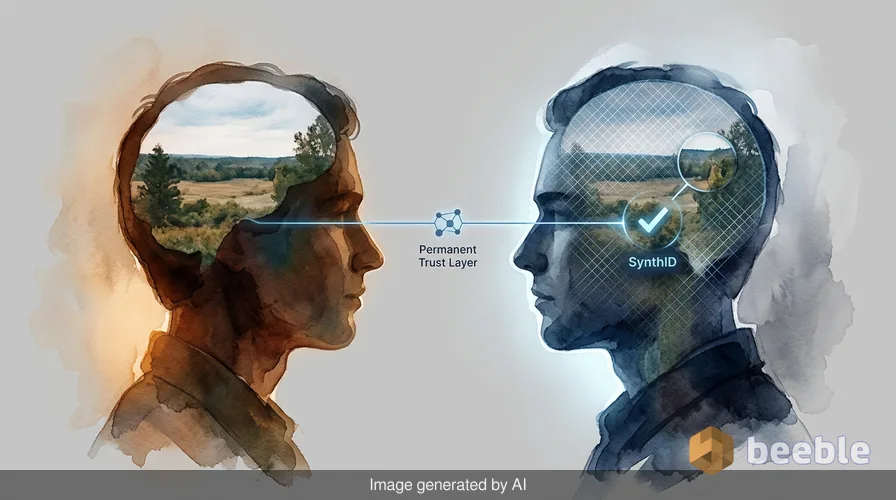
At the center of this project is Google’s SynthID, a technology that has quietly moved from an experimental research paper to a ubiquitous layer of the internet's fabric. Recently, Google announced a significant expansion of the SynthID ecosystem, introducing a Content Detection API for Google Cloud’s Gemini Enterprise platform and securing adoption from industry heavyweights like Nvidia and OpenAI. While these updates might sound like dry enterprise news, they signal a profound change in how software will mediate our reality. Through this user lens, we aren't just seeing a new feature; we are witnessing the construction of a permanent trust layer for digital media.
Under the Hood of the Invisible Ink
To understand why this matters, we have to look at what is happening behind the screen. When you capture a photo on a traditional camera, the image is a direct translation of light hitting a sensor. When an AI generates an image, it is a mathematical prediction of what pixels should look like based on a prompt. Historically, we tried to label these AI images using metadata—digital tags attached to the file that say, "I was made by a computer." The problem, as any developer who has dealt with legacy systems knows, is that metadata is fragile. It is the digital equivalent of a post-it note stuck to a package; it’s the first thing to fall off when the file is cropped, compressed, or screenshotted.
SynthID takes a more robust approach. Instead of a tag, it embeds an imperceptible signal directly into the pixels themselves. Technically speaking, it uses deep learning models to make subtle adjustments to the image’s colors, textures, and spectral noise. These changes are so minute that the human eye cannot perceive them, yet they are resilient enough to survive significant transformations.
If you take a screenshot of a watermarked image, the signal remains. If you apply a heavy filter, the signal remains. Behind the scenes, Google’s new Content Detection API acts as the detective for this invisible ink. When a business—say, a news organization or an insurance company—sends an image to this API via a REST request, the system analyzes the pixel-level artifacts and noise patterns. It doesn’t need to look at the metadata; it looks at the "DNA" of the image to determine if it originated from an AI model. This is a pragmatic solution to a fragmented digital landscape where truth is increasingly difficult to verify.
Zooming Out: The Industry's Unified Front
Why is this happening now? Zooming out to the industry level, we can see that the tech giants are facing a collective crisis of confidence. If users stop trusting what they see on their screens, the entire economy of the web—from advertising to social engagement—begins to crumble. Consequently, we are seeing a rare moment of alignment between competitors.
OpenAI, once the primary disruptor of digital authenticity with DALL-E and Sora, is now adopting a multi-layered approach that combines SynthID with C2PA (Coalition for Content Provenance and Authenticity) metadata. This creates a redundant security system: C2PA provides the "who, what, and where" context, while SynthID provides the durable proof of origin. Nvidia is integrating SynthID into its Cosmos foundation models, and platforms like Canva and Shutterstock are using the detection API to sort through the billions of images they host.
This isn't just about catching "fake news." In everyday terms, it’s about backend operations that keep our digital lives functional. Think of an insurance company receiving a photo of a car accident; the Content Detection API allows them to automatically flag potentially fraudulent, AI-generated evidence. Paradoxically, as AI makes it easier to fabricate reality, the software that detects those fabrications is becoming a mandatory part of every enterprise's technical debt. To put it another way, the industry is building a lock for a door it just finished inventing.
The Ecosystem Lock-in of Truth
From a developer's standpoint, there is a fascinating tension between open-source ideals and proprietary control here. Google has already watermarked over 100 billion images and videos. By expanding this to Chrome, Search, and even the hardware level of Pixel phones (models 8 through 10), they are positioning themselves as the de facto arbiter of digital provenance.
When a Pixel 10 user takes a photo, the camera app will use C2PA Content Credentials to certify the image is "real." If that same user sees an image in Chrome, the browser might eventually use the SynthID API to whisper, "This was generated by a machine." This creates a seamless but opaque ecosystem where the software doesn't just display information; it interprets its validity for you.
This is where we see the "walled garden" effect. While the C2PA standard is an open-source effort, the machine learning models required to detect deep-level watermarks like SynthID are proprietary and compute-intensive. As a result, the ability to "know what is real" is becoming a service that businesses must rent from the cloud giants. We are moving toward a future where digital truth is a subscription-based utility.
The Paradox of the Arms Race
Ultimately, we must ask: Can this ever be a final solution? The history of software is a graveyard of "unbreakable" security measures. Every time a new watermarking technique is developed, a new "cleaning" algorithm is designed to strip it away. It is an iterative game of cat and mouse.
However, the goal of SynthID isn't necessarily to be perfect; it's to be resilient. Like a city's infrastructure, it doesn't need to prevent every crime; it just needs to make the cost of committing the crime high enough to deter most people. By weaving these signals into the very fabric of the internet—from the foundation models of Nvidia to the consumer devices in our pockets—Google and its partners are raising the baseline for digital accountability.
Curiously, this shift might actually make us more reliant on our devices, not less. We are delegating our skepticism to the software. Instead of trusting our eyes, we are learning to trust the little checkmark in the corner of the screen. It is a profound shift in the human-computer relationship, where the machine becomes the guardian of its own output.
Reclaiming the Human Eye
As we navigate this new landscape, it is easy to feel like a passive observer in a battle between algorithms. But on an individual level, these updates offer us a chance to reflect on our own digital literacy. The next time you see a "perfect" image, don't just look for a watermark; consider the engineering logic that put it there.
We should be hyper-observant not just of the pixels, but of the systems that manage them. While Google’s Content Detection API is a streamlined and necessary tool for an AI-saturated world, it is also a reminder that our digital tools are no longer neutral windows. They are active participants in our perception of reality.
Instead of waiting for a piece of software to tell you what is true, use this shift as a prompt to reclaim a sense of control. Question the provenance of the information you consume. Understand that every "seamless" experience in your browser is the result of thousands of hours of developer labor designed to manage the chaos of the modern web. The invisible ink is there, but the most important tool for navigating the future remains your own critical thinking.
Sources:
- Google Cloud: Introducing the SynthID Content Detection API for Gemini Enterprise.
- OpenAI: Implementation of C2PA and SynthID Watermarking Standards.
- Nvidia Developer: Cosmos Foundation Models and SynthID Integration.
- C2PA (Coalition for Content Provenance and Authenticity): Technical Specifications v2.1.
- Google DeepMind: Research on Imperceptible Watermarking in Generative Media.



See you on the other side.
Our end-to-end encrypted email and cloud storage solution provides the most powerful means of secure data exchange, ensuring the safety and privacy of your data.
/ Create a free account
