


How a Single Toggle in Ubuntu 26.04 Explains the Future of Computing

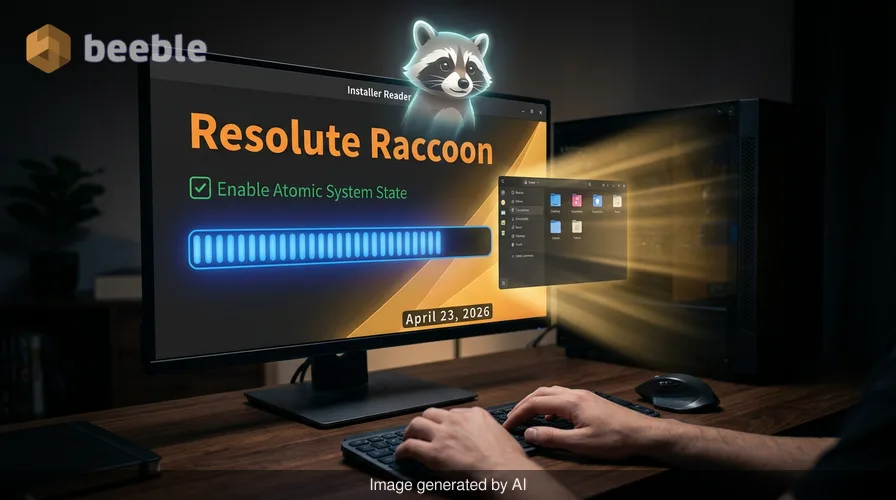
The progress bar crawls forward with a rhythmic, almost hypnotic pulse. It is the morning of April 23, 2026, and I am sitting in a dimly lit home office, watching the 'Resolute Raccoon' install itself onto a machine that has seen four previous versions of Ubuntu. The installer for Ubuntu 26.04 LTS looks familiar, yet it feels different. There is a new, unassuming checkbox during the partitioning phase that simply reads: ‘Enable Atomic System State.’ It is a minor interface detail, a tiny grain of digital sand in the vast desert of a full operating system installation. On the surface, it looks like just another feature for power users to ignore. But as the installation finishes and the system reboots in record time, that little checkbox begins to feel like something much larger.
Through this user lens, the immediate experience of Resolute Raccoon is one of startling, almost eerie smoothness. The desktop environment, powered by GNOME 50, no longer stutters when you drag a window across a high-refresh-rate monitor. The icons are crisp, the animations are fluid, and the legacy of clunky interface transitions seems to have finally been buried. You open the file manager, and it responds with an intuitive snap that makes you realize how much digital friction you had simply learned to tolerate over the last decade. But why does this specific release feel so much more intentional than the ones that came before it? Why does a single toggle in the installer feel like a pivot point for the entire open-source ecosystem?
Zooming out to the industry level, we see that Ubuntu 26.04 is not just an incremental update; it is the culmination of a decade-long struggle to modernize the very foundation of how we interact with computers. Under the hood, the 'Atomic System State' toggle represents a shift toward immutability, a concept where the core operating system is treated as a read-only image rather than a collection of files that can be haphazardly modified by any rogue script or poorly written installer. Historically, the Linux desktop was a playground for tinkerer-centric chaos, where one wrong command could send the entire system into a spiral of dependency hell. Paradoxically, by restricting what the user can change in the core system, Canonical is actually providing more freedom—the freedom from the constant fear of a broken update.
At its core, this shift addresses the overarching problem of technical debt. If we think of an operating system as a city’s infrastructure, the legacy way of managing Linux was like allowing every resident to dig up the street to fix their own pipes whenever they felt like it. Eventually, the map of the city becomes an unnavigable mess of patches and temporary fixes. In everyday terms, Ubuntu 26.04 is finally moving the pipes into a centralized, protected vault. This ensures that the water keeps running and the lights stay on, regardless of what the individual user decides to install in their own 'apartment' or user space. Consequently, the 'Resolute' in 'Resolute Raccoon' refers to a hardened, unyielding commitment to stability that previous versions often sacrificed at the altar of total user control.
Technically speaking, the reliance on Snap packages has reached a tipping point in this release. While the tech community has long been divided on the merits of containerized applications, their implementation in 26.04 feels seamless rather than forced. The startup times for ubiquitous apps like Firefox and Spotify, which used to be a point of major frustration, have been slashed thanks to the new compressed metadata layer in the Linux 7.0 kernel. This kernel, which makes its LTS debut here, also introduces profound improvements in how the system handles NPUs—Neural Processing Units. As AI-assisted features move from the cloud to our local hardware, the operating system must act as a pragmatic mediator between hungry algorithms and limited battery life. How does a developer ensure that a background LLM doesn't drain a laptop in forty minutes? The answer lies in the highly granular resource scheduling found deep within the Resolute Raccoon’s architecture.
But as we look closer at these advancements, a question arises: are we losing the soul of the open-source movement in exchange for a streamlined user experience? From a developer's standpoint, the move toward an immutable base and a proprietary-adjacent delivery system like Snap can feel like the construction of a walled garden. In contrast to the wide-open frontiers of the early 2000s, modern Ubuntu feels more like a curated gallery. It is beautiful, it is robust, and it is incredibly difficult to break. Yet, the opacity of some of these background processes can make the system feel less like a tool you own and more like a service you are merely borrowing. Is the trade-off worth it for the average person who just wants to get their work done without worrying about a kernel panic?
In practice, for the vast majority of users, the answer is a resounding yes. The fragmented nature of the Linux desktop has been its greatest weakness for twenty years, preventing it from reaching the desk of the ordinary professional who isn't a hobbyist. By prioritizing resilience over total malleability, Ubuntu 26.04 is positioning itself as the de facto choice for the next generation of workstations. It is a system designed for a world where we no longer have time to clean up our digital messy closets. We want our technology to be invisible, acting like a restaurant waiter who brings us exactly what we need without us ever having to see the chaos of the kitchen.
Ultimately, our relationship with our operating systems is evolving. We are moving away from the era of the 'Disposable OS'—where you expected to wipe and reinstall your machine every year just to keep it fast—and into an era of sustainable, long-term digital environments. Ubuntu 26.04 'Resolute Raccoon' is the clearest signal yet that the industry is ready to treat the desktop as a serious piece of infrastructure rather than an experimental hobby. It reminds us that sometimes, the most revolutionary thing a piece of software can do is stay out of your way and work exactly as promised.
As you sit back and watch the 'Installation Complete' message appear on your screen, take a moment to look at your own habits. Do you value the ability to tinker with every line of code, or do you value a tool that remains steadfast and predictable under pressure? Perhaps the true meaning of this release isn't found in the new kernel or the updated GNOME interface, but in the peace of mind that comes from knowing your digital foundation is solid. In an increasingly volatile tech landscape, there is something profoundly radical about a raccoon that refuses to move.
Key Takeaways for the Resolute User
- The Power of the Immutable: Consider trying the 'Atomic' installation mode. While it restricts some deep-system tweaking, it offers a 'rollback' feature that can save you hours of troubleshooting if an update goes sideways.
- Snap Maturity: Observe the launch times of your most-used apps. The improvements in 26.04 suggest that the performance gap between containerized and native apps is finally closing, making the debate more about philosophy than practicality.
- Hardware Symbiosis: If you are running 26.04 on a laptop with an NPU, look for the new 'Intelligent Power' settings. This is the first LTS version to truly understand how to balance local AI tasks with traditional computing needs.
- A Shift in Ownership: Reflect on your digital tools. As software becomes more streamlined and 'locked-in' for the sake of stability, how much of the underlying mechanics do you still feel you control, and how much are you willing to delegate to the developers?
Sources
- Canonical Ltd., Official Ubuntu 26.04 (Resolute Raccoon) Release Notes, April 2026.
- GNOME Foundation, GNOME 50 Design Specifications and Human Interface Guidelines.
- The Linux Foundation, Kernel 7.0 Documentation: Advanced Scheduling for Heterogeneous Computing.
- Ubuntu Discourse, Community Feedback Thread: The Transition to Atomic Desktop Architectures.
- Open Source Initiative, Report on the Evolution of Immutable Distributions in Enterprise Environments.



See you on the other side.
Our end-to-end encrypted email and cloud storage solution provides the most powerful means of secure data exchange, ensuring the safety and privacy of your data.
/ Create a free account
