


How a Student’s Hesitation in a Tallinn Cafe Explains Estonia’s Radical Defense Against Artificial Laziness

A teenage girl sits in a corner of a glass-walled cafe in central Tallinn, the late May sun catching the edge of her tablet. She is engaging with a custom-built interface, her fingers hovering over the screen. There is a specific, almost imperceptible choreography to her movements: a quick tap, a long pause where her eyes narrow at the text, and then a deliberate sequence of typing. She isn’t just looking for an answer; she is interrogating the process of finding one. This minute friction—the refusal to simply click 'accept'—is the visceral heartbeat of a national experiment. It is a microcosm of what happens when a society decides that digital literacy is not about knowing how to use tools, but about knowing how to resist them.
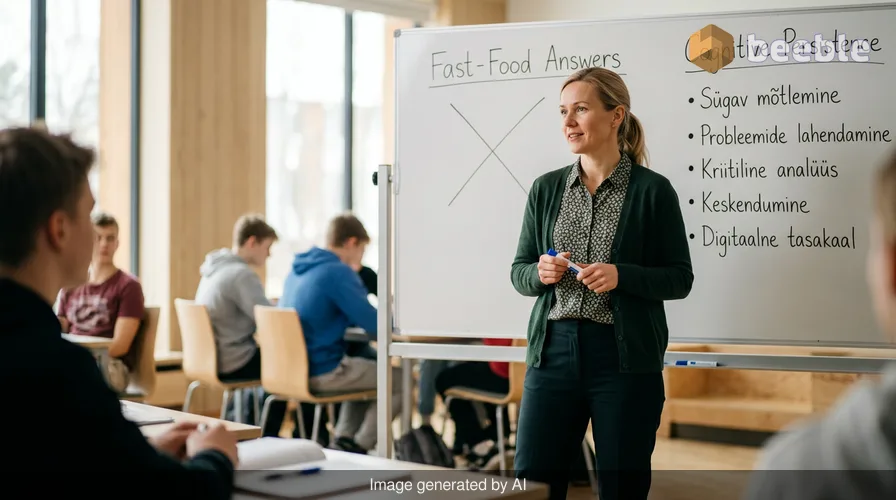
Zooming out from this single table, we see a country navigating the complexities of liquid modernity. In Estonia, the conversation around technology has shifted. While many European neighbors are still caught in a cycle of moral panic or passive observation, the Estonian 'AI Leap' (Tehisintellektihüpe) has moved toward a technorealistic stance. It is a recognition that the younger generation—those who have never known a world without ubiquitous connectivity—are already deeply embedded in AI ecosystems. The challenge is no longer access; it is the quality of engagement. Culturally speaking, we are witnessing a move away from the 'fast-food' diet of instant chatbot answers toward a more nutritious, albeit more difficult, form of cognitive persistence.
The Architecture of the AI Leap
By May 2026, the Estonian AI Leap has matured into a systemic framework that rejects the simplistic 'vendor lock-in' approach. Instead of merely purchasing bulk licenses for generic tools, the program focuses on a profound transformation of the educational habitus. The scale is significant: over two years, the initiative is training 48,000 students and 6,700 teachers. This isn't just a technical upgrade; it is a sociological restructuring of the classroom.
At its core, the program rests on five pillars designed to prevent the 'atomization' of learners—the state where students become isolated consumers of algorithmic outputs rather than active participants in a collective intellectual tradition.
- The Socratic Bot: Unlike standard LLMs that prioritize helpfulness and brevity, Estonia’s tailored educational chatbots are designed to be intentionally 'difficult.' They guide students through inquiry rather than providing direct conclusions.
- Study Circles: These professional learning communities for teachers meet monthly to dismantle the 'ivory tower' of tech expertise, allowing educators to co-create strategies that suit their specific classroom dynamics.
- Advanced Tool Access: Over 4,000 teachers have premium access to tools like ChatGPT and Gemini, not to replace lesson planning, but to serve as a sophisticated sparring partner for pedagogical innovation.
- Non-formal Engagement: Through debate leagues and creative arts, students are encouraged to use AI in immersive settings that require a visceral, human response.
- Centralized Resources: A platform that blends educational psychology with technical documentation ensures that the 'how-to' is always balanced with the 'why.'
Breaking the Hall of Mirrors
Paradoxically, the greatest threat posed by AI is not its lack of intelligence, but its ability to reflect our own biases and intellectual laziness back at us. This creates a digital 'hall of mirrors' where the user becomes trapped in a feedback loop of their own making. If a student asks an AI to write an essay on Estonian history and accepts the first draft, they are not learning history; they are performing a hollow ritual of completion.
Estonia’s approach targets this specific vulnerability. By integrating AI across all disciplines—not just informatics—the system ensures that critical thinking becomes a pervasive habit rather than a niche skill. In a literature class, for instance, the AI might be used to generate three different interpretations of a poem, which the students must then deconstruct, compare, and verify against historical context. This process turns the AI from an 'answer machine' into a 'discourse provocateur.'
A Partnership of Public and Private Wills
One of the most nuanced aspects of the Estonian model is its management structure. Strategies in the EU often wither in the implementation phase because they lack local buy-in. Estonia has bypassed this by creating a public-private partnership where the state provides 50% of the funding, and the private sector—companies like Telia and the Skaala fund—contributes the rest. This isn't just about money; it's about shifting the cultural needle. When local tech CEOs act as hackathon mentors, the 'everyday routines' of the business world are directly injected into the educational sphere.
| Feature | Passive/Soft Approach | Estonian AI Leap (Technorealistic) |
|---|---|---|
| Focus | Ethical lectures & warnings | Active practice & critical inquiry |
| Tooling | General consumer AI | Custom Socratic bots & premium tools |
| Pedagogy | AI as a threat to be managed | AI as a catalyst for deeper thinking |
| Management | Top-down ministry guidelines | Regional managers & school-level autonomy |
| Expertise | Academic/Theoretical | Multi-disciplinary (Psychology, Tech, Business) |
The Philology of Oversight
Linguistically speaking, we often use the term 'human oversight' as a sort of cultural anesthetic—a phrase that sounds reassuring but remains frustratingly opaque in practice. What does it actually mean to oversee a system that can generate ten thousand words in the time it takes us to blink? The Estonian model suggests that oversight is not a final check at the end of a process, but a constant state of cognitive friction throughout it.
On an individual level, this means teaching students the semantics of AI prompts and the structural weaknesses of probabilistic reasoning. It involves understanding that an LLM does not 'know' facts; it predicts sequences. When students learn to see the 'language' of the machine as an archaeological site, where they can dig through layers of training data to find the source of a hallucination or a bias, they regain their agency. They move from being subjects of the technology to its curators.
From Graders to Thinkers
Ultimately, the AI Leap is an attempt to solve a problem that predates the invention of the silicon chip: the tendency of educational systems to mass-produce students who are motivated only by grades and immediate results. In the age of AI, 'results' are cheap. A grade-based system is easily gamed by an algorithm. Consequently, the only way to maintain the relevance of school is to shift the focus back to the process of thought itself.
Through this lens, the AI is not the enemy of the classroom; it is the ultimate mirror, forcing us to confront what makes human intelligence unique. It is our ability to navigate ambiguity, to feel empathy, and to question the 'why' behind the 'what.' Estonia's pragmatic embrace of these tools suggests that the future of education isn't about high-tech classrooms, but about high-thinking individuals who use technology to amplify their humanity rather than replace it.
Food for Thought
- The Pause as a Tool: Next time you use a generative tool, notice when you feel the urge to just 'copy-paste.' That moment of laziness is where your critical thinking ends. Can you consciously insert a 'friction point'?
- The Socratic Shift: If you are a parent or educator, try responding to a question with a question that forces the student to evaluate the AI's output. How does the dynamic change when the 'expert' is the one who asks, not the one who tells?
- Structural Awareness: Consider how much of your daily digital routine is curated by an algorithm. Does your 'habitus' allow for unexpected, non-algorithmic discovery, or are you living in a digital archipelago of your own biases?
Sources:
- Estonian Ministry of Education and Research: AI Leap Program Strategy (2024-2026).
- Hariduse Tehnoloogia Kompass (Educational Technology Compass): Annual Report on Digital Literacy.
- Zygmunt Bauman, 'Liquid Modernity': On the impermanence of modern social structures.
- Pierre Bourdieu, 'The Logic of Practice': Concepts of habitus and social field dynamics.
- OpenAI & Google: Collaborative Whitepapers on Localized Educational AI Implementation in Northern Europe.



See you on the other side.
Our end-to-end encrypted email and cloud storage solution provides the most powerful means of secure data exchange, ensuring the safety and privacy of your data.
/ Create a free account
