


How Michael Mann Is Reclaiming the Blockbuster From the Superheroes

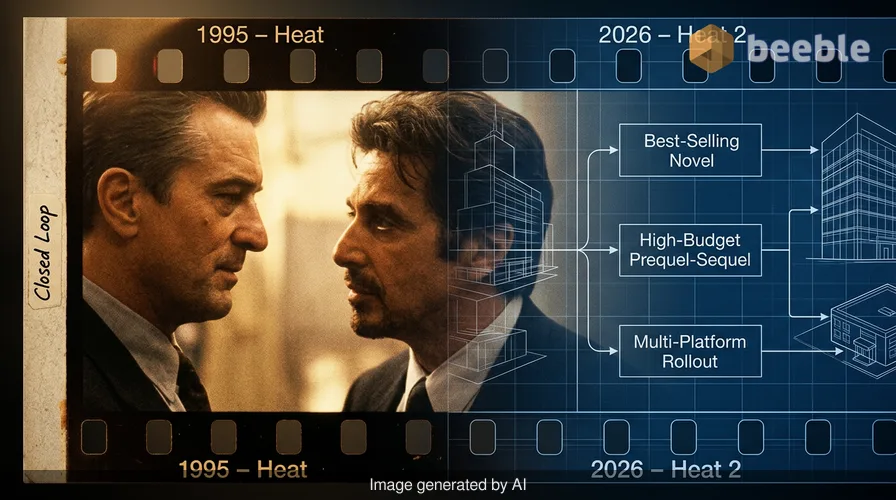
There is a specific, metallic sound that exists only in the world of 1995. It is the rhythmic clatter of an assault rifle in the middle of a sun-bleached Los Angeles street. For anyone who grew up on the cinema of Michael Mann, that sound is a sensory anchor. It represents a time when movies for adults had the budgets of small nations and the gravitational pull of planets. Watching the original Heat is an exercise in high-stakes melancholy. You feel the coldness of the blue-lit glass houses and the heat of the asphalt. It was a closed loop. The story was over. Neil McCauley was dead on a runway, and Vincent Hanna was holding his hand.
Behind the scenes, the industry is no longer interested in closed loops. The announcement that Leonardo DiCaprio and Christian Bale have joined the cast of Heat 2 is the clinical reality of a modern media landscape. Amazon MGM has reportedly spent a year in difficult negotiations to finalize these deals. This is the corporate machinery of the legacy sequel. It is a process where the ghosts of 1990s cinema are resurrected to provide a foundation for a new franchise. The raw, subjective emotion of the original film has been dissected and reassembled into a strategic asset. What was once a singular cultural moment is now a multi-platform architecture consisting of a best-selling novel and a high-budget prequel-sequel.
The weight of the legacy casting
The choice to cast Leonardo DiCaprio as Chris Shiherlis and Christian Bale as Vincent Hanna is a move of calculated scale. In the 1990s, stars were the engine. Al Pacino and Robert De Niro did not just play characters. They were the spectacle. Today, the industry relies on the intersection of established Intellectual Property and A-list validation. DiCaprio has a reputation for being selective. He is an actor who rarely participates in franchises or sequels. His involvement suggests that the script for Heat 2 has a level of prestige that distinguishes it from standard studio fare.
Christian Bale is an actor known for physical transformation and intensity. He is stepping into a role previously defined by Al Pacino’s operatic, cocaine-fueled energy. The negotiations for these actors lasted a year because the stakes are high. When a studio attempts to follow a masterpiece, the casting must be bulletproof. A representative for Amazon MGM told TheWrap that deals are not yet finalized, but sources indicate the core ensemble is coming together. This ambiguity is common in high-level talent acquisitions. It creates a vacuum that keeps the project in the news cycle for months before a single frame is shot.
The architecture of the prequel-sequel
Michael Mann is a filmmaker who treats research like a religion. When he released the novel Heat 2 in 2022, he did not just write a book. He built a roadmap for a cinematic expansion. The story exists as both a prequel and a sequel. It explores the early lives of Neil McCauley and Vincent Hanna in 1988 while simultaneously following Chris Shiherlis in the years after the original film’s shootout. This structural choice is a solution to the problem of the finality of the first movie.
In everyday terms, this is a home renovation on a massive scale. You cannot change the foundation of the house, so you build out and down. By going back to 1988, Mann can bring back the character of Neil McCauley without violating the logic of his death. Stephen Graham is in talks to take over the role Robert De Niro made famous. Graham is an actor who carries a specific kind of blue-collar volatility. He does not look like De Niro, but he shares a certain internal rhythm. This is the goal of the modern reboot. It is not about imitation. It is about capturing the essence of a brand.
The novel as a protective barrier
Historically, sequels were often mandated by studios based on box office numbers. The creative team was then forced to find a reason for the story to continue. Mann reversed this process. He conceived the idea for Heat 2 nearly a decade ago and released it as a novel during the production of his film Ferrari. By publishing the story as a book first, he established the narrative as a definitive work of fiction before the studio system could touch it.
This move was a defensive maneuver. In an era where algorithms often dictate plot points and character arcs, the novel serves as a shield. The story is already public. The fans have read it. The tone is established. Paradoxically, this makes the movie more attractive to actors like DiCaprio and Bale. They are not joining a corporate brainstorm. They are joining an adaptation of a successful literary work. This shift highlights a growing trend among veteran directors. They are bypassing the standard development process by creating their own source material. It is a way to maintain authorship in a fragmented industry.
The shift from film to franchise
Zooming out to the industry level, the production of Heat 2 is a case study in the power of the library. Amazon MGM is not just making a movie. They are investing in a world. The report that Adam Driver is in negotiations to play the villain Otis Wardell adds another layer of modern prestige. Driver has worked with Mann before on Ferrari. He represents the bridge between the old-school director and the new generation of cinema.
We used to go to the movies to see a story end. Now, we go to see a story expand. This change is driven by the economics of streaming platforms. A standalone film has a limited shelf life. A cinematic universe with multiple timelines and a deep cast list provides years of content. It creates a walled garden where the audience stays within the same ecosystem. If you watch Heat 2, the algorithm will inevitably guide you back to the 1995 original. The two films exist in a symbiotic relationship.
The human scale of high-stakes crime
Despite the massive budgets and the year-long contract disputes, the appeal of Heat remains grounded in human failure. It is a story about men who are excellent at their jobs but terrible at their lives. This is the resonant core that Michael Mann must preserve. If Heat 2 becomes just another slick action movie, it will fail regardless of who is in the cast. The original film worked because it felt heavy. The weapons were heavy. The consequences were heavy.
From a creator's standpoint, the challenge is to replicate that weight with a new cast. When audiences scroll through a streaming library on a Friday night, they are looking for something that feels real. They are tired of the polished, weightless digital effects of the last decade. There is a hunger for the tactile. The report that filming will begin in November 2026 suggests a long pre-production period. This is necessary for a director like Mann, who is known for putting his actors through rigorous tactical training. He wants the movements to be instinctive. He wants the actors to understand the mechanics of the crime as well as the characters do.
Reclaiming the viewer's attention
As the production moves toward its November start date, the hype will only increase. We are currently in the era of the A-list name-drop. Every day brings a new rumor about a "number of actresses" circling the role of Charlene. This is the marketing of the modern blockbuster. It is an attempt to make the movie feel like an event before a single trailer exists. It is a way to cut through the noise of the digital buffet.
Ultimately, the success of Heat 2 will depend on whether it can move beyond its own status as a strategic asset. We live in a world of infinite content where very little of it feels profound. The original Heat is a reminder of what happens when a director has a singular vision and the resources to execute it. This new project is an attempt to capture that lightning twice. It is a gamble on the idea that the audience still wants complex, adult drama on a grand scale. We are invited to watch a new generation of icons inhabit the shadows of the old ones. The goal is not to replace the memory of 1995. The goal is to prove that those shadows are still long enough to cover us all.



See you on the other side.
Our end-to-end encrypted email and cloud storage solution provides the most powerful means of secure data exchange, ensuring the safety and privacy of your data.
/ Create a free account
