


How three countries are building a cross-border hydrogen economy from the ground up

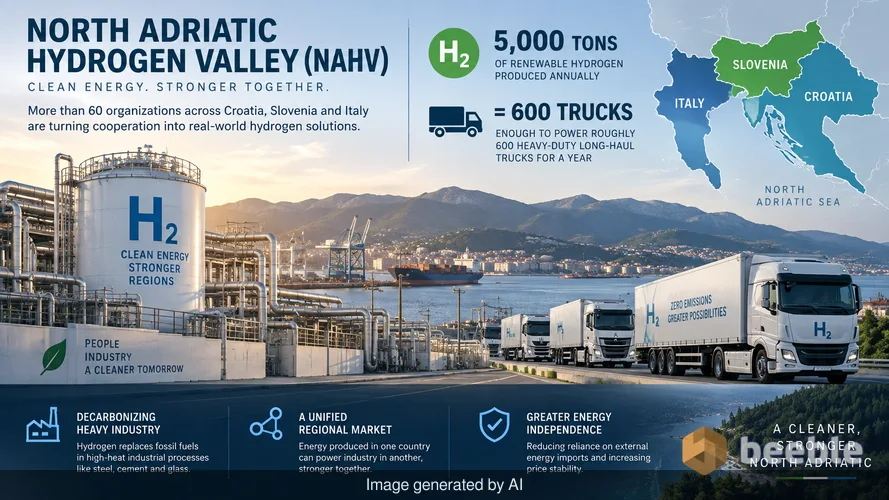
The North Adriatic region is currently managing a shift that few industrial hubs attempt successfully. Over sixty organizations across Croatia, Slovenia, and Italy are now actively moving from theoretical cooperation to the physical deployment of a hydrogen-based economy. This project, known as the North Adriatic Hydrogen Valley (NAHV), aims to produce 5,000 tons of renewable hydrogen every year. To put that in perspective, 5,000 tons of hydrogen provides enough energy to power roughly 600 heavy-duty long-haul trucks for an entire year of operation. This isn't just a political experiment. It is a massive re-engineering of the regional industrial backbone.
Heavy industry is the invisible backbone of modern life. Everything from the steel in your car to the glass in your windows relies on high-heat processes that currently burn fossil fuels. Hydrogen acts as a clean substitute for these processes. By focusing on a cross-border approach, the North Adriatic Hydrogen Valley bypasses the typical limitations of small, isolated energy grids. It creates a unified market where energy produced in one country can power a factory in another, reducing the reliance on external energy imports that have caused price volatility in recent years.
The transition from pilot projects to industrial reality
The project began as a concept in 2021. By March 2022, representatives from Croatia, Slovenia, and the Italian region of Friuli Venezia Giulia signed a formal Joint Letter of Intent. This document was the starting gun for what has now become a complex network of innovation and investment. Historically, cross-border energy projects fail because of conflicting regulations and fragmented funding. The NAHV structure avoids this by using a centralized framework that connects production, transport, and end-use across all three territories.
We are now entering the market deployment phase. This means the focus has shifted from "can we do this?" to "how do we make this profitable and scalable?" The ecosystem has expanded to include specialized initiatives like NACHIP, NASCHA, and H2READY. These programs are the gears that turn the large engine of the Hydrogen Valley. They ensure that the technology works in specific scenarios, such as urban transport or heavy manufacturing, rather than just remaining as a laboratory success.
How small businesses enter the hydrogen supply chain
For the average person or small business owner, hydrogen technology often feels like something reserved for billion-dollar corporations. The North Adriatic ecosystem is trying to change that perception through the NACHIP and NASCHA programs. NACHIP focuses on validating clean hydrogen technologies within manufacturing and urban mobility. Essentially, it acts as a testing ground for hardware that will eventually end up in city buses or delivery fleets.
The NACHIP Second Open Call is currently active, providing a path for smaller companies to participate in this energy shift. Meanwhile, the NASCHA initiative prepares for its First Open Call. NASCHA focuses on Smart Communities of Practice and making projects ready for private investors. This is where the "So What?" filter becomes important for local economies. By involving small and medium-sized enterprises (SMEs), the region ensures that the economic benefits of the energy transition stay local. It prevents a scenario where large international firms own all the infrastructure while local businesses only pay the bills.
Building the infrastructure for international energy trade
Hydrogen is a volatile and light gas, making it notoriously difficult to move and store. The OGAB initiative (Oryx Green Adriatic Blue) is the project's answer to the logistics problem. It extends the North Adriatic cooperation beyond the European Union, looking at international supply chains. Renewable hydrogen production requires vast amounts of sun, wind, or water power. Sometimes, a region might produce more than it needs, or it might need to import from areas with even higher renewable potential.
OGAB supports large-scale storage and transmission systems. These are the pipes and tanks that function like the digital crude oil infrastructure of the future. Without these systems, hydrogen remains a niche product. With them, it becomes a globally traded commodity. This international dimension is what makes the North Adriatic a systemic player in the European Green Deal. The goal is to build a resilient network that can withstand supply shocks, much like how a diversified stock portfolio protects an investor from a single company's failure.
Why local municipalities are the frontline of energy change
Technological innovation often hits a wall when it reaches the local government level. Zoning laws, safety regulations, and public transport procurement rules can stop a project faster than a technical glitch. The H2READY initiative focuses specifically on municipalities. It helps city planners and local officials understand how to integrate hydrogen into their existing infrastructure.
Imagine a city trying to replace its diesel bus fleet with hydrogen fuel cell vehicles. The city needs fueling stations, specialized maintenance crews, and new safety protocols for tunnels and garages. H2READY provides the roadmap for these changes. From a consumer standpoint, this means the air quality in urban centers might improve as heavy transit shifts away from combustion. It also means that local tax dollars are invested in infrastructure that is future-proof against upcoming carbon taxes and fossil fuel bans.
The role of the upcoming Gorizia and Nova Gorica conference
The evolution of this entire ecosystem is visible in the growth of its central event. The Sixth Hydrogen Ecosystem North Adriatic Conference will take place on November 11th and 12th, 2026, in the twin cities of Gorizia and Nova Gorica. These cities are a fitting metaphor for the project itself: two separate entities working as a single urban area across a national border.
The conference has grown from a simple industry meeting in 2021 to a platform for multi-million euro investments and market deployment strategies. It is where the sixty organizations involved in the valley meet to finalize contracts and share data from their pilot projects. For industry analysts, this event is a barometer for the actual health of the hydrogen market. It moves past the PR hype and focuses on tangible results, such as real-world production costs and the efficiency of new storage technologies.
What this means for the everyday consumer
While you might not be buying a hydrogen-powered car for your daily commute anytime soon, this industrial shift will affect your life in three specific ways:
- Job Market Shifts: The demand for technicians, engineers, and project managers specialized in clean gases is increasing in the Adriatic region. This is a foundational change in the local labor market.
- Energy Resilience: As the region produces its own hydrogen, it becomes less vulnerable to global oil and gas price spikes. This can lead to more stable prices for industrial goods produced locally.
- Urban Environment: The demonstration projects in urban mobility mean that the public transit you use or the delivery trucks on your street will eventually run quieter and cleaner.
Practically speaking, we are watching the birth of a new utility sector. Just as the arrival of the electric grid or the internet changed how businesses operated, the hydrogen ecosystem is setting the stage for a post-carbon industrial era. It is a decentralized and resilient system that treats energy as a shared regional resource rather than a national secret.
Ultimately, the success of the North Adriatic Hydrogen Valley depends on whether it can move from subsidized pilots to a self-sustaining market. The upcoming months, marked by new funding calls and the November conference, will provide the clearest evidence yet of whether hydrogen can truly become the digital crude oil of a new European economy. Observe your local industrial zones and transport hubs over the next two years. The arrival of new storage tanks and specialized transport vehicles will be the first physical sign that this invisible backbone is finally being replaced.
Sources:
- North Adriatic Hydrogen Valley (NAHV) Official Progress Reports 2024-2026
- Joint Letter of Intent between Croatia, Slovenia, and Friuli Venezia Giulia (March 2022)
- Clean Hydrogen Partnership Technical Documentation
- NACHIP and NASCHA SME Funding Guidelines 2026
- ECUBES Oryx Green Adriatic Blue (OGAB) Initiative Summary



See you on the other side.
Our end-to-end encrypted email and cloud storage solution provides the most powerful means of secure data exchange, ensuring the safety and privacy of your data.
/ Create a free account
