


How your conversation with a map reveals the death of the rigid interface

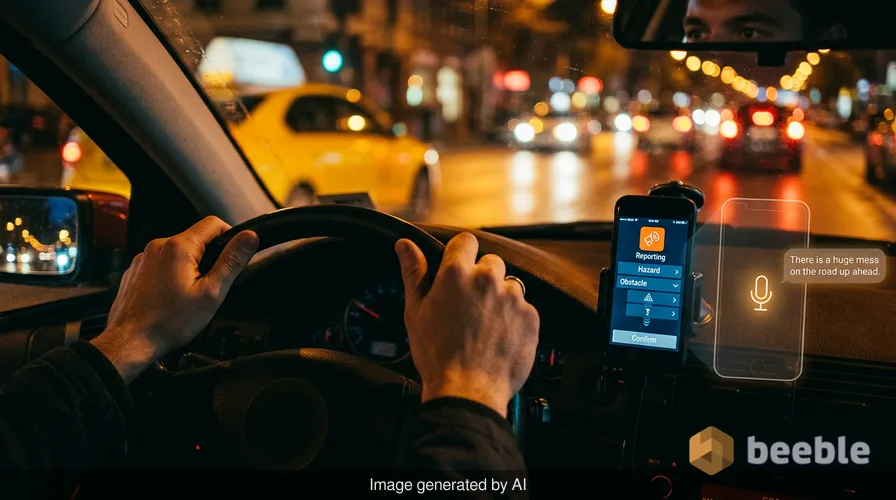
A pothole appears suddenly in the right lane. You want to warn other drivers, but your hands are on the wheel and your eyes are on the road. You glance at your phone, mounted on the dashboard, and consider the series of taps required to report the hazard. You have to find the orange reporting icon, select the hazard category, choose the specific type of obstacle, and then confirm the submission. In the time it takes to process those visual steps, you have already traveled three blocks. Most users simply give up. They choose safety over the data needs of the app. This is the friction that has defined software for decades. Every action requires a specific path through a menu designed by an engineer who is not in your car.
Everything changes when you can just talk. Waze is currently rolling out updates that replace these rigid menu structures with conversational interfaces powered by Google Gemini AI. Instead of navigating a tree of icons, a user can say something as simple as "There is a huge mess on the road up ahead." The software listens, understands the context, and translates that vague sentence into a specific data point on a map. This is not a minor feature addition. It is a fundamental shift in how humans interact with code. We are moving from a world where we must speak the language of the machine to a world where the machine finally speaks ours.
The bridge between human speech and structured data
Under the hood, this conversational reporting system represents a sophisticated application of Large Language Models (LLMs) in a mobile environment. Traditionally, a developer had to hardcode every possible user interaction. If a user wanted to report a road closure, the software waited for a specific API call triggered by a specific button press. If the user said "The street is blocked" to a basic voice recognizer, the system might struggle to map those words to the correct database entry. LLMs change this dynamic because they operate on probabilistic inference rather than strict logic gates. Gemini analyzes the intent behind the speech. It identifies the entity, which is the road, and the state, which is closed, even if the user uses slang or imprecise phrasing.
Zooming out to the industry level, this transition helps resolve a long-standing issue in software development known as technical debt. For years, Waze and similar apps had to maintain complex UI code for every possible edge case in road reporting. Each new category of hazard meant more buttons, more icons, and more potential for user confusion. By moving the logic to an AI-powered conversational layer, the developers can theoretically simplify the front-end interface. The complexity moves from the visual UI to the invisible model. Consequently, the app becomes more powerful while appearing less cluttered to the person behind the wheel.
Personalization and the end of the generic route
Why does every driver see the same blue line on their screen? Historically, navigation algorithms prioritized the absolute fastest route based on a mathematical abstraction of distance and speed limits. This approach ignored the human element of driving. Some people feel anxious on six-lane highways. Others despise the stop-and-go rhythm of residential neighborhoods. Waze now addresses this through personalized navigation that learns from your trip history. If you consistently ignore a highway suggestion in favor of a scenic coastal road, the algorithm adjusts its weightings. It recognizes your preference as a data point as valid as a traffic jam.
Technically speaking, this is a transition from static heuristics to dynamic user models. The app is no longer a neutral tool that calculates the shortest path between point A and point B. It has become a reflection of your specific habits. This shift raises important questions about the role of the user. When an app suggests a route based on your history, is it being helpful, or is it creating an algorithmic filter bubble for the physical world? Paradoxically, the more a tool knows about us, the less we are forced to think about the tool. This creates a seamless experience, but it also deepens the ecosystem lock-in that keeps users tethered to a specific brand of software.
The precision of motorcycle mode
Software updates often treat all users as a single, homogenous group. This creates a clunky experience for anyone who does not fit the default profile. The new Motorcycle mode in Waze is a pragmatic response to the fragmented nature of global transportation. Riders have different needs than drivers. They can navigate narrow shortcuts that would trap a sedan. They are also more vulnerable to environmental hazards like raised crosswalks or shoulder endings. By using AI to account for these two-wheeler-specific variables, Waze is creating a specialized version of its infrastructure.
From a developer's standpoint, this requires a massive influx of specialized data. The app must distinguish between a narrow bridge that is safe for a motorcycle and a road restriction that applies to all motorized vehicles. In countries like Malaysia and the Philippines, where motorcycles dominate urban transit, this is not a niche feature. It is the primary way people move through the city. The implementation of this mode demonstrates how AI can be used to carve out specialized utility from a general-purpose application. It is an example of code adapting to the physical constraints of the hardware it serves.
The luxury of digital silence
Feature creep is a constant threat to successful software. As companies add more capabilities, apps often become bloated and noisy. Waze has long been criticized for being too "chatty," with constant alerts for every police vehicle or stalled car on the shoulder. The introduction of a "less chatty" mode is a rare admission that more data is not always better. This setting minimizes voice prompts to the bare essentials, allowing the user to focus on a podcast or the road. It reflects a growing awareness in the UX design community regarding cognitive load.
In everyday terms, this is about the right to be left alone by your technology. We have reached a point of digital saturation where the most valuable feature a developer can offer is silence. By toggling this mode, the user reclaims control over their auditory environment. This is a subtle but profound shift in design philosophy. Instead of competing for every second of your attention, the software acknowledges that its primary job is to be an invisible assistant. The app is most successful when you forget it is there.
Navigating the conversational future
Through this user lens, we can see that the recent Waze updates are not just about adding Gemini or making the map look better. They represent the slow disintegration of the traditional software interface. For decades, we have used mice, keyboards, and touchscreens to tell computers what to do. These were compromises. We used them because the machines were not smart enough to understand us any other way. Now, the machine is starting to understand the nuances of a casual conversation. You can ask for a coffee shop that is open right now or a gas station with the lowest prices, and the AI handles the search, the filtering, and the navigation.
This leads to a fundamental question about our relationship with digital tools. As software becomes more intuitive and proactive, do we lose the ability to navigate the world without it? Digital literacy in the age of AI is not about knowing which buttons to press. It is about understanding the logic that governs the suggestions we receive. When the app tells you to take a specific street because it knows you like it, you should wonder what other paths you are missing because the algorithm decided you didn't want to see them.
Ultimately, the goal of these updates is to reduce friction and make the act of getting from one place to another more streamlined. Whether you are reporting a pothole via voice or following a personalized route to work, the code is working to remove the barriers between your intention and the physical world. It is a reminder that software is not a static object. It is a living set of rules that evolves to match the complexity of human life. As users, our task is to remain observant. We must appreciate the convenience of a map that listens to us while staying aware of the silent ways it shapes our view of the road ahead.
Sources
- Waze Official Blog and Product Release Notes.
- Google Gemini Developer Documentation regarding NLU integration.
- Waze Beta Community Release Announcements for Android and iOS.
- Technical overviews of Google's AI-integrated mobility services.



See you on the other side.
Our end-to-end encrypted email and cloud storage solution provides the most powerful means of secure data exchange, ensuring the safety and privacy of your data.
/ Create a free account
