


India’s $750 Million Chip Bet: Why Your Next Smartphone Might Come from a Different Supply Chain

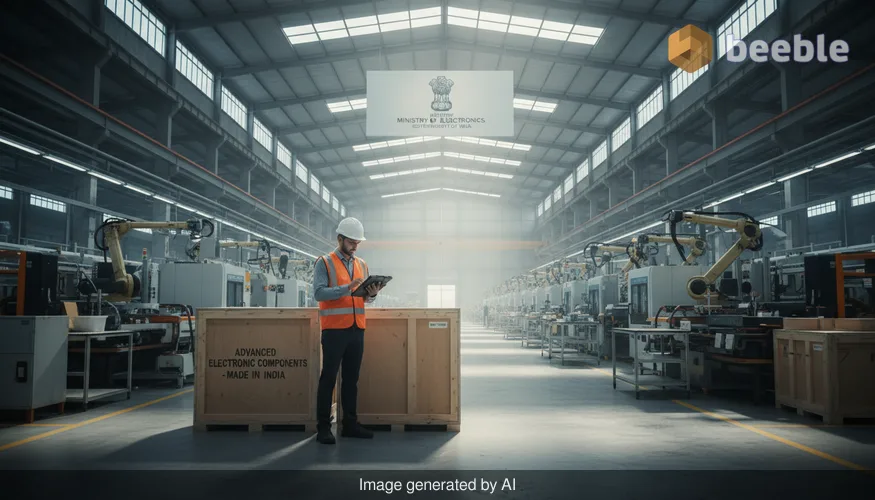
Despite the endless hype around fully autonomous robots, over 80% of global shipping still relies on decades-old heavy industry infrastructure. We often forget that the sleek, glass-and-metal rectangles in our pockets are the result of a massive, invisible relay race. This week, that race took a significant turn in South Asia. On March 30, 2026, the Indian government approved 29 new projects under its electronics component manufacturing program, injecting 71.04 billion rupees—roughly $751 million—into the foundational layers of the tech industry.
Looking at the big picture, this isn't just about a government spending money; it is about a systemic shift in how the world builds the tools we use every day. From the resistors that manage power in your laptop to the specialized connectors in an electric vehicle, India is attempting to move from being the world’s back-office to becoming its high-tech workshop.
Under the Hood: The Shift from Assembly to Anatomy
For years, India’s role in the global tech ecosystem was largely focused on assembly. Think of it as a giant LEGO set: the pieces were made elsewhere, and workers in India simply snapped them together. While this created jobs, it left the country vulnerable to the volatile nature of global supply chains. If a factory in another part of the world stopped making a specific $0.10 capacitor, the entire assembly line in India would grind to a halt.
What this means is that India is now focusing on the 'anatomy' of the device rather than just the final skin. The 29 approved proposals target the manufacturing of active and passive components, PCB (Printed Circuit Board) assemblies, and specialized materials. In simple terms, they are moving from putting the LEGO blocks together to manufacturing the plastic and the molds themselves. This creates a more resilient local ecosystem that is less dependent on the 'dropped batons' of international logistics.
The Invisible Backbone of Your Wallet
From a consumer standpoint, you might wonder why a factory opening in a different hemisphere matters to your monthly budget. Historically, the price of electronics has been dictated by the efficiency of the global supply chain. When manufacturing is concentrated in a single geographic region, any local disruption—be it a pandemic, a geopolitical spat, or a natural disaster—acts like a kink in a garden hose. The flow of products thins, and prices at your local retailer spike.
By diversifying where these components are made, the industry creates a more robust global network. For the average user, this translates to more stable pricing over the long term. When India scales its capacity to produce these foundational parts, it introduces more competition into the market. Curiously, even if you never buy a 'Made in India' phone, the mere existence of these factories helps keep the global market from becoming too opaque or monopolized by a few dominant players.
Breaking Down the Investment
To understand the scale of this move, we can look at the breakdown of how this $751 million is being channeled into the industry. The focus is not just on the 'big names' but on the decentralized network of suppliers that feed into them.
| Project Category | Focus Area | Impact on Consumer Tech |
|---|---|---|
| Active Components | Transistors, Diodes | Better power efficiency and battery life |
| Passive Components | Resistors, Capacitors | Improved device longevity and stability |
| PCB Assemblies | Mainboards, Circuits | Lower production costs for budget devices |
| Specialized Materials | Chemicals, Foils | More sustainable and resilient hardware |
Essentially, these investments act as a foundational layer. They aren't as flashy as a new AI feature or a folding screen, but they are the reason those features can exist at a price point that doesn't require a second mortgage.
The Pragmatic Reality of 'Self-Reliance'
Behind the jargon of 'Atmanirbhar Bharat' (Self-Reliant India) lies a very practical industrial strategy. India is currently a massive consumer of electronics, but a significant portion of the value within those devices is imported. This creates a trade imbalance that can lead to currency depreciation, which eventually makes imported tech even more expensive for the local population.
By localizing the 'invisible backbone' of the industry, India is attempting to capture more of the value chain. On the market side, this makes the Indian economy more resilient to global shocks. For a professional analyst, it’s a classic example of a cyclical shift: as labor costs rise in traditional manufacturing hubs, capital flows toward emerging markets that have the scale and the political will to build a streamlined infrastructure.
What This Means for You
Ultimately, the success of these 29 projects won't be measured by a single product launch, but by the gradual shift in the labels on the back of your gadgets. For the average user, the impact is three-fold:
- Supply Security: Fewer 'out of stock' messages when a global crisis hits, as the world has more than one primary source for essential parts.
- Competitive Pricing: Increased manufacturing capacity generally leads to a downward pressure on component costs, which can help offset the rising costs of R&D in high-end tech.
- Economic Interconnection: As more countries become vital nodes in the tech supply chain, the global economy becomes more interconnected and, theoretically, more stable.
As we move forward, keep an eye on the 'innards' of your tech. The next time you upgrade your device, remember that its journey likely began in a high-precision clean room funded by a multi-million dollar government initiative. We should appreciate the invisible industrial mechanics that power our daily lives, recognizing that a more decentralized manufacturing world is, in the long run, a more user-friendly one.
Sources
- Ministry of Electronics and Information Technology (MeitY) Official Press Release, March 2026.
- India Brand Equity Foundation (IBEF) Electronics Industry Report.
- Global Supply Chain Volatility Index Data, Q1 2026.
- Reserve Bank of India Economic Update on Manufacturing Incentives.



See you on the other side.
Our end-to-end encrypted email and cloud storage solution provides the most powerful means of secure data exchange, ensuring the safety and privacy of your data.
/ Create a free account
