


Inside the 16-year construction of the final European vacuum vessel for ITER

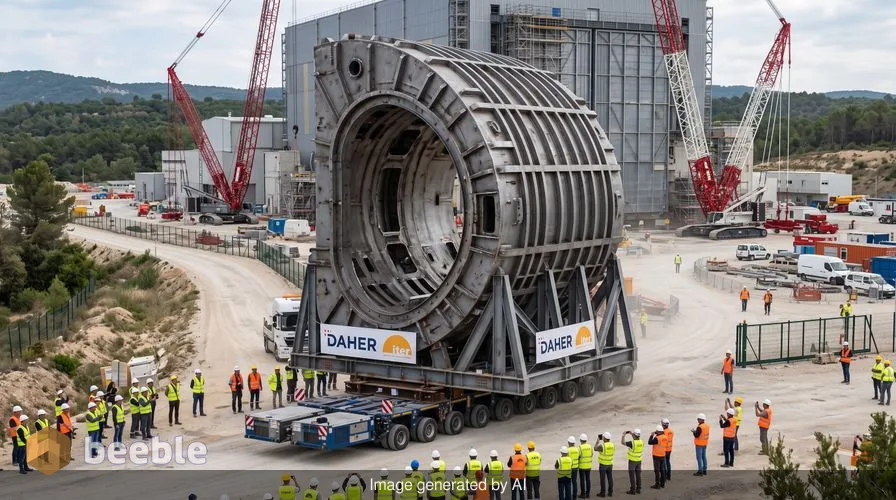
A massive steel component recently arrived at a construction site in Cadarache, France, and its presence marks a shift in the timeline for global energy research. This component is the fifth and final vacuum vessel sector provided by Europe for the International Thermonuclear Experimental Reactor, or ITER. To look at it is to see a 440-tonne wedge of high-grade steel that stands over 14 meters tall. This single piece is part of a larger puzzle that, when complete, will form a 5,200-tonne doughnut-shaped chamber designed to contain a controlled fusion reaction.
The journey of this sector began long before the heavy-load trucks from DAHER moved it across the French countryside. It started 16 years ago in the design offices and factories of Italy. To understand how a piece of heavy industry this large impacts the average household, one must look past the grey steel and into the manufacturing process that created it. This project is the invisible backbone of modern industrial development, testing the limits of what humans can build with metal and math.
The long road from the Italian coast
The final sector left the Westinghouse factory in Monfalcone, a town on the Adriatic coast of Italy. Before it could be shipped, workers spent years assembling four distinct segments into a single, unified wedge. These segments were the result of a collaboration between Westinghouse and Walter Tosto, a company based in Chieti. The process was not a simple matter of pouring metal into a mold. Each sector required more than 1.6 kilometers of welding to ensure it could withstand the intense pressure and heat of a fusion environment.
If you take the total length of the welding beads across all five European sectors, you get a line 750 kilometers long. That distance is roughly the same as driving from Paris to the Mediterranean coast. Every millimeter of those welds had to be perfect. The vacuum vessel acts like a high-tech thermos. It must keep the outside world out and the 150-million-degree plasma in. Even a tiny leak or a structural misalignment of more than a few millimeters would make the entire reactor useless. This level of precision is common in watchmaking but rarely seen in components that weigh as much as 350 mid-sized cars.
Artificial intelligence on the factory floor
During the manufacturing phase, Fusion for Energy, the agency responsible for Europe’s contribution, turned to software to solve human problems. They used artificial intelligence to cross-check data collected by technical teams in the factories. This was a practical application of AI rather than the speculative use often seen in consumer tech. The software looked for patterns in the manufacturing data that might indicate a tiny flaw or a deviation from the design.
By using AI as a tireless intern to scan through millions of data points, the engineers could ensure that the steel segments would fit together perfectly once they reached the site in France. This data-driven approach saved thousands of hours of manual inspection. It also provided a blueprint for how heavy industry can use digital tools to manage massive hardware projects. Practically speaking, this means the techniques developed for ITER will likely find their way into the construction of bridges, ships, and standard power plants in the next decade.
A tale of two manufacturing hubs
The production of the nine sectors that make up the vacuum vessel was a shared responsibility. Europe was originally tasked with producing seven sectors, while South Korea was responsible for two. In 2016, the groups changed the plan. South Korea took over the production of two additional sectors originally assigned to the EU. This shift allowed the project to move forward more efficiently by using the specialized facilities available in both regions.
South Korea completed its four sectors between 2020 and 2024. With the arrival of the fifth European sector, the manufacturing of these massive wedges is finally finished. Looking at the big picture, this international cooperation is what makes ITER possible. No single nation has the budget or the factory capacity to build every part of a fusion reactor alone. The costs are shared among 35 nations, including China, India, Japan, Russia, and the United States. The European Union pays for nearly half of the construction, while the others split the remaining costs.
The weight of the world’s largest thermos
Once all nine sectors are welded together in France, the vacuum vessel will be 19.4 meters wide and 11.4 meters high. Its interior volume is 1,400 cubic meters, which is roughly half the volume of an Olympic swimming pool. However, the steel shell is only the beginning. Engineers must still install the blanket and the divertor inside the vessel. These parts protect the steel from the heat of the plasma.
When these internal components are in place, the total weight of the vessel will jump from 5,200 tonnes to 8,500 tonnes. For the average user, this number is hard to visualize. It is roughly equivalent to the weight of the Eiffel Tower’s iron frame. Moving and aligning these components requires a level of engineering patience that is foreign to the fast-paced world of consumer electronics. While a new smartphone might take 18 months to develop, a single sector of the ITER vessel took 16 years to complete.
What this means for your future power bill
It is important to remember that ITER is a science experiment, not a commercial power plant. It will not put electricity onto the grid. The goal is to prove that we can get 500 megawatts of fusion power out of the system while only putting 50 megawatts of heating power in. If this works, it will pave the way for a new generation of power plants that provide carbon-free energy without the long-lived radioactive waste associated with traditional nuclear fission.
From a consumer standpoint, the benefit is long-term energy stability. Fusion fuel is derived from water and lithium, which are abundant. Unlike oil or gas, the price of fusion energy will not be tied to volatile global supply chains or geopolitical conflicts in the same way. However, the timeline is long. The project recently revamped its schedule to aim for full operation by 2035. This means fusion will not solve the immediate energy crisis, but it remains a foundational part of the plan for the second half of this century.
Industrial resilience and the finish line
The delivery of this final sector is a tangible victory for European manufacturing. Marc Lachaise, the Director of Fusion for Energy, noted that the team worked as a single unit to overcome the technical hurdles of the last decade. This project shows that European companies like Walter Tosto and Ansaldo Nucleare can compete at the highest level of global technology.
Ultimately, the arrival of the sector in Cadarache is a reminder that big things take time. In an era of instant gratification and digital speed, the 2 million hours of labor put into these five sectors represent a different kind of progress. It is progress measured in millimeters and decades rather than likes or shares. As the assembly phase continues in France, the focus moves from making the parts to putting them together. The success of this 16-year manufacturing journey is a necessary step toward a world where clean energy is as common as the water we drink.
Sources: ITER Organisation, Fusion for Energy (F4E), Westinghouse Electric Company, Ansaldo Nucleare.



See you on the other side.
Our end-to-end encrypted email and cloud storage solution provides the most powerful means of secure data exchange, ensuring the safety and privacy of your data.
/ Create a free account
