


Inside the Barcelona Chapel Where Europe is Building its Quantum Future

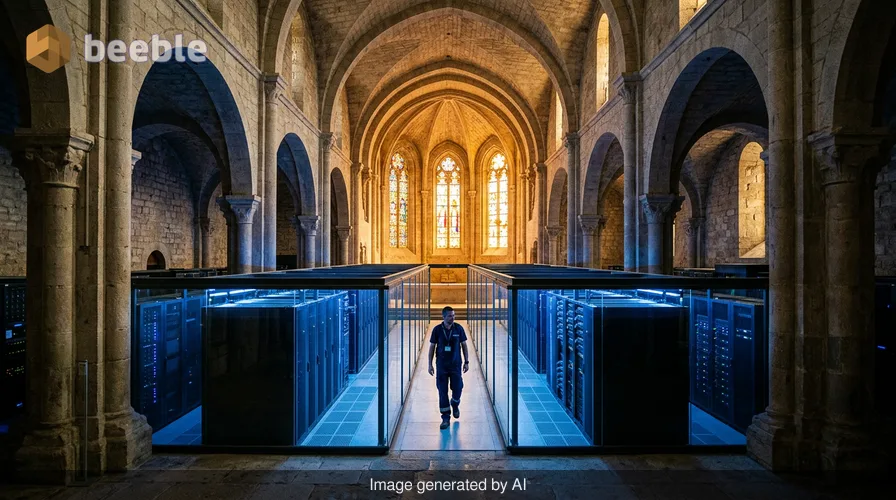
A 19th-century chapel in Barcelona might seem like an unlikely place to find the pulse of the 21st-century's most disruptive technology. Yet, within the Torre Girona chapel at the Barcelona Supercomputing Center (BSC), the traditional silence has been replaced by the hum of cooling systems. This is the home of MareNostrum 5, and more recently, the site of a €9.8 million investment that marks a pivotal shift in how the European Union plans to handle its digital future.
Behind the jargon of qubits and superposition lies a tangible industrial reality: Europe is attempting to build its own digital backbone to avoid being a permanent tenant in the houses of US-based 'Big Tech.' With the addition of a third quantum computer, a machine designed and built by the local firm Qilimanjaro Quantum Tech, the BSC is no longer just a participant in the global tech race; it is becoming a foundational hub for what experts call technological sovereignty.
Looking at the big picture, this isn't just about faster math. Since its launch in early 2025, the quantum partition of this system—named MareNostrum Ona—has already clocked over 4,200 computing hours across 53 distinct research projects. These numbers represent a systemic effort to move quantum computing out of the experimental lab and into the practical world of heavy industry and drug discovery.
The Hybrid Secret: Mixing the Old with the New
To understand why this specific machine matters, we need to look under the hood. Most people think of quantum computers as a replacement for the laptops we use today. In reality, they are more like a highly specialized high-speed wind tunnel for data. They don't replace classical computers; they supercharge them.
MareNostrum Ona is unique because it integrates classical supercomputing, artificial intelligence, and quantum computing into a single, interconnected workflow. For the average user, the difference between a classical bit and a quantum qubit is the difference between a light switch and a dimmer. A bit is either a 0 or a 1—on or off. A qubit can represent both states at once, allowing it to explore billions of possibilities simultaneously.
Curiously, this new Spanish machine adds another layer of complexity: it is an analogue quantum computer. While the two previous machines at the center are digital—meaning they process information in discrete steps—this analogue version behaves more like a physical model of the problem it’s trying to solve. In simple terms, while a digital computer tries to calculate the path of every water molecule in a pipe, an analogue computer builds a smaller pipe and watches the water flow. This approach is often much faster and more energy-efficient for specific tasks like optimization and complex physics simulations.
Why the Mediterranean is the New Silicon Valley
The funding for this project didn't just appear out of thin air. It is a calculated move by the European Commission and Spain’s Secretariat of State for Digitalisation and AI. On the market side, the motivation is clear: resilience. Currently, the vast majority of the world's computing power is concentrated in the hands of a few American and Chinese giants. If those companies change their pricing or restrict access, European industries—from car manufacturers to pharmaceutical labs—could find themselves stranded.
| Feature | Classical Computing (MareNostrum 5) | Quantum Computing (Ona) |
|---|---|---|
| Processing Unit | Bits (0 or 1) | Qubits (Superposition) |
| Best Used For | General tasks, databases, high-fidelity graphics | Complex optimization, molecular simulation, AI training |
| Tech Origin | Global Supply Chain | 100% European Technology |
| Energy Profile | High consumption for brute-force tasks | Potentially lower for specific complex problems |
| Current State | Mature and Scalable | Emerging and Foundational |
By investing in 100% European technology, as emphasized by the Catalan Minister for Research and Universities, Núria Montserrat, the region is securing its strategic autonomy. This is about making sure that the algorithms governing future European city planning or healthcare aren't running on an opaque black box controlled from across the ocean.
The "So What?" Filter: Practical Impacts for the Public
You won't be buying a quantum laptop anytime soon. However, the work being done at the BSC has a slow, cascading effect on everyday life. Essentially, these machines act as a tireless intern for scientists, doing the heavy lifting that would take a normal computer decades to finish.
Practically speaking, here is how this €10 million investment eventually reaches your pocket:
- Better Batteries: One of the biggest bottlenecks for electric vehicles (EVs) is chemistry. Designing a battery that lasts longer and charges faster requires simulating how atoms interact at a level that crushes classical computers. Quantum computers are the perfect tool for this, potentially leading to cheaper, more robust EVs.
- Streamlined Logistics: Whether it's the delivery of your online orders or the scheduling of public transit, the "traveling salesman problem"—finding the most efficient route between hundreds of points—is a nightmare for standard chips. Quantum optimization could mean lower shipping costs and less traffic in urban centers.
- AI Without the Hallucinations: AI requires massive amounts of data and training. By combining classical AI with quantum processing, researchers hope to create more intuitive models that are less prone to errors and require less energy to run.
A Network of Giants
Zooming out, the Barcelona machine is just one piece of a much larger puzzle. The European High Performance Computing Joint Undertaking (EuroHPC JU) has acquired six quantum computers across the continent—in Poland, the Czech Republic, Germany, and now Spain.
Historically, Europe has been excellent at research but has often struggled to turn that research into a scalable industry. This new network suggests a shifting strategy. Instead of isolated labs, these systems are interconnected, allowing a researcher in Warsaw to utilize the analogue power of the Barcelona machine. This decentralized approach is Europe's answer to the centralized data centers of Silicon Valley.
Ultimately, the goal is to create a ecosystem where a startup in Madrid or a factory in Munich doesn't have to ask permission from a foreign tech titan to solve a complex problem. They can use a local, transparent infrastructure that they know is built and regulated under European laws.
The Bottom Line
The launch of MareNostrum Ona is a reminder that the digital world has a very physical home. While the investment of nearly €10 million is significant, it is a drop in the bucket compared to the trillions spent by private tech firms annually. However, because this is public-sector infrastructure, its focus is on foundational research rather than quarterly profits.
For the average consumer, this news shouldn't be a signal to go out and buy quantum-related stocks or worry about their encryption being broken tomorrow. Instead, it is an invitation to observe how the invisible mechanics of our world are being rebuilt. The next time you see a breakthrough in a more effective medicine or a more efficient power grid, there is a high probability that the heavy lifting was done inside a chapel in Barcelona.
As we move further into the decade, the line between "tech" and "industry" will continue to blur. To put it another way, computing is no longer just a tool we use; it is the digital crude oil that fuels every other sector. By refining that oil at home, Europe isn't just playing catch-up—it's building a resilient path for what comes next.
Sources
- Barcelona Supercomputing Center (BSC-CNS) Official Press Release, May 2026.
- European High Performance Computing Joint Undertaking (EuroHPC JU) Strategic Roadmap.
- Qilimanjaro Quantum Tech: Technical Specifications for Analogue Systems.
- Spanish Secretariat of State for Digitalisation and Artificial Intelligence: Investment Reports 2024-2026.
- Ministry for Research and Universities, Government of Catalonia: Public Policy Statements.



See you on the other side.
Our end-to-end encrypted email and cloud storage solution provides the most powerful means of secure data exchange, ensuring the safety and privacy of your data.
/ Create a free account
