


Inside the factory where Europe is trying to build the physical heart of quantum computing

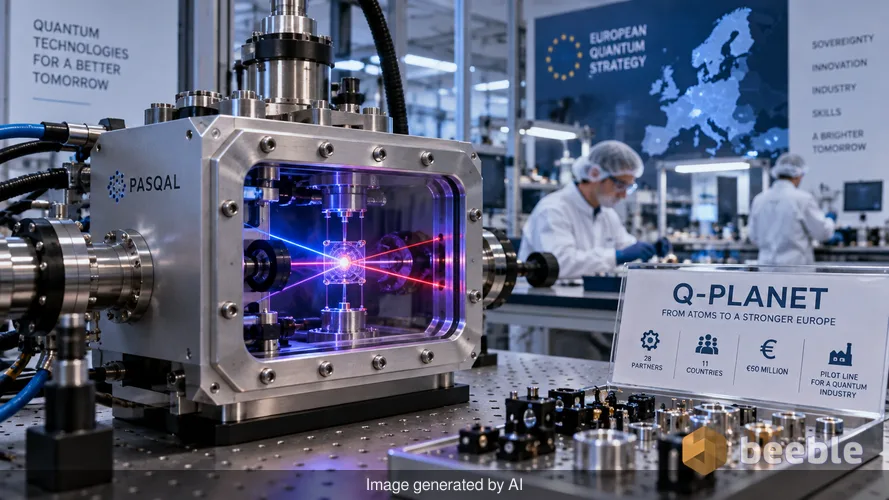
The journey toward a better electric vehicle battery or a life-saving cancer drug does not start in a laboratory or a hospital. In the near future, it begins inside a vacuum chamber the size of a shoebox, where individual atoms are frozen in place by beams of light. This hardware is the physical foundation of the neutral-atom quantum computer, a machine capable of simulating the complex dance of molecules that traditional supercomputers cannot handle. To build these machines at scale, however, the industry needs more than just brilliant physics. It needs a reliable source of specialized parts.
Behind the jargon of the European Quantum Strategy lies a massive logistics and manufacturing puzzle. The Q-PLANET pilot line, a €50 million initiative led by the French company Pasqal, is the solution to that puzzle. Over the next three years, 28 partners from 11 European countries are moving from the design phase to the actual production of the components that make quantum computing possible. This effort is the invisible backbone of a new industrial era, focusing on the literal nuts and bolts of the quantum world.
The path from a pharmaceutical lab to a vacuum chamber
If you want to design a new material that pulls carbon dioxide directly from the air, you have to understand how atoms interact at a level that breaks standard software. Quantum computers solve this by using atoms to simulate other atoms. Practically speaking, this requires a supply chain that can produce lasers, microscopic chips, and glass vapor cells with extreme precision.
Historically, these parts were custom-made by graduate students in university basements. This manual approach is slow, expensive, and prone to error. Q-PLANET changes this dynamic by creating a standardized production line. The goal is to move quantum technology out of the research phase and into a state where a company can order a batch of 100 specialized lasers and expect them to work perfectly. This transition is foundational for any technology that wants to reach the consumer market.
Building the invisible backbone of quantum computing
Heavy industry is often the hidden driver of modern life, and quantum computing is no different. The Q-PLANET consortium acts as a factory for the high-tech tools that allow quantum processors to function. These tools include lasers tuned to specific colors, such as 461 nm and 1013 nm, which are necessary to manipulate strontium and rubidium atoms.
Pasqal is the lead partner in this group, but the workload is spread across the continent. By bringing together research organizations and industrial manufacturers, the project creates a streamlined path for innovation. When a scientist at a university discovers a better way to trap an atom, Q-PLANET provides the manufacturing infrastructure to turn that discovery into a chip-based product. This system ensures that Europe does not just invent the technology, but also owns the machines that make it.
Trapping atoms with a box of light
To understand why this project matters for the average user, we have to look under the hood of a neutral-atom computer. Unlike some quantum systems that require temperatures colder than outer space, neutral-atom technology uses light to hold atoms in a vacuum. These atoms are the qubits, the basic units of quantum information.
Because these atoms are not charged, they are less sensitive to the noise and interference that plague other types of quantum hardware. This makes the technology scalable. However, the lasers that hold these atoms must be incredibly stable. If the light flickers even slightly, the computation fails. Q-PLANET focuses on the development of chip-based laser sources. These are smaller, more durable, and cheaper to produce than the bulky table-top lasers used in labs today. These components are the digital crude oil of the 21st century, powering the machines that will drive the next wave of economic growth.
Why Europe is betting on domestic laser production
Strategic autonomy is a frequent topic in Brussels, but for a tech analyst, it has a very practical meaning. If a company in Paris or Berlin depends on a laser manufacturer in a volatile region outside the European Union, their entire business model is at risk. Q-PLANET builds a resilient supply chain within Europe.
By developing these components locally, the consortium protects the industry from global trade shifts and shipping delays. The project focuses on four key laser wavelengths and microfabricated vapor cells for atomic clocks and field sensors. These vapor cells are tiny glass boxes filled with gas. They are the heart of precise sensors that can find underground minerals or help a self-driving car navigate without a GPS signal. Having a local source for these parts is a matter of economic security.
Turning scientific theories into repeatable assembly lines
One of the most transparent indicators of a maturing industry is the arrival of standardized design tools. Q-PLANET is developing Process Design Kits (PDKs) and Assembly Design Kits (ADKs). In simple terms, these are the instruction manuals for the factories.
In the early days of the microchip, every engineer had to reinvent the wheel. Eventually, the industry settled on standard kits that allowed any designer to create a chip that a factory could understand. Q-PLANET is doing the same for quantum hardware. These kits allow different companies to collaborate on the same hardware platform. This standardization lowers the barrier to entry for smaller startups and makes the entire ecosystem more competitive. It also includes energy-efficiency monitoring. As data centers consume more of the global power supply, ensuring that quantum manufacturing is efficient from the start is a pragmatic choice.
What this means for your future medication and data security
Zooming out, the success of Q-PLANET will eventually change what you see on your pharmacy shelves and how your personal data is protected. When the hardware becomes cheaper and more reliable, the cost of running a quantum simulation drops. This allows pharmaceutical companies to test thousands of drug candidates in a virtual environment before they ever start a clinical trial.
On the market side, this development accelerates the arrival of quantum-secure communication. The same technology used in these pilot lines can create sensors that detect tiny changes in gravity or magnetic fields. This has applications in everything from civil engineering to medical imaging. Ultimately, the Q-PLANET initiative is not just about building a computer. It is about creating the manufacturing capability to sustain a new era of industrial science.
The bottom line for the consumer is a shift in how we solve our most difficult problems. We are moving away from a world of trial and error and toward a world of high-precision simulation. This progress depends on the success of these invisible supply chains. As you watch the development of new tech, keep an eye on the factories and the component makers. They are the ones who turn a scientific dream into a tangible product in your hands.
Sources:
- Official Q-PLANET Project Kick-off Announcement, Brussels, 2026.
- Pasqal Technical Roadmap for Neutral-Atom Quantum Computing.
- EU Chips Joint Undertaking (Chips JU) Strategic Planning Document.
- European Quantum Strategy and Quantum Act Framework.



See you on the other side.
Our end-to-end encrypted email and cloud storage solution provides the most powerful means of secure data exchange, ensuring the safety and privacy of your data.
/ Create a free account
