


Inside the German Factory Where NVIDIA and Siemens are Proving Robots Can Play Well With Others

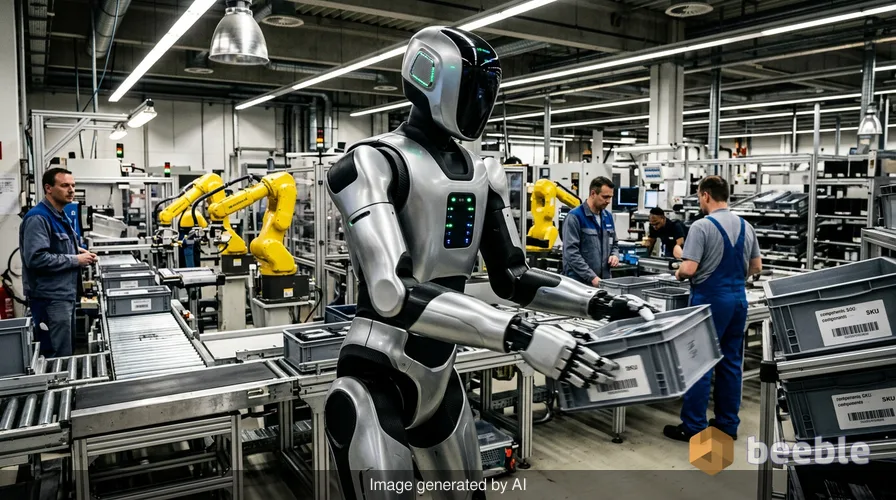
For decades, the image of a factory robot was a massive, orange mechanical arm bolted to the floor, swinging with terrifying precision behind a safety cage. If a human stepped into that cage, the machines stopped instantly to prevent a tragedy. But a recent trial at a Siemens electronics plant in Erlangen, Germany, suggests that the cage is finally coming down. In a quiet but foundational shift for the global manufacturing sector, German technology giant Siemens and AI heavyweight NVIDIA have successfully integrated a humanoid robot into a live production environment.
The numbers coming out of the Erlangen facility are striking. The robot, a model known as the HMND 01 developed by the UK-based firm Humanoid, operated autonomously for a full eight-hour shift. During that time, it successfully completed over 90% of its assigned tasks, which involved the routine but essential labor of picking up, moving, and placing containers for human workers. To put it another way, the machine managed to move roughly 60 containers per hour, matching a pace that keeps the factory’s circulatory system flowing without human intervention.
Looking at the big picture, this isn't just about a robot moving boxes. It is a tangible demonstration of 'Physical AI'—the concept where artificial intelligence stops being a chatbot on your phone and starts interacting with the messy, unpredictable physical world. For the average user, this trial marks the moment when humanoid robots transitioned from viral YouTube dance videos to a resilient, industrial reality.
The Digital Twin Cheat Code: From Years to Months
Behind the jargon of 'edge inference' and 'simulation-first training' lies a surprisingly simple trick that has accelerated the development of these machines. Historically, teaching a robot to perform a new task required months of physical programming and trial-and-error on the factory floor. If the robot dropped a container, an engineer had to reset it, tweak the code, and try again.
Under the hood, NVIDIA and Siemens are using what is known as a 'Digital Twin.' Think of this as a hyper-realistic video game version of the Siemens factory. Because this virtual environment obeys the laws of physics—gravity, friction, and weight—the HMND 01 robot can 'practice' its job millions of times in a simulated space before it ever touches a real piece of hardware. This approach is essentially a tireless intern that can work 24/7 without getting bored or making a physical mess.
The results of this method are unprecedented. By using NVIDIA’s simulation tools, the development timeline for the robot was slashed from a projected two years down to just seven months. For a consumer, this accelerated cycle means that the disruptive tech we read about today will likely land in the supply chains of our favorite gadgets and cars much sooner than we expected. It is a streamlined path from a research lab to the products on your shelf.
Why Humanoids? The Case for the Bipedal Employee
One might naturally wonder: why bother with a robot that looks like a human? We have had automated guided vehicles (AGVs) and conveyor belts for years. The answer lies in the concept of an interconnected, legacy environment. Most factories on Earth were designed by humans, for humans. They have stairs, narrow aisles, and workbenches built at waist height.
Instead of spending billions to tear down and rebuild a factory to accommodate wheeled robots, it is more practical to build a robot that fits the existing infrastructure. The HMND 01 is designed to be a drop-in replacement for the most repetitive, physically taxing roles that humans currently perform. It’s not about replacing the human mind; it’s about replacing the human lower back in a system that was never meant to be fully automated.
From a consumer standpoint, this shift is foundational for price stability. As labor shortages in manufacturing hubs become more systemic, the cost of producing everything from smartphones to washing machines tends to rise. If a fleet of humanoid robots can handle the mundane logistics within a plant, the human staff can focus on quality control, complex assembly, and maintenance—tasks where human intuition still reigns supreme.
The 'So What?' Filter: Practical Implications for Your World
While this trial took place in Germany, the ripple effects are global. We often think of heavy industry as the invisible backbone of modern life, and when that backbone gets an upgrade, the entire body feels it. Here is what this means for the everyday user:
- Supply Chain Resilience: One of the main reasons for product delays in recent years has been 'bottlenecks' in simple logistics. Robots that can work 24/7 in warehouses and plants help ensure that the 'slow leak' of inflation caused by supply shortages is kept in check.
- The Changing Job Market: We are moving away from a world where 'automation' means a machine taking a job, and toward a world where 'cobotics' (collaborative robotics) is the norm. The skill set required for a factory worker in 2026 is shifting from physical stamina to robot supervision and digital coordination.
- Democratization of Tech: As NVIDIA scales its physical AI stack, the cost of this technology will eventually drop. Much like how the internal combustion engine eventually moved from factories to personal cars, the software 'brain' powering these Siemens robots will eventually find its way into home assistance devices.
A Dose of Pragmatic Skepticism
Despite the successful trial, it is important to remain grounded. A 90% success rate is impressive for a pilot program, but in the world of high-precision manufacturing, that remaining 10% is where the headaches live. If a robot fails one out of every ten tasks, a human still has to be nearby to fix the mistake.
Curiously, the companies involved have remained opaque about a specific timeline for a wide-scale rollout. Building a single robot for a controlled trial is one thing; maintaining a fleet of thousands across multiple continents is a volatile engineering challenge. These machines require immense amounts of power and constant software updates, and the legal frameworks for humans and humanoids sharing the same workspace are still emerging.
The Bottom Line
Ultimately, the Siemens and NVIDIA trial in Erlangen proves that the barrier between 'digital intelligence' and 'physical labor' is dissolving. We are witnessing the birth of a more robust industrial era where AI-powered machines act as a tireless extension of the human workforce rather than a replacement for it.
Looking ahead, we should stop viewing AI as something that only lives behind a screen. As you go about your day, observe the logistics around you—the delivery trucks, the stock on grocery shelves, the assembly of your vehicle. The invisible mechanics of our world are becoming more intuitive and adaptive. The next time you order a piece of electronics, there is a growing chance that a humanoid robot was the one that moved it onto the pallet, working side-by-side with a human counterpart in a factory that never sleeps.
Sources:
- Siemens Global Press Office: Industrial Integration and Humanoid Deployment in Erlangen.
- NVIDIA Newsroom: Physical AI and the Isaac Robotics Platform Updates.
- Humanoid (UK) Technical Specifications: HMND 01 Performance Data.
- Market Analysis: Labor Trends in European Electronics Manufacturing 2025-2026.



See you on the other side.
Our end-to-end encrypted email and cloud storage solution provides the most powerful means of secure data exchange, ensuring the safety and privacy of your data.
/ Create a free account
