


Inside the Oakland Courtroom Where the Future of AI is Being Stripped Bare
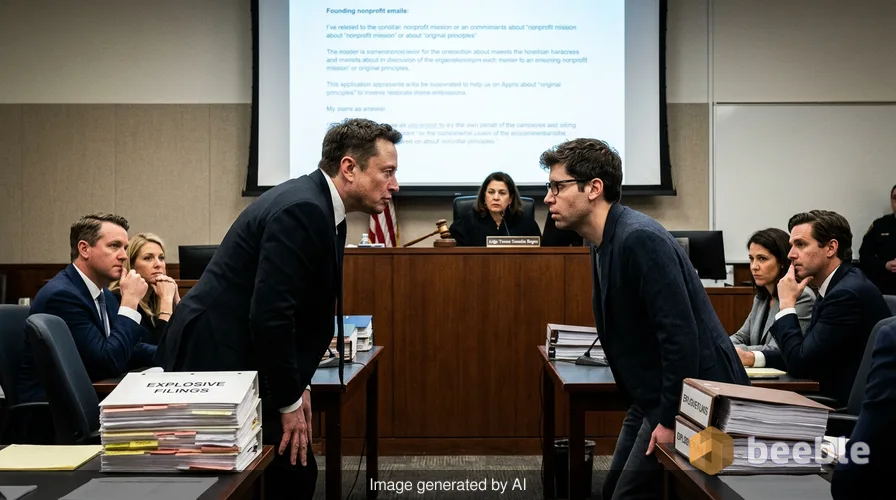
While the tech world often presents artificial intelligence as a purely scientific pursuit—a race of chips, data, and algorithms—the trial opening this week in Oakland, California, tells a much different story. It is a story about a broken handshake, a massive pivot in business strategy, and a deeply personal feud between two of the most influential figures in Silicon Valley. Elon Musk is taking Sam Altman and OpenAI to court, and the stakes involve much more than just billions of dollars. This case is effectively a battle over who gets to own the intelligence that will likely power our future.
At first glance, this looks like a standard corporate dispute, but looking at the big picture, it is an existential crisis for the AI industry. On one side, Musk claims he was swindled into funding a charity that turned into a cash cow. On the other, Altman and OpenAI argue that Musk is simply experiencing a severe case of seller’s remorse after walking away from the most successful startup of the decade. As jury selection begins, the opaque inner workings of the company behind ChatGPT are about to become public record.
The Handshake That Launched an Era
To understand why these two titans are facing off in front of a judge, we have to go back to 2015. At the time, the fear was that Google would monopolize AI and keep its benefits behind a paywall. Musk and Altman, along with a handful of researchers, founded OpenAI as a non-profit. The goal was simple: build "Artificial General Intelligence" (AGI)—essentially a tireless intern that can perform any intellectual task a human can—and make sure it belongs to everyone.
Musk provided the initial credibility and a significant portion of the early funding, roughly $38 million by his count. The founding agreement, which Musk claims was a binding contract, stated that the company’s technology would be open-source and used for the benefit of humanity, not for shareholder profit. This was the foundational promise that attracted top-tier talent who wanted to work on something bigger than a stock price.
However, building a tireless intern turns out to be incredibly expensive. It requires billions of dollars in electricity and specialized hardware. By 2019, OpenAI underwent a radical transformation, creating a for-profit subsidiary to bring in massive investments, most notably from Microsoft. In everyday life, this is the equivalent of a local community garden suddenly deciding to become a high-end organic grocery chain. Musk alleges this was the moment the original mission died, replaced by a quest for a $1 trillion valuation.
A Comparison of the Two OpenAIs
| Feature | The 2015 Vision (Non-Profit) | The 2026 Reality (For-Profit Focus) |
|---|---|---|
| Primary Goal | Benefit humanity, unconstrained by profit | Generate returns for investors and Microsoft |
| Transparency | Open-source research and code | Proprietary models and "black box" algorithms |
| Governance | Board focused on safety and ethics | Board navigating commercial interests and IPO plans |
| Valuation | Not applicable ($0) | Estimated $1 trillion |
| Main Backer | Elon Musk and individual donors | Microsoft (multi-billion dollar partnership) |
The Long Con or the Sore Loser?
Musk’s legal team is leaning into a narrative of betrayal. They describe Altman’s leadership as a "long con," suggesting that the non-profit structure was merely a lure to gather the necessary resources before flipping the switch to monetization. Behind the jargon of fiduciary duties and breach of contract, Musk is essentially saying he was robbed of the opportunity to guide the world's most powerful technology because he was lied to about where the money was going.
Conversely, OpenAI’s defense is rooted in pragmatism. They argue that without the shift to a for-profit model, OpenAI would have simply ceased to exist. In their view, Musk isn't a protector of humanity; he’s a disruptor who tried to take over the company in 2018, failed, and is now trying to sabotage it from the outside. They have even published internal emails suggesting that Musk himself once agreed that a massive for-profit arm was the only way to compete with giants like Google.
From a consumer standpoint, the personal animosity is secondary to the legal precedent. If the court finds that OpenAI’s shift was illegal, it could force the company to open up its "secret sauce" or even lead to a systemic restructuring of the firm. Musk is specifically asking for the removal of Altman and Greg Brockman, a move that would be equivalent to removing the architects of a skyscraper while the building is still under construction.
Why This Matters for Your Digital Life
The outcome of this trial will have tangible effects on how we interact with AI over the next decade. For the average user, the "So What?" filter comes down to three main areas: cost, access, and safety.
First, there is the question of the digital commons. If Musk wins and the court forces OpenAI back toward a strictly non-profit, open-source model, we might see a surge in free, high-quality AI tools available to everyone. It would be a win for decentralized development. However, it could also slow down the pace of innovation, as the company would lose the massive capital influx it currently gets from being a for-profit entity.
Second, the trial will likely expose just how much influence Microsoft has over the AI you use every day. As OpenAI prepares for a potential public offering, the level of transparency required by the court could reveal whether the "guardrails" on AI are there to protect you or to protect the company's bottom line.
Finally, the volatile nature of this leadership battle creates a risk of systemic instability. If the leadership is ousted, the developers who build these tools might flee to competitors. For businesses that have built their entire infrastructure on top of OpenAI’s technology, this trial represents a potential single point of failure. It’s a reminder that even the most robust tech is ultimately controlled by human egos and legal fine print.
The Bottom Line for the Consumer
Ultimately, this case pulls back the curtain on the "humanitarian concern" that Silicon Valley often uses as a marketing tool. To put it another way, we are witnessing the messy divorce of two people who both want custody of the world’s most advanced brain.
Musk’s demand for $134 billion in damages sounds like a staggering sum, but in the context of a company valued at $1 trillion, it is a battle for the steering wheel. If that money is redirected to a non-profit arm, it could fundamentally change the trajectory of the AI boom, shifting the focus from product sales back to basic research.
Practically speaking, we should expect a few weeks of explosive headlines. We will see private texts that reveal what these billionaires actually think of their users and each other. We will see how the "digital crude oil" of the 21st century is being refined behind closed doors.
As the trial unfolds, the most important thing for the everyday user to do is shift their perspective. Stop viewing these AI tools as magical, neutral services. Instead, start seeing them for what they are: the product of intense, often bitter corporate competition. As you use these tools to write emails, generate images, or code software, remember that the "open" in the name is currently a matter of legal debate. The verdict in Oakland won’t just decide who gets the money—it will decide if the future of intelligence is a public utility or a private luxury.
Sources:
- Superior Court of California, County of Alameda: Elon Musk v. Samuel Altman et al.
- OpenAI Blog: "The truth about Elon Musk and OpenAI"
- SEC Filings regarding Microsoft and OpenAI partnership structures
- Founding Mission Statement of OpenAI (December 2015)
- Publicly released internal correspondence (Musk-Altman 2015-2018)



See you on the other side.
Our end-to-end encrypted email and cloud storage solution provides the most powerful means of secure data exchange, ensuring the safety and privacy of your data.
/ Create a free account
