


Inside the orbital workshop trying to save the world's most expensive machines

The digital signal that brings a live sports broadcast to your screen or coordinates a global supply chain often starts as a pulse of light in a data center. It travels through thousands of miles of fiber optic cable, eventually reaching a massive ground station. From there, the data beams toward a metal box the size of a school bus, floating 22,236 miles above the Earth. This box is a geostationary satellite, the invisible backbone of modern life. When these machines run out of gas, they become multi-billion dollar pieces of space junk, even if their computers and cameras still work perfectly. A new robotic mechanic is currently in orbit to change that outcome.
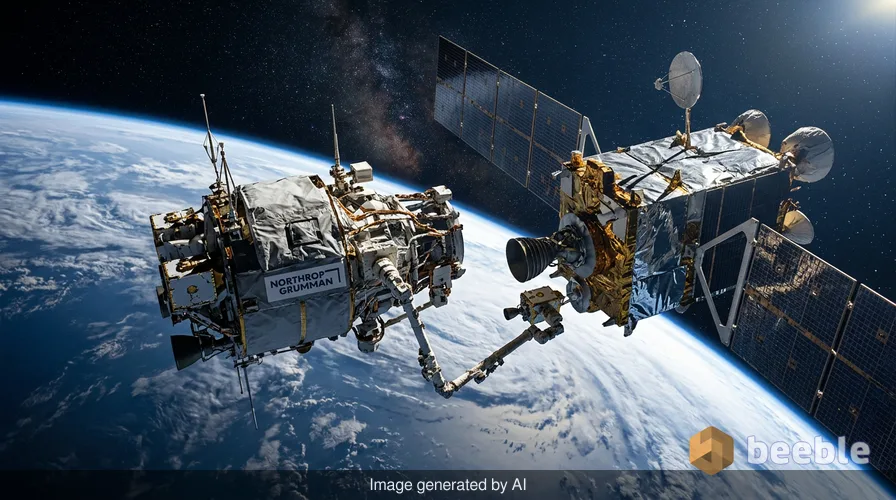
In July 2026, a SpaceX Falcon 9 rocket carried a specialized Northrop Grumman spacecraft into the sky. This vehicle, the Mission Robotic Vehicle (MRV), is the core of a new service industry focused on satellite maintenance. While earlier versions of this technology acted like a dedicated tow truck for a single customer, the MRV is a mobile repair shop. It carries a backpack of smaller engines, known as Mission Extension Pods (MEPs), which it can attach to aging satellites to keep them in place for years. The goal is a transition from a disposable space economy to one that is scalable and sustainable.
The gas tank problem in high orbit
Most people assume satellites fail because their electronics break down. In reality, the hardware often outlives the fuel supply. High-orbit satellites must stay in a very specific location relative to the Earth to maintain a steady signal. Over time, gravity from the moon and sun, along with solar winds, pushes them out of position. Satellites use small thrusters to correct their course, a process called station-keeping. Once that fuel is gone, the satellite drifts into a useless orbit, even if its state-of-the-art communication gear is in pristine condition.
Historically, this meant launching a replacement satellite every 15 years. This cycle is expensive and generates waste. A new satellite can cost upwards of $300 million, and a launch adds tens of millions more to the bill. By sending a robotic mechanic to install a fresh engine, companies can keep their existing assets in service. The Australian firm Optus is the latest to adopt this strategy. Their D3 satellite, launched in 2009, was nearing the end of its predicted life. By using a life-extension vehicle, Optus ensures the machine continues to generate revenue for another six years. This is a practical solution to a foundational infrastructure problem.
How the robotic mechanic works
Under the hood, the MRV is a marvel of autonomous engineering. It has two advanced robotic arms developed by DARPA, the research wing of the U.S. military. These arms allow the vehicle to perform delicate tasks in the vacuum of space while moving at thousands of miles per hour. The docking process is a high-stakes dance. The MRV must approach a target satellite, match its speed and orientation exactly, and then use its arms to attach a Mission Extension Pod to the customer satellite's thruster nozzle.
This modular approach is the key difference between the new system and its predecessors. The original Mission Extension Vehicles (MEVs) were permanent attachments. Once an MEV grabbed a satellite, it stayed there, effectively becoming the satellite’s new engine. This was a one-to-one service model. The MRV, conversely, is a one-to-many service. It carries several pods, docks with a satellite, attaches a pod, and then moves on to the next customer. This streamlined process makes life extension cheaper for operators because they only pay for the pod and the delivery service, rather than the entire spacecraft.
A shift toward orbital sustainability
This technology is the first step toward a circular economy in space. For the average user, this means the services that rely on these satellites—like global internet, maritime navigation, and weather forecasting—become more resilient. When infrastructure is repairable, it is less prone to sudden outages caused by aging hardware. Looking at the big picture, this shift mirrors how we treat heavy industry on the ground. We do not throw away a cargo ship just because the engine needs a part; we send it to a dry dock. The MRV brings that same logic to the stars.
There is also a tangible impact on the problem of space debris. The regions of space where these satellites live are increasingly crowded. When a satellite dies and drifts, it creates a collision risk for every other machine in that orbit. By extending the life of current satellites, we reduce the need to launch new ones, which slows the rate at which we fill the sky with metal. Northrop Grumman is also designing the MRV to be refueled in orbit. This is a proof of concept for a future where spacecraft are not just disposable tools, but long-term infrastructure assets that can be upgraded and maintained for decades.
The cost of staying connected
From a consumer standpoint, the benefit of these robot mechanics is stability. The satellite market is volatile, and launch delays can often leave gaps in coverage. If a company can squeeze five or ten extra years out of a satellite that is already in place, they can delay the massive capital expenditures required for a new launch. Practically speaking, this helps keep the costs of satellite-delivered services from spiking. While you might not see a "robotic repair fee" on your monthly bill, the efficiency gains in the supply chain help stabilize the prices of the data you consume.
However, the industry is split on the best way forward. While companies like Northrop Grumman and startups like Katalyst Space focus on fixing expensive, large satellites, others are moving in the opposite direction. SpaceX's Starlink and Amazon's Kuiper project use thousands of small, cheap satellites in low orbit. These are designed to be disposable. When one fails, it simply falls back into the atmosphere and burns up, only to be replaced by another inexpensive unit. The MRV is a solution for the heavy industry of space—the massive, expensive machines that provide the foundational links for global telecommunications and defense.
Security and the defense question
The involvement of DARPA indicates that this technology has implications beyond commercial internet. The U.S. military owns many of the most expensive and vital satellites in orbit. The ability to repair these assets is a strategic advantage. Conversely, the technology also creates new tensions. A robot that can reach out and grab a friendly satellite to fix it can also, theoretically, grab a rival satellite to disable it. The U.S. Space Force has previously noted that similar Chinese servicing vehicles could be used as weapons. Northrop Grumman maintains that its focus is strictly on servicing and life extension, but the dual-use nature of robotic arms in space is an opaque area of international policy.
Curiously, this development arrives just as other servicing missions face hurdles. Recently, NASA and the startup Katalyst Space worked to address malfunctions on a space telescope. These missions are difficult because satellites were never designed to be serviced. They have no handles, no refueling ports, and no standardized docking points. The MRV is proving that even without those features, a clever enough robot can still get the job done. The bottom line is that the era of "one and done" spacecraft is ending.
Observing the invisible mechanics
As we look toward the end of the decade, the presence of robotic mechanics in orbit will become a standard part of space logistics. You should view these developments not as a distant science project, but as a modernization of the tools that make your digital life possible. When your GPS works in a remote area or your trans-Atlantic call remains clear, there is a high probability that a robotic arm helped keep that signal alive.
Ultimately, this transition forces us to rethink our digital habits and the physical costs associated with them. Every app, stream, and navigation request relies on a massive industrial base that is currently being rebuilt for longevity. We are moving away from a period of unprecedented waste in orbit toward a model of practical maintenance. The next time you see a satellite streaking across the night sky, consider that it might not be a lonely traveler, but a machine waiting for its next scheduled tune-up.



See you on the other side.
Our end-to-end encrypted email and cloud storage solution provides the most powerful means of secure data exchange, ensuring the safety and privacy of your data.
/ Create a free account
