


Inside the Race to Turn the World’s Most Powerful Laser into Your Next Light Bulb

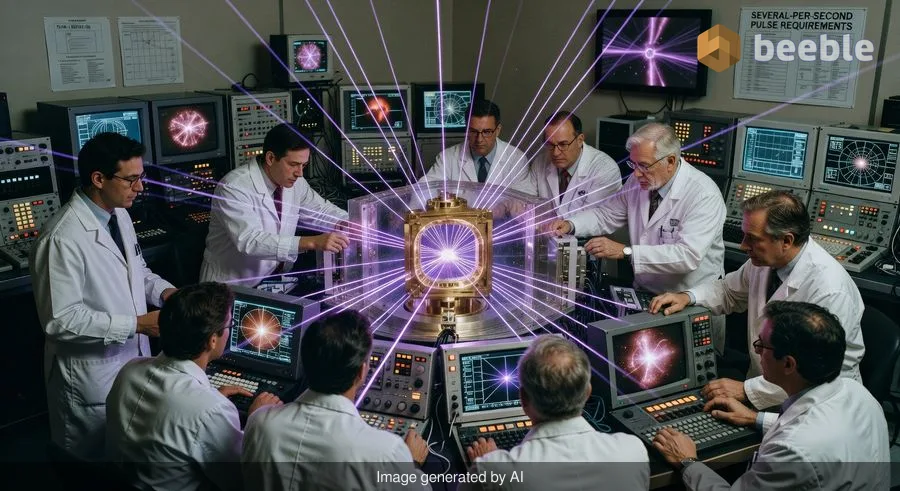
When you flip a light switch today, you are likely drawing power from a grid sustained by burning coal, natural gas, or the steady split of uranium atoms. But if a group of physicists and venture capitalists in California have their way, that same bulb will eventually be powered by the same process that fuels the sun. This week, the dream of 'star power' moved a significant step closer to the commercial world as Inertia Enterprises signed three major agreements with the Lawrence Livermore National Laboratory (LLNL).
To understand the magnitude of this deal, we have to trace the energy backward. The electricity in your home would come from a turbine, spun by steam, heated by a reaction so intense it mimics the center of a star. That reaction happens inside a tiny, diamond-coated fuel pellet no larger than a BB. To ignite that pellet, you need 192 of the world’s most powerful lasers to strike a gold cylinder with surgical precision. And to build the machine that does all of this, you need the $450 million in Series A funding that Inertia recently secured.
Looking at the big picture, this isn't just another tech partnership. It is an attempt to industrialize one of the most complex science experiments in human history.
The Breakthrough at the National Ignition Facility
For decades, fusion energy was the 'forever technology'—always thirty years away and never quite arriving. The narrative shifted in late 2022 when the National Ignition Facility (NIF) at LLNL achieved 'ignition.' In simple terms, they got more energy out of a fusion reaction than the laser energy they put into it.
Historically, fusion research has been split into two camps. Most startups use massive magnets to trap a cloud of superheated gas (plasma) until atoms fuse. Inertia, however, is betting on 'inertial confinement.' Instead of magnets, they use raw power. By blasting a fuel pellet with lasers, they create an implosion so violent and fast that the fuel has no choice but to fuse.
While the NIF proved the physics works, it was never designed to be a power plant. It is a massive, building-sized scientific instrument that, until recently, could only fire a few times a day. For a commercial plant to be viable, Inertia needs to figure out how to repeat that 'once-in-a-lifetime' explosion several times every second.
Behind the Jargon: How Laser Fusion Actually Works
If we look under the hood of this process, the complexity is staggering. The core of the operation is a hohlraum—a small gold cylinder. Inside sits a fuel pellet containing deuterium and tritium (isotopes of hydrogen).
When the lasers hit the inside of that gold cylinder, it doesn't just heat up; it vaporizes, creating a bath of high-energy X-rays. These X-rays strike the diamond coating of the fuel pellet, causing it to explode outward. According to Newton’s third law, that outward explosion forces an equal and opposite inward crush. The fuel is compressed to a density greater than the lead in a car battery, reaching temperatures hotter than the sun.
What this means is that for a fraction of a billionth of a second, a tiny sun is born in a laboratory. The challenge for Inertia is that while the NIF used 192 lasers based on 1990s technology, a real power plant needs modern, efficient, and robust hardware that doesn't melt after the first shot.
The Business of Building a Star
On the market side, Inertia is entering a crowded and volatile field. They aren't the only ones trying to capture lightning in a bottle. However, their $450 million war chest makes them one of the most well-capitalized players in the industry.
| Company | Primary Approach | Key Advantage |
|---|---|---|
| Inertia Enterprises | Laser (Inertial Confinement) | Direct partnership with LLNL/NIF |
| Helion Energy | Magnetic Accelerator | Backed by Microsoft/Sam Altman |
| Commonwealth Fusion | High-Field Magnets | Spin-out from MIT |
| First Light Fusion | Projectile Impact | Simplified 'target' design |
Curiously, the goal here isn't just to build a better laser. It’s to build a supply chain. To run a power plant, you need millions of these precision-engineered fuel pellets every year. You need mirrors that can withstand constant radiation and a vacuum chamber that can handle the equivalent of a small grenade going off ten times a second, 24 hours a day. Heavy industry is the invisible backbone of modern life, and Inertia is essentially trying to build a new vertebrae from scratch.
Why the Average Consumer Should Care
For the average user, the talk of X-rays and hohlraums feels distant. But the systemic impact of successful fusion would be foundational. Unlike solar or wind, fusion doesn't care if the sun is shining or the wind is blowing. It provides 'baseload' power—the steady, unceasing flow of electricity that keeps hospitals running and server farms humming.
Practically speaking, we are still years away from seeing 'Fusion Powered' labels on our electric bills. The current deals with LLNL are about 'tech transfer'—taking the blueprints and secrets learned at the taxpayer-funded NIF and translating them into a streamlined, scalable design.
There is, of course, room for skepticism. The history of energy is littered with disruptive ideas that failed to move from the lab to the loading dock. The costs are unprecedented, and the engineering hurdles are systemic. However, the fact that a private company now has the keys to the NIF’s data suggests that the era of 'pure science' is ending, and the era of 'fusion engineering' has begun.
Looking Ahead: The Road to the Grid
Ultimately, the success of Inertia Enterprises won't be measured by how many scientific papers they publish, but by how cheaply they can produce a kilowatt-hour. We are moving away from a world where energy is something we dig out of the ground and toward a world where energy is a manufactured product.
As a result, we may eventually view energy the way we view microchips: something that gets better, smaller, and more efficient over time through sheer engineering will. While the $450 million spent today seems like a massive sum, it is a drop in the bucket compared to the trillions of dollars spent annually on global energy.
From a consumer standpoint, the best thing you can do is keep an eye on the timeline. Don't expect a fusion reactor in your basement, but do expect the conversation around 'clean energy' to shift from 'how do we save power?' to 'how do we use this abundance?'
Instead of viewing the energy grid as a fragile, aging web, we should start imagining it as a robust, high-tech infrastructure that finally matches the digital world it supports. The next time you see a headline about a 'breakthrough' in a lab, remember that the real work is happening in the boring stuff: the contracts, the supply chains, and the industrial scaling that turns a brilliant idea into a tangible reality.
Sources:
- Lawrence Livermore National Laboratory (LLNL) Official Press Release, April 2026.
- Department of Energy (DOE) Fusion Energy Sciences Report.
- Inertia Enterprises Series A Funding Announcement, February 2026.
- National Ignition Facility (NIF) Experimental Data Archives.



See you on the other side.
Our end-to-end encrypted email and cloud storage solution provides the most powerful means of secure data exchange, ensuring the safety and privacy of your data.
/ Create a free account
