


Inside the US$15 billion engine room Google is building on the Indian coast

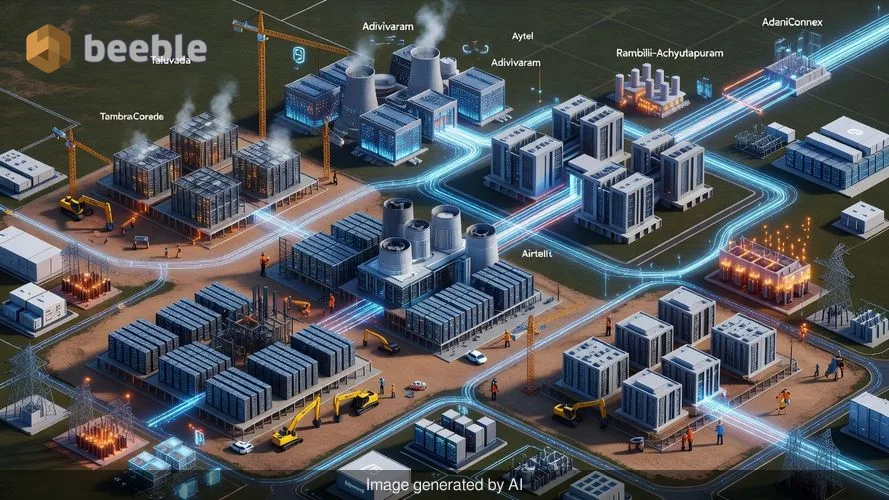
Google is currently transforming 601.4 acres of land in Andhra Pradesh into the largest artificial intelligence hub outside the United States. This US$15 billion project spans three distinct sites in Visakhapatnam: Taluvada, Adivivaram, and the Rambilli-Achyutapuram area. Since breaking ground in April 2026, the development has become a central piece of India’s industrial strategy. The facility is a massive bet on the idea that AI infrastructure is the invisible backbone of modern life, similar to how power plants or steel mills defined the previous century.
The scale of this investment is difficult to overstate. To put it in perspective, the total land area equals roughly 450 football fields. This space is necessary to house thousands of specialized computer racks, cooling systems, and the power infrastructure required to run the next generation of digital tools. While Google operates data centers in 12 countries, this specific hub serves as a primary anchor for the company’s expansion in Asia. The project involves major local players, including construction partner AdaniConnex and telecommunications giant Airtel, who are handling the physical build and the network connections respectively.
The hardware behind the AI curtain
Under the hood, these buildings do not contain standard office computers. They house massive clusters of Tensor Processing Units (TPUs) and Graphics Processing Units (GPUs). To the average user, these are just acronyms, but they function as the specialized muscles for AI. Think of a standard computer processor as a general handyman who can do many tasks slowly. In contrast, TPUs and GPUs are like a dedicated assembly line designed to do one specific type of math very fast.
These machines perform deep learning and neural network training. Essentially, they act as a tireless intern, reading billions of lines of text or looking at millions of images to help AI models learn how to converse or recognize patterns. When you ask a chatbot a question in 2028, the answer will likely be calculated by a chip sitting in one of these Visakhapatnam halls. By July 2028, the facility will also handle large-scale AI model inference, which is the process of an AI actually providing an answer or generating an image after its training is complete.
A new nervous system for the Indian Ocean
Data centers are useless without a way to move information. Part of the US$15 billion budget goes toward a new international subsea gateway. Multiple fiber-optic cables will land on the eastern coast of India, connecting the Visakhapatnam hub directly to other global tech centers. Airtel is currently deploying the intra-city and inter-city fiber networks to ensure this data can travel across India in milliseconds.
For the average internet user, this means lower latency. Latency is the delay between you clicking a button and the server responding. Historically, much of India's data had to travel to servers in Singapore or Europe. By processing data locally, Google reduces this delay, making everything from video calls to online gaming feel more immediate. Practically speaking, this infrastructure moves the "brain" of the internet closer to the people using it.
The conflict between data and drinking water
Progress on the site is not without significant friction. Local activists in Visakhapatnam have recently held protests, carrying banners with the phrase "We cannot drink DATA." The primary concern involves the massive amount of water required to keep high-powered AI chips from overheating. A typical large data center can consume hundreds of millions of gallons of water annually, often competing with local agriculture and residential needs.
An environmental group named Jal Biradari has filed a public interest lawsuit in the Andhra Pradesh High Court. The group claims the project threatens a critical reservoir that supplies the local population. While state officials have labeled these claims as incorrect, the court has ordered the government to provide a detailed response by August 24, 2026. This legal hurdle reflects a growing global trend where local communities question the resource costs of the digital economy. The state of New York, for example, recently paused similar large-scale data projects to evaluate their impact on the power grid and water supply.
Google has stated it will use advanced air cooling systems to protect local water sources. Air cooling acts like a giant version of the fan inside a laptop, using atmosphere rather than liquid to pull heat away from the processors. While this is more expensive to operate in hot climates, it significantly reduces the facility’s water footprint.
Neighbors with leopards and pangolins
Geography adds another layer of complexity. One of the sites is located only 860 meters from the Kambalakonda Wildlife Sanctuary. This forest is home to leopards, pangolins, and several rare bird species. The proximity has raised alarms about noise pollution and the heat discharge from the facility.
Google plans to implement sound-dampening measures to remain a quiet neighbor to the sanctuary. The company has publicly committed to meeting all legal environmental standards, but the physical presence of a massive industrial hub next to a sensitive ecosystem remains a point of contention for local conservationists. The outcome of the ongoing court case will likely determine if Google needs to add further protections or modify its construction timeline.
Digital sovereignty and the 2047 vision
On the policy side, the Indian government views this project as a foundation for digital sovereignty. This concept is the idea that a nation should have control over its own data and the infrastructure that processes it. By storing and processing AI workloads within Indian borders, the government ensures that sensitive information remains under local jurisdiction rather than sitting on servers in foreign countries.
The project supports the Viksit Bharat 2047 vision, a government plan to turn India into a fully developed nation within the next two decades. Part of this plan involves Andhra Pradesh developing 6GW of data center capacity by 2029. To attract this investment, the state government offered subsidized land and electricity, viewing the long-term economic gains as more valuable than the immediate costs.
| Facility Component | Detail/Specification |
|---|---|
| Total Investment | US$15 Billion |
| Primary Hardware | TPU and GPU Compute Clusters |
| Total Land Area | 601.4 Acres across three sites |
| Cooling Technology | Advanced Air Cooling |
| Connectivity | Subsea Fiber Gateway and Airtel Fiber Network |
| Target Completion | July 2028 |
The bottom line for consumers
Looking at the big picture, the Visakhapatnam hub is more than just a corporate expansion. It represents a shift in how the internet is physically built. For years, the digital world felt like something that existed in a vacuum, but the protests in Andhra Pradesh remind us that AI has a physical footprint. It requires land, massive amounts of electricity, and sophisticated cooling.
From a consumer standpoint, the completion of this hub in 2028 will likely lead to faster AI tools and more reliable cloud services across South Asia. However, the true cost of these tools includes the environmental and social trade-offs occurring in cities like Visakhapatnam. As AI becomes as common as electricity, the tension between industrial growth and natural resource preservation will become a standard part of the tech conversation.
Ultimately, you should observe how your own digital habits rely on these invisible structures. Every time an AI helps you write an email or plan a trip, it is utilizing hardware in a place like Taluvada or Rambilli. Appreciating these mechanics helps clarify why tech companies are willing to spend billions on coastal land and why local residents are so protective of the water that flows beneath it.
Sources:
- Google Cloud official project announcement
- Data Centre Dynamics construction reports
- Andhra Pradesh Government Department of IT and Electronics
- Reuters environmental impact reporting
- BBC South Asia technology analysis



See you on the other side.
Our end-to-end encrypted email and cloud storage solution provides the most powerful means of secure data exchange, ensuring the safety and privacy of your data.
/ Create a free account
