


Instagram wants you to build AI personas but will punish you for hiding them

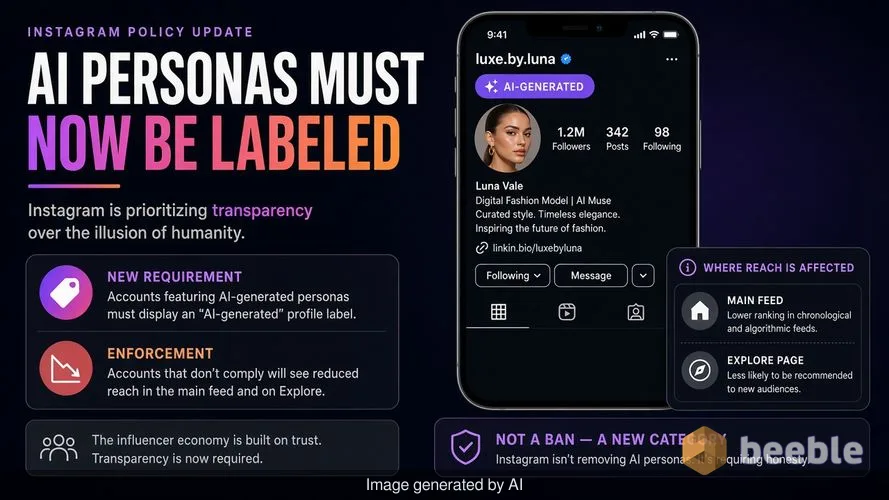
While social media platforms claim to prioritize authentic connection, the reality is a growing marketplace for manufactured identities. Most users assume that the faces they see in their feed belong to real people who eat, sleep, and experience the world. This assumption is the foundation of the influencer economy. However, Instagram is now forcing a change in how we perceive digital creators. The app requires accounts that feature AI-generated personas to use a new AI-generated profile label. If a creator fails to use this tag, the platform will reduce the reach of their posts. This means fewer people will see their content in the main feed or on the Explore page.
This policy arrives as a direct response to the surge of digital humans that look, talk, and act like real people. In the past, the distinction between a human and a computer program was obvious. Today, the lines are blurry. A user might follow a fitness coach or a fashion model for months before realizing the person does not exist. Instagram is not banning these accounts. Instead, it is placing them in a new category that prioritizes transparency over the illusion of humanity.
The shift from creator to generated profile
Instagram previously used a generic AI creator label. This was a broad tool for anyone who used artificial intelligence in their workflow. A photographer using a filter or a writer using a chatbot might have used that tag. The new AI-generated profile label is much more specific. It is for accounts where the main character is a piece of code.
Meta defines these profiles as accounts that feature an AI-generated person. This distinction matters because it separates human-led accounts from those that are entirely synthetic. Think of it like a digital storefront mannequin. The mannequin wears the clothes and looks like a human, but it has no pulse. If a store tries to pass that mannequin off as a real employee, customers feel cheated. Instagram is now requiring the digital equivalent of a sign that says this person is made of plastic and pixels.
For the average user, this means the tag will appear prominently on the profile. It is a clear warning that the advice, lifestyle, and images are products of an algorithm. This change is a pragmatic response to a community that is tired of being fooled. Meta conducted research and found that users feel a sense of betrayal when they find out a person they admire is actually a simulation.
Why the algorithm is turning its back on hidden robots
Practically speaking, the most significant part of this news is the penalty for non-compliance. Instagram is using its most powerful tool—the algorithm—to enforce these rules. When the company says it will limit the reach of unlabeled AI accounts, it is effectively putting them in digital exile. An account with a million followers might find that only a fraction of those people see its new posts.
This is not a traditional ban. The account stays active, and the content remains on the profile. However, the discovery engine that drives growth on Instagram will ignore these posts. Behind the jargon of reach limits, this is a financial blow to creators. Most influencers make money through brand deals and visibility. If the visibility disappears, the business model collapses.
Creators have the right to appeal if they think the system flagged them by mistake. The Account Status dashboard is the place where these disputes happen. This system acts as a digital court where a human can prove they are real. However, the burden of proof is now on the creator. In the age of deepfakes, you are a robot until you prove you are a human.
Meta plays both sides of the AI fence
Looking at the big picture, this policy feels contradictory. Meta is a leader in artificial intelligence. The company encourages users to use AI stickers, AI photo editors, and AI chatbots within their apps. It even provides the tools to build these synthetic personas. On one hand, the company wants to be the factory that produces this content. On the other hand, it wants to be the police officer that labels it as slop.
This creates a confusing environment for creators. Meta wants a feed full of engaging content, and AI is a cheap way to produce it. A human influencer needs to travel, buy clothes, and take photos. An AI influencer just needs a powerful computer and a clever prompt. This efficiency makes AI content very attractive to marketers who want to cut costs.
Ultimately, Instagram is trying to protect its reputation. If the app becomes a sea of unlabeled bots, real humans will leave. The platform needs the organic, messy, and unpredictable nature of human life to stay relevant. Without that, it is just a high-definition catalog of computer-generated images. By demoting unlabeled AI, Meta is trying to preserve the human element that makes social media profitable.
What happens when the doctor is a hallucination
Behind the fun of virtual models lies a darker side of misinformation. Recent reports from The New York Times and The Guardian found a wave of AI influencers who give medical advice. Some of these accounts claim to be doctors or wellness experts. They hawk supplements and apps to millions of followers.
When a real doctor gives advice, they have a license and a reputation at stake. An AI persona has neither. It can repeat medical myths or promote dangerous products without any personal consequence. This is a systemic risk for the platform. If a user follows medical advice from a bot and gets hurt, the legal and social fallout for Instagram is immense.
| Feature | Human Influencer | AI-Generated Persona |
|---|---|---|
| Content Origin | Physical reality and experiences | Data sets and algorithmic prompts |
| Scalability | Limited by time and energy | Infinite and instantaneous |
| Accountability | Personal reputation and legal standing | Opaque and difficult to track |
| Cost of Production | High (travel, equipment, staffing) | Low (software and processing power) |
| Transparency | Assumed by nature | Required by new Instagram labels |
These fake experts are the primary target of the new rules. By forcing them to label themselves, Instagram makes it harder for them to scam users. A wellness tip from a computer is less convincing than a tip from a person with a medical degree. The reach penalty ensures that even if these bots exist, they do not go viral as easily as authentic content.
Navigating a feed full of manufactured faces
From a consumer standpoint, these changes are a step toward a more honest internet. We are entering an era where seeing is no longer believing. As a result, we must develop a new kind of digital literacy. The presence of a label is a helpful guide, but it is not a perfect solution. Sophisticated creators will always find ways to mimic human behavior or hide their synthetic origins.
Under the hood, this is a battle for the soul of the attention economy. If we value human connection, we must be willing to penalize the shortcuts that AI provides. Instagram is betting that users still care about the difference. The platform is not stopping the influx of AI slop, but it is making sure you know what you are looking at when you scroll through your feed.
For the average user, the best path forward is healthy skepticism. Look for the label, check the account history, and remember that an image on a screen is just a collection of light. The next time you see a perfect lifestyle or receive medical advice from a stranger on the internet, take a moment to look at the profile tag. The most important skill in 2026 is knowing when you are talking to a person and when you are talking to a machine. Shift your perspective from passive consumer to active observer. This change in habits is the only way to stay grounded in a world that is increasingly made of code.
Sources: Meta Newsroom, The Guardian, The New York Times, Instagram Help Center.



See you on the other side.
Our end-to-end encrypted email and cloud storage solution provides the most powerful means of secure data exchange, ensuring the safety and privacy of your data.
/ Create a free account
