


Is Your TV About to Become a Family Art Studio?

Have you ever sat on your couch, remote in hand, and felt that your television was missing something fundamental—not a better resolution or a faster processor, but a sense of humor? It sounds like a strange question. For decades, the TV has been a passive window, a one-way street where content is beamed into our living rooms for quiet consumption. However, Google’s latest update suggests the tech giant wants to turn that window into a mirror, or perhaps a digital canvas.
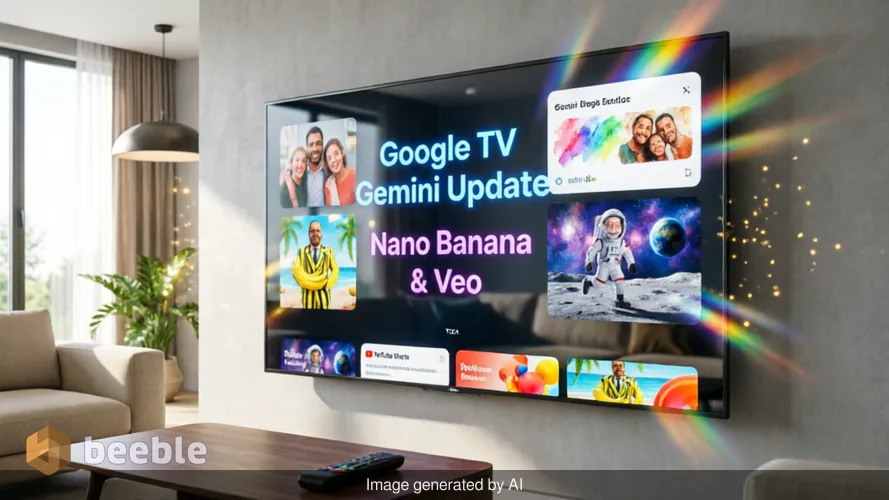
With the announcement of new Gemini-powered features coming to Google TV, the platform is shifting away from being a mere content aggregator. By integrating generative AI tools like Nano Banana and Veo directly into the home screen, Google is betting that the future of the living room isn't just about what we watch, but what we create together between episodes of a sitcom.
Looking at the big picture, this isn't just a software update; it is an attempt to solve the “dead screen” problem. When we aren't watching a movie, the TV is a giant black rectangle on the wall. Google wants to fill that space with your memories, your AI-generated art, and a constant stream of short-form content. But for the average user, the question remains: is this a genuine evolution of the home experience, or just another layer of digital clutter?
The Living Room’s New Tireless Intern
At the heart of this rollout is a new “Create” button within the Gemini tab. This is where users encounter Nano Banana and Veo. To put it another way, Google is essentially giving you a tireless intern who lives inside your TV, ready to whip up a visual gag or a personalized video at a moment’s notice.
Nano Banana, Google’s latest image-generation and editing model, is designed for the shared experience. Unlike using an AI tool on a smartphone, which is a solitary activity, Nano Banana is built for the crowd. Using simple voice prompts, families can transform their photos. You can swap out a rainy background for a sunny beach or, as Google suggests, put your dad in a ridiculous outfit to entertain the kids.
Veo takes this a step further by bringing motion into the mix. It allows users to create short video clips from scratch or animate existing photos. From a consumer standpoint, the potential for “memes” in the living room is high. The prompt “make my grandfather moonwalk in space” might seem trivial, but it represents a foundational shift in how we interact with our hardware. We are moving from a world where we search for content to a world where we generate it to suit our immediate mood.
The Google Photos Upgrade: Beyond the Grid
If you have ever tried to find a specific photo on a TV app, you know it is usually a nightmare of scrolling through endless chronological grids. Google is using Gemini to fix this with an intuitive search function. Instead of digging through folders, you can simply ask for “the photos from our trip to the Grand Canyon” or “pictures of the kids at the park last summer.”
This robust search capability is paired with new creative features like “Remix” and “Dynamic Slideshows.” For the average user, this means your TV can now double as a high-end digital art frame. The Remix tool allows you to apply artistic styles—like watercolor or oil painting—to your existing photos with a single click.
| Feature | Old Experience | Gemini-Powered Experience |
|---|---|---|
| Search | Manual scrolling by date | Natural language voice prompts |
| Visual Style | Static image display | Artistic filters (Remix) and frames |
| Slideshows | Basic cross-fade transitions | Dynamic layouts and color treatments |
| Creation | Viewing existing media only | Generating new images/videos (Veo/Nano Banana) |
These updates make the TV a more resilient part of the home’s aesthetic. By selecting Google Photos as your screensaver, the “Dynamic Slideshows” feature uses animated layouts and color-matching frames to make your personal library look like professional curated content. It is a streamlined way to keep your memories front and center without the manual labor of building an album.
The Short-Form Invasion: YouTube Shorts on the Big Screen
Perhaps the most controversial part of the update is the new “Short videos for you” row. Google is bringing YouTube Shorts directly to the home screen. This move is curiously timed, given that YouTube recently gave mobile users the option to hide Shorts, signaling that not everyone is a fan of the frantic, vertical video format.
However, on the market side, the logic is clear. Short-form video is a scalable juggernaut that keeps users engaged for longer periods. By bringing this to Google TV, Google is trying to bridge the gap between the “lean back” experience of a movie and the “lean forward” experience of social media scrolling.
Practically speaking, watching vertical video on a massive horizontal screen has always felt a bit like looking through a mail slot. But with Instagram already expanding its TV app presence, it seems the industry has decided that we want our dopamine hits on the biggest screen available. What this means is that your TV is no longer just for long-form storytelling; it’s becoming an extension of the scrolling habit we usually reserve for our phones.
The Hardware Hurdle: Why TCL is First
It is worth noting that these Gemini features are not hitting every Google TV device at once. They are rolling out first on Gemini-enabled TCL TVs in the U.S. This isn't just a marketing partnership; it’s a reflection of the systemic requirements of modern AI.
Running models like Nano Banana and Veo requires significant processing power, often involving dedicated Neural Processing Units (NPUs). In simple terms, your five-year-old streaming stick might not have the muscle to handle real-time image generation. As a result, we are entering a new cyclical phase of hardware upgrades where “Smart TVs” are judged not just by their panels, but by their onboard AI capabilities.
Historically, TV manufacturers have struggled to keep their software snappy as apps become more demanding. By partnering with TCL to integrate Gemini at a foundational level, Google is trying to ensure a transparent, lag-free experience. For consumers, this highlights a shifting reality: your next TV purchase might depend more on its “brain” than its screen size.
The Bottom Line: Useful Tool or Digital Gimmick?
Zooming out, Google’s strategy is to make the TV the decentralized hub of the smart home. By embedding Gemini, they are making the interface more conversational and the content more personal.
But we should maintain a healthy level of skepticism. While the idea of “making dad moonwalk” is fun for a few minutes, the real value of these tools lies in the utility. The Gemini-powered search in Google Photos is a tangible improvement that solves a real frustration. The AI-generated art, however, runs the risk of becoming digital clutter—the modern equivalent of the novelty screen savers from the 1990s.
Ultimately, the success of these features will depend on how well they disappear into the background. If the AI feels like an intrusive gimmick that slows down the process of actually watching a movie, users will ignore it. But if it successfully acts as a streamlined bridge to our personal memories and creative whims, it could redefine the role of the television in the modern household.
From a consumer standpoint, my advice is to observe how you actually use your living room. If your TV is currently just a high-tech fireplace, these creative tools might breathe new life into it. But if you value the TV as a sanctuary from the constant noise of the internet, you might find yourself looking for the “off” switch for these new AI rows. As the digital and physical worlds become more interconnected, the most important feature of any smart device remains the user’s ability to control the experience.
Sources
- Google Official Keyword Blog: Updates on Google TV and Gemini integration.
- YouTube Official Blog: Trends in short-form video and TV app development.
- TCL Industrial Holdings: Hardware specifications for AI-enabled displays.
- Industry Market Reports: Analysis of the 2026 smart home ecosystem.



See you on the other side.
Our end-to-end encrypted email and cloud storage solution provides the most powerful means of secure data exchange, ensuring the safety and privacy of your data.
/ Create a free account
