


Japan’s New AI Healthcare Alliance is Rewriting the Rules of Medical Privacy

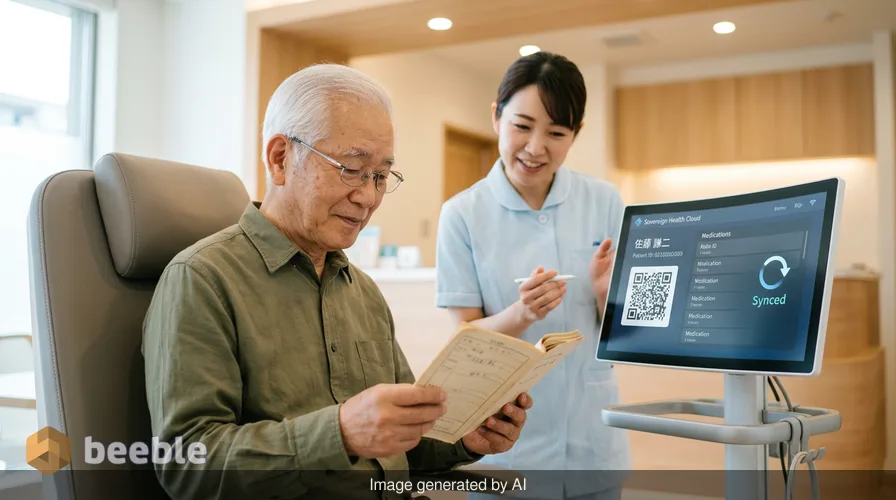
By 2040, nearly 35% of Japan’s population will be over the age of 65. This isn’t just a demographic statistic; it’s a looming logistical bottleneck for a healthcare system that, despite its world-class reputation, still relies heavily on manual paperwork and fragmented digital silos. To combat this, a powerhouse quartet consisting of IBM Japan, Fujitsu, SoftBank, and Sumitomo Mitsui Financial Group (SMBC) has begun deploying a massive, interconnected AI healthcare platform designed to serve 60 million citizens.
Looking at the big picture, this isn't just about making apps for doctors. It is a fundamental shift in how a nation-state manages its most sensitive asset: the biological data of its citizens. By moving away from decentralized, legacy databases and into a unified, “sovereign” cloud, Japan is attempting to build a digital immune system that is as resilient as it is efficient.
The Mathematics of a Super-Aging Society
To understand why this move is disruptive, we have to look at the sheer volume of data involved. A single hospital produces petabytes of data annually, from high-resolution MRIs to messy, handwritten nursing notes. Historically, this data has been trapped within the four walls of individual clinics. If you moved from Osaka to Tokyo, your medical history didn't necessarily move with you—at least not without a significant administrative headache.
The alliance’s primary goal is to solve this fragmentation. By establishing a common technology layer, these companies are essentially building a universal language for medical records. This streamlined approach ensures that whether you are at a university hospital or a local neighborhood clinic, your data is accessible, standardized, and secure.
Beyond the Jargon: What is a Sovereign Cloud?
One of the most robust terms being thrown around in this partnership is "sovereign cloud architecture." For the average user, this sounds like high-level IT talk, but the concept is simple. In the past decade, much of the world’s data has migrated to massive data centers owned by a handful of global tech giants, often based in the United States.
Data sovereignty is the digital equivalent of home-field advantage. It ensures that sensitive medical records—your DNA sequences, your chronic condition history, your prescriptions—physically reside on servers located within Japanese borders and are governed strictly by Japanese law. This protects the national interest from shifting geopolitical winds and ensures that a foreign entity cannot suddenly change the terms of how that data is accessed or stored. Under the hood, Fujitsu and IBM Japan are building this fortress to ensure that while the AI might be cutting-edge, the data stays close to home.
Meet the Architects: Who is Doing What?
The scale of this project is so large that no single company could tackle it alone. Each player brings a specific, foundational skill set to the table.
| Company | Primary Role | Key Contribution |
|---|---|---|
| Fujitsu | Infrastructure & Cloud | Developing the sovereign cloud and healthcare-specific AI models. |
| IBM Japan | Systems Integration | Modernizing Electronic Health Records (EHR) and automating claims. |
| SMBC Group | Fintech & Payments | Integrating health services with the "Olive" digital finance platform. |
| SoftBank | Distribution & UI | Using LINE and Yahoo Japan to put health tools in the hands of users. |
From a consumer standpoint, the involvement of SMBC and SoftBank is particularly interesting. It suggests that healthcare is no longer being viewed as a separate utility, but as a core part of a citizen’s digital lifestyle. Imagine paying for a prescription through the same app you use to check your bank balance, with your insurance claim being processed automatically by an AI before you even leave the pharmacy.
The Tireless Intern: AI in the Doctor’s Office
Perhaps the most tangible change for medical staff is the introduction of specialized AI agents. Think of these AI systems as a tireless intern that never sleeps and has a perfect memory. One of the biggest drains on a doctor’s time is clinical documentation—the endless typing of reports and the complex "DPC coding" required for insurance payouts.
Behind the jargon, DPC coding is essentially the math used to calculate medical fees. It is notoriously complex and prone to human error. By using natural language processing, the new platform can listen to a consultation (with consent) and automatically generate the necessary reports and codes. This doesn't just reduce burnout for nurses and physicians; it speeds up the entire hospital workflow, theoretically reducing wait times for patients.
Practically speaking, if a doctor spends 20% less time on paperwork, they have 20% more time for patient interaction. In a country with a shrinking workforce, this efficiency isn't just a luxury; it’s a necessity for the system’s long-term sustainability.
The Personal Health Partner in Your Pocket
For the everyday user, the most visible part of this plan will be the AI health agents delivered via apps like LINE. Curiously, Japan is one of the few places where a messaging app has become the de facto operating system for daily life. SoftBank is leveraging this by turning LINE into a portal for preventive care.
These AI agents are designed to be more than just chatbots. By accessing your integrated health data, they can provide personalized recommendations. For example, if your recent blood work shows a trend toward high cholesterol, the AI might suggest specific dietary changes or remind you to schedule a follow-up appointment. This shifts the healthcare model from “reactive” (fixing you when you’re broken) to “proactive” (keeping you from breaking in the first place).
There is, of course, a level of mild skepticism required here. Anytime we see phrases like "consent-based access controls," we must ask how easy those controls are to use. The alliance promises transparency, but as these systems scale to 60 million users, the user interface must be intuitive enough for an 80-year-old in rural Hokkaido to navigate without feeling like their privacy is being compromised.
The Bottom Line for the Consumer
Ultimately, what this means for you is a healthcare experience that feels less like a bureaucratic maze and more like a modern service. The integration with the “My Number” portal—Japan’s national ID system—is the final piece of the puzzle. It allows for a seamless flow of information between government services, private hospitals, and your personal devices.
We are moving toward a world where your medical history is a resilient, portable asset rather than a scattered collection of paper files. While the tech is unprecedented, the goal is ancient: better care through better understanding.
As this platform continues to roll out through 2026, the real test will not be the complexity of the AI, but the level of trust the Japanese public places in it. If the alliance can prove that their sovereign cloud is indeed a digital fortress, they may well provide the global blueprint for how an aging society can thrive in the digital age.
Sources:
- Fujitsu Global: Healthcare Digital Transformation and Cloud Initiatives.
- IBM Japan: Official Press Release on Sovereign Cloud Partnership.
- SoftBank Corp: Investor Relations - AI and Healthcare Strategy 2026.
- SMBC Group: Digital Financial Services and Ecosystem Expansion Reports.



See you on the other side.
Our end-to-end encrypted email and cloud storage solution provides the most powerful means of secure data exchange, ensuring the safety and privacy of your data.
/ Create a free account
