


Jensen Huang’s Blue-Collar Blueprint: Why the AI Revolution Isn’t Just for Silicon Valley

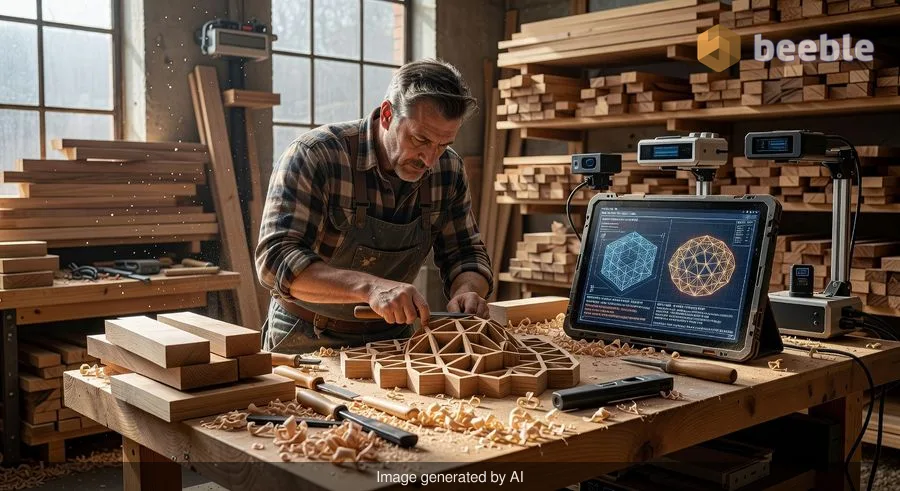
When Was the Last Time You Thought of a Circular Saw as an AI Peripheral?
For years, the narrative surrounding artificial intelligence has been framed as a white-collar crisis. We’ve heard the warnings about paralegals, junior analysts, and copywriters being replaced by large language models. But what about the person fixing your HVAC system, the farmer tending to a thousand acres of corn, or the carpenter framing a new home? According to Nvidia CEO Jensen Huang, if these workers think they are immune to the AI wave—or worse, that the technology isn't for them—they are missing the most significant tool for professional evolution in a century.
In a recent discussion on Lex Fridman’s podcast, Huang pivoted the conversation away from the usual Silicon Valley echo chamber. He argued that blue-collar industries aren't just safe harbors from AI; they are the next frontier for its most transformative applications. For Huang, the goal isn't for AI to replace the carpenter, but for the carpenter to use AI to become a disruptive force in their own right.
From the Small Town to the Global Grid
I grew up in a small town where the local economy was built on physical labor and tangible goods. Back then, the internet felt like something that happened elsewhere—a digital layer that didn't quite touch the grease on a mechanic's hands. Nevertheless, as I transitioned from an academic background in sociology to traveling the world as a tech journalist, I realized that technology is the ultimate border-eroder. Whether I’m testing the latest wearable tech at a summit in Berlin or filing a story from a quiet corner of Bali, the lesson is always the same: those who master the tools of the era define the era.
In practice, this means a shift in how we view "technical" skills. Huang’s message is clear: the barrier to entry for high-level innovation has collapsed. You no longer need a computer science degree to command a computer. You just need to know how to talk to it.
The Carpenter as a Coder
Huang’s most provocative example involved the trades. He suggested that a carpenter should go "completely berserk" using AI. At first glance, this sounds like a mismatch. How does a generative model help with a miter saw? Under the hood, however, a carpenter’s work is a complex series of geometric puzzles, material science, and supply chain management.
By using AI-driven design tools, a master builder can optimize lumber cuts to minimize waste—essentially treating wood as a precious resource managed by an intelligent system. They can use AI to generate complex architectural blueprints that would have previously required an expensive firm. To put it another way, AI becomes a digital apprentice that never sleeps, handling the friction-heavy administrative and design tasks so the human can focus on the craft.
Agriculture and Pharmacy: The New Frontiers
Curiously, the industries we often consider the most "traditional" are the ones most ripe for a paradigm-shifting upgrade. Take farming, for instance. A farmer using AI isn't just driving a tractor; they are managing a sophisticated ecosystem of data.
- Precision Agriculture: Using computer vision to identify specific pests or nutrient deficiencies in real-time.
- Predictive Analytics: Forecasting crop yields based on hyper-local weather patterns and soil sensors.
- Autonomous Logistics: Coordinating a fleet of drones and harvesters through a single, intuitive interface.
Similarly, Huang pointed to pharmacists. In a world of increasingly complex drug interactions and personalized medicine, an AI-empowered pharmacist becomes an innovator. They can use the technology to cross-reference vast medical databases instantly, ensuring that a patient’s unique genetic profile matches their prescription perfectly. This isn't just efficiency; it's a higher tier of care.
Training the AI Apprentice
We often think of AI as a black box—a mysterious entity that spits out answers. But Huang views it more like raising an apprentice. You don't just turn it on; you guide it, refine its outputs, and integrate it into your specific workflow. For a blue-collar worker, this means taking decades of "tribal knowledge"—the kind of intuition you can only get from years on the job—and using AI to scale that expertise.
Because of this, the most valuable skill in 2026 isn't knowing a specific programming language; it's domain expertise. The AI knows how to write the code or draw the plan, but it doesn't know the nuances of a specific piece of land or the structural quirks of an old building. The human provides the intent; the AI provides the execution.
Finding Balance in a Hyper-Connected World
As someone who spends a significant amount of time tracking my sleep with a smart ring and using meditation apps to manage the stress of constant travel, I’m the first to admit that the "always-on" nature of tech can be exhausting. There is a risk that by bringing AI into every trade, we increase the pressure to be constantly productive.
Even so, the goal of Huang’s vision isn't to make us work more, but to work with more agency. When I’m at a tech expo, surrounded by the latest disruptive gadgets, I often find myself needing to turn off all notifications and go for a run to clear my head. We must apply that same intentionality to how we integrate AI into the trades. It should be a tool that grants us more freedom, not a leash that ties us to a screen.
Practical Steps for the Modern Worker
If you are in a trade or a service-oriented profession, how do you actually start? It doesn't require a massive investment in hardware.
- Identify the Friction: What part of your job is the most repetitive or frustrating? Whether it's invoicing, scheduling, or basic design, that is where your AI journey begins.
- Use Natural Language: Start experimenting with tools like ChatGPT or specialized industry bots. Ask them to solve a specific problem you encountered that day.
- Stay Curious, Not Fearful: Treat AI as a new power tool. You wouldn't be afraid of a new type of drill; you’d learn how to use it to make your work better.
- Focus on Your Unique Value: AI cannot replicate the physical dexterity of a plumber or the empathetic ear of a healthcare provider. Lean into the skills that are uniquely human.
Conclusion: The Future belongs to the Innovators
The AI revolution is not a closed-door meeting for software engineers. It is an open invitation to every person who builds, heals, grows, or fixes. Jensen Huang’s message is a call to action: don't wait for the future to happen to you. Whether you are holding a wrench or a prescription pad, the tools to revolutionize your industry are already in your pocket.
Your next step: Pick one repetitive task in your daily routine this week and see if a free AI tool can help you optimize it. The era of the AI-powered artisan has begun.
Sources
- Lex Fridman Podcast, Episode #418: Jensen Huang.
- Nvidia Official Newsroom: AI and the Future of Industry.
- World Economic Forum: The Future of Jobs Report.
- Bureau of Labor Statistics: Occupational Outlook for Skilled Trades.



See you on the other side.
Our end-to-end encrypted email and cloud storage solution provides the most powerful means of secure data exchange, ensuring the safety and privacy of your data.
/ Create a free account
