


Listening to the Deep: How Autonomous Robots Are Decoding Sperm Whale Conversations in Real Time

Did you know that a sperm whale can hold its breath for nearly an hour while diving over 1.6 kilometers into the ink-black depths of the ocean? For decades, these magnificent creatures have remained largely invisible to us, existing as ghostly echoes on sonar or fleeting shadows near the surface. Growing up in a small town, I remember the internet arriving like a slow-motion tidal wave, eroding the borders of my world and making the distant feel reachable. Yet, the deep ocean remained the ultimate 'dead zone'—a place where our connectivity and curiosity were thwarted by crushing pressure and vast distances.
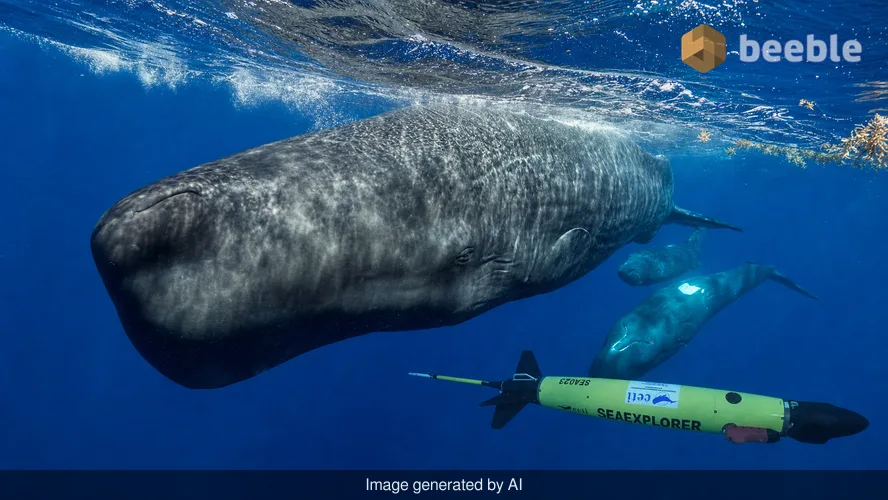
Today, that border is finally dissolving. Researchers from Project CETI (Cetacean Translation Initiative) have unveiled a sophisticated autonomous underwater glider capable of tracking sperm whale vocalizations in real time. This isn't just a win for marine biology; it’s a paradigm-shifting leap in how we interact with the non-human intelligences that share our planet.
The Silent Explorer: A New Way to Listen
Traditional whale tracking has always been a friction-heavy endeavor. Scientists usually rely on suction-cup tags that cling to a whale’s skin for a few days before falling off, or stationary hydrophones that are useless once the pod moves out of range. In contrast, the new robotic system uses a buoyancy-driven glider.
As David Gruber, founder of Project CETI, aptly describes it, the glider is less like a loud motorized boat and more like a soaring albatross. It moves by shifting its internal weight to sink or rise, gliding forward with minimal noise. This silence is crucial. Because the robot doesn’t churn the water with propellers, it can listen to the intricate 'codas'—patterned sequences of clicks—that sperm whales use to socialize and navigate.
Under the Hood: The Backseat Driver
What makes this technology truly innovative is its internal logic. Most underwater drones are essentially 'dumb' recorders; they collect data that must be analyzed months later in a lab. The Project CETI glider, however, utilizes a feature called a backseat driver.
Under the hood, the glider’s software processes acoustic data from four onboard hydrophones. When it detects the distinctive rhythmic clicks of a sperm whale, it doesn't just record them. It calculates the direction of the sound and automatically overrides the navigation system to steer toward the source.
In practice, this allows the robot to make autonomous decisions while still submerged. It continuously updates its flight path to maintain contact with a specific whale or group. This shift from opportunistic glimpses to continuous observation is transformative, allowing scientists to witness the nuanced social structures of whale families for the first time.
From Brief Encounters to Long-Term Relationships
During my time traveling for tech expos, from the frantic halls of CES to the humid coworking spaces of Bali, I’ve become obsessed with how we use data to bridge gaps. I often find myself checking my smart ring to see how my sleep cycles adjust to new time zones or using meditation apps to stay grounded amidst the chaos of a nomadic lifestyle. We use technology to understand ourselves; now, we are using it to understand the 'other.'
By staying with a whale pod for weeks or even months, this robotic system allows us to observe life events that were previously hidden. We can see how a mother teaches her calf the specific 'dialect' of their clan. We can witness how they coordinate during a hunt in the darkness of the mesopelagic zone. This isn't just data collection; it's the beginning of a continuous relationship with a species that has its own culture and history.
Comparing Whale Tracking Technologies
| Feature | Traditional Suction Tags | Stationary Hydrophones | Autonomous Gliders (CETI) |
|---|---|---|---|
| Duration | Short-term (Days) | Long-term (Years) | Extended (Months) |
| Mobility | Follows whale | Fixed location | Autonomous following |
| Data Processing | Post-retrieval | Real-time or post | Real-time onboard |
| Human Presence | High (Requires boat) | Low (Remote) | Low (Autonomous) |
| Cost/Scale | High per encounter | Moderate | Scalable and robust |
The Challenges of a Liquid Wild West
Nevertheless, the ocean remains a precarious environment for robotics. Even with cutting-edge software, precise localization is a resilient challenge. The glider can determine the direction of a whale, but pinpointing its exact coordinates in a three-dimensional, high-pressure void is difficult.
Communication is another bottleneck. Because radio waves don't travel well through salt water, the robot must periodically surface to send updates via satellite. To put it another way, the robot is like a deep-sea diver who has to come up for air and a signal bar every few hours. This makes the monitoring process slightly asynchronous, though it remains far more performant than anything we’ve had before.
Why This Matters for Conservation
As someone who advocates for a healthy balance between our digital and physical lives—often trading my laptop for a yoga mat or a trail run—I see this technology as a way to restore balance to the ocean. Our seas are increasingly volatile, crowded with shipping noise and industrial activity.
By tracking how whales respond to human-made noise in real time, we can create more sophisticated policy decisions. Imagine a future where ship speeds are automatically reduced or routes are diverted because an autonomous glider has flagged a nursing whale mother in the area. This isn't just about science; it's about building a digital immune system for the planet.
Conclusion: A New Frontier for Intelligence
Developing these systems brings us closer to understanding a form of intelligence that is fundamentally different from our own. It challenges us to rethink our place in the ecosystem. As we build AI and robots that can 'speak' the language of the natural world, we aren't just raising an apprentice; we are learning to be better neighbors.
If you want to support this work, consider following the progress of Project CETI or advocating for increased funding in marine bioacoustics. The next time you look out at the ocean, remember: it’s no longer a silent void. It’s a conversation, and we’re finally starting to listen.
Sources:
- Project CETI (Cetacean Translation Initiative) Official Documentation
- Scientific Reports: "Autonomous tracking of sperm whales using underwater gliders"
- Baruch College, City University of New York (CUNY) Research Archives
- Marine Technology Society Journal: Advancements in Passive Acoustic Monitoring



See you on the other side.
Our end-to-end encrypted email and cloud storage solution provides the most powerful means of secure data exchange, ensuring the safety and privacy of your data.
/ Create a free account
