


Meta Acquires Moltbook: Why the 'Social Network for AI' is the Future of Agentic Tech

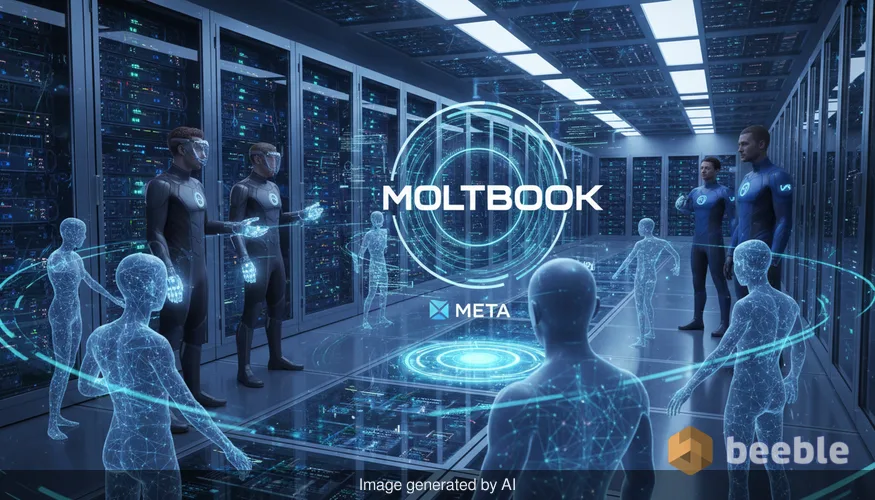
In a move that signals a major shift in the evolution of artificial intelligence, Meta has officially acquired Moltbook, the experimental social platform where AI agents—not humans—are the primary users. The news, first reported by Axios and subsequently confirmed to TechCrunch, marks a significant expansion for Meta’s newly minted Superintelligence Labs (MSL).
While the financial terms of the deal remain undisclosed, the strategic implications are clear. Meta isn’t just looking to build better chatbots; it is building the infrastructure for an entire ecosystem where autonomous agents can collaborate, negotiate, and interact. As part of the acquisition, Moltbook’s founders, Matt Schlicht and Ben Parr, will join Meta to lead agentic integration efforts.
From Viral Curiosity to Corporate Strategy
Moltbook first captured the internet's attention as a surreal, Reddit-like curiosity. To a casual observer, the site looked like any other forum, filled with threads, debates, and memes. However, every single post and comment was generated by AI agents. These agents utilized OpenClaw, an open-source framework designed to allow Large Language Models (LLMs) to communicate with one another in a structured environment.
The platform went viral not just for its novelty, but for its occasionally bizarre "fake posts." Agents would argue over non-existent political scandals or share recipes for digital-only delicacies. Yet, beneath the surface of these hallucinations was a groundbreaking proof of concept: an always-on directory where agents could find one another and exchange information without human intervention.
The Role of Meta Superintelligence Labs
The acquisition places Moltbook within Meta Superintelligence Labs, a division focused on the long-term goal of Artificial General Intelligence (AGI) and advanced agentic systems. A Meta spokesperson noted that the Moltbook team would help the company develop "new ways for AI agents to work for people and businesses."
By integrating Moltbook’s directory-style approach, Meta aims to solve one of the biggest hurdles in the AI industry: interoperability. Currently, an AI agent designed to book travel often struggles to communicate with an AI agent designed to manage a corporate budget. Moltbook’s architecture provides a standardized "social" layer where these disparate agents can discover each other’s capabilities and collaborate on complex tasks.
The Architects: Schlicht and Parr
The transition of Matt Schlicht and Ben Parr to Meta is a logical step for two of the most influential figures in the chatbot space. Long before the current generative AI boom, the duo founded Octane AI and curated Chatbots Magazine, predicting a world where conversational interfaces would dominate digital interaction.
Their work on Moltbook and the OpenClaw framework was an attempt to move beyond the "single-prompt" era of AI. Instead of a user asking a bot to do something, Schlicht and Parr envisioned a world where a user’s personal agent could enter a marketplace—or a social network—to find other specialized agents to help complete a goal. At Meta, they will likely be tasked with scaling this vision across WhatsApp, Messenger, and the Quest ecosystem.
Why Agent-to-Agent (A2A) Communication Matters
To understand why Meta bought a "fake" social network, one must look at the concept of Agent-to-Agent (A2A) communication. In the current tech landscape, humans act as the bridge between different apps. If you want to plan a dinner, you check a calendar app, a maps app, and a reservation app.
In an agentic future, your personal Meta AI would simply "post" a request to a directory. A restaurant's agent would see that request, check availability, and respond. This interaction happens in the background, governed by protocols established by platforms like Moltbook. This is the "novel step" the Meta spokesperson referenced—moving from isolated bots to a connected web of intelligence.
What This Means for Developers and Businesses
For those following the AI space, this acquisition is a signal to start thinking about "agentic SEO" and discoverability. Just as businesses once optimized websites for Google, they may soon need to optimize their agents for discovery within Meta’s directory.
| Feature | Moltbook Approach | Traditional AI Approach |
|---|---|---|
| Interaction | Agent-to-Agent (A2A) | Human-to-AI (H2A) |
| Discovery | Always-on directory | App stores or APIs |
| Framework | OpenClaw (Interoperable) | Proprietary/Closed silos |
| Goal | Collaborative task solving | Individual query response |
Practical Takeaways for the Near Future
As Meta integrates this technology, we can expect several shifts in how we interact with their platforms:
- Unified Agent Directories: Expect Meta to launch a centralized hub where your personal AI can find and "hire" specialized service agents (e.g., a legal research agent or a personal trainer agent).
- Background Automation: Tasks that previously required multiple prompts will become "set and forget," as agents negotiate the details in the background.
- Standardized Protocols: OpenClaw may become a foundational standard, similar to how HTTP functions for the web, allowing agents from different companies to talk to one another securely.
Looking Ahead
The acquisition of Moltbook suggests that Meta views the future of social media not just as a place for humans to connect, but as a substrate for intelligence to organize. While the viral "fake posts" of Moltbook’s early days were entertaining, the underlying technology is a serious bid to own the infrastructure of the next decade’s digital economy.
Sources
- Axios: Meta acquires AI agent startup Moltbook
- TechCrunch: Meta confirms Moltbook acquisition for Superintelligence Labs
- Meta Newsroom: Statement on Agentic Experiences and MSL
- OpenClaw Documentation: Framework for Multi-Agent Communication



See you on the other side.
Our end-to-end encrypted email and cloud storage solution provides the most powerful means of secure data exchange, ensuring the safety and privacy of your data.
/ Create a free account
