


Meta Can’t Skip the Bill: Why Europe’s Top Court Sided With News Publishers

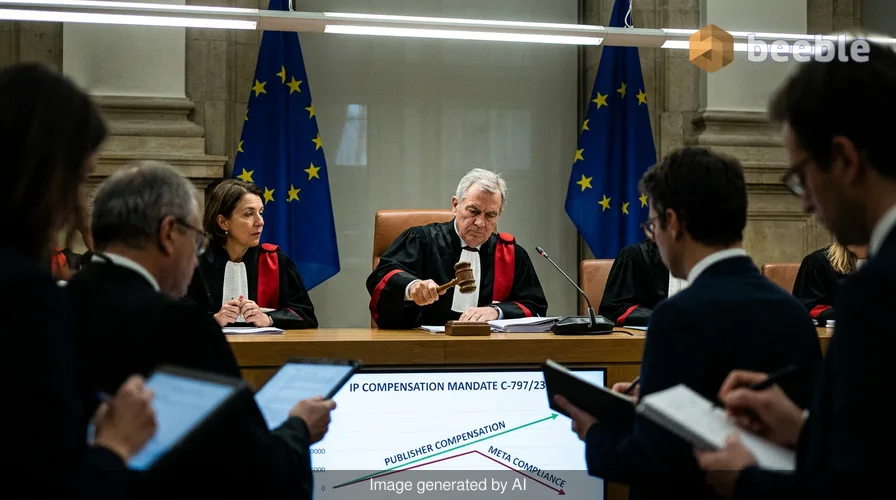
We often think of the internet as a vast, open library where information flows freely, yet we forget that someone had to write the books on the shelves. In our daily digital lives, we scroll through a Facebook feed or an Instagram tab, glancing at headlines and reading short snippets of news stories without ever clicking away to the original source. To the average user, this feels like a seamless, cost-free convenience. Under the eyes of the law, however, those snippets represent valuable intellectual property that costs real money to produce.
This week, that legal reality caught up with Meta Platforms. In a landmark decision, the Court of Justice of the European Union (CJEU) ruled that Meta must comply with Italian regulations requiring it to compensate news publishers for the content it displays. This isn't just a minor administrative hiccup for a tech giant; it is a fundamental shift in the power dynamic between the people who report the news and the platforms that distribute it.
As your Legal Navigator, I want to pull back the curtain on this complex dispute. This case, known formally as C-797/23, isn't just about Meta and Italy. It’s a blueprint for how copyright will be enforced in the age of social media and Artificial Intelligence.
The Deli Sample Paradox
To understand this case, consider a simple analogy. Imagine a local deli that spends all morning roasting meats and baking bread. A large tour bus operator starts bringing hundreds of tourists to the deli’s front door every day. Instead of letting them go inside to buy a sandwich, the tour operator takes small samples of the deli’s best meats, puts them on toothpicks, and hands them out for free on the sidewalk. The tourists are satisfied with the samples and never feel the need to walk inside and pay for a full meal. The tour operator, meanwhile, charges the tourists a fee for the 'guided culinary experience.'
In this scenario, the tour operator is Meta, and the deli is an Italian news publisher. Meta argued that because they were only showing 'snippets'—small fragments of an article—they shouldn't have to pay. They claimed that these snippets actually helped publishers by sending them traffic. But the Italian regulator, AGCOM, and now Europe’s highest court, disagreed. They’ve essentially ruled that if the tour operator is making money from those samples, the deli owner deserves a cut of the profits.
Why Meta Challenged the Referee
The heart of this battle was not just about money, but about authority. Meta challenged the power of AGCOM, Italy’s communications watchdog. Meta’s legal team argued that national regulators shouldn't have the jurisdiction to step in and set prices. They essentially wanted the 'freedom of contract'—the right to negotiate (or refuse to negotiate) with publishers on their own terms without a government referee blowing the whistle.
Meta’s argument was that EU-wide copyright rules already covered these issues and that Italy’s specific measures were a step too far. However, the CJEU found that a right to fair compensation is consistent with EU law. The court clarified that as long as the payment is seen as a 'consideration' (a legal term for a bargained-for exchange) for the right to use the publication online, the regulator has every right to intervene if negotiations break down.
Understanding 'Neighboring Rights'
You might be familiar with basic copyright—if you write a book, you own it. But this case leans heavily on a newer, more nuanced concept called 'neighboring rights' (or related rights).
In the past, copyright primarily protected the individual journalist who wrote the story. Neighboring rights, however, extend protection to the publisher—the organization that invested the money, hired the staff, and took the risk to produce the news. Because of this legal framework, publishers have a statutory right to authorize or prohibit the digital use of their press publications. This makes the publishers' position much more robust when sitting across the table from a multi-billion-dollar tech corporation.
The AI Connection: The Stakes Just Got Higher
While this specific ruling focused on news snippets on social media, the overarching implications for Artificial Intelligence are massive. We are currently in the middle of a systemic shift where companies like Meta, OpenAI, and Anthropic are using vast troves of newspaper articles to train their Large Language Models (LLMs).
If the courts decided that snippets were 'fair use' and didn't require payment, it would have been much easier for tech companies to argue that using articles for AI training is also free. By ruling that publishers have an actionable right to fair compensation for even small uses of their work, the CJEU has reinforced a defensive wall for content creators. Ultimately, this precedent suggests that if a tech company wants to use high-quality journalism to make its AI smarter (and more profitable), it cannot simply bypass the bill.
Is Your Facebook Feed About to Change?
For the ordinary user, this ruling might feel like it’s happening in a vacuum, but the practical consequences could show up on your phone screen sooner than you think. In the past, when faced with similar laws in countries like Australia or Canada, Meta has occasionally chosen to 'pull the plug'—removing news content from its platforms entirely rather than paying the fees.
However, the tide is turning. With Europe’s top court now providing a binding precedent, Meta’s legal options are becoming increasingly precarious. They can no longer claim that these national laws are invalid under EU standards. As a result, we are likely to see more 'good faith' negotiations.
| Feature | Meta's Previous Stance | Post-CJEU Ruling Reality |
|---|---|---|
| Payment for Snippets | Often viewed as optional or a 'gift' of traffic. | Legally recognized as 'fair compensation.' |
| Regulator Power | Claimed regulators had no right to set prices. | Regulators (like AGCOM) are confirmed as valid referees. |
| Negotiation Tactics | Could 'walk away' or refuse to negotiate indefinitely. | Expected to negotiate in good faith under statutory frameworks. |
| AI Training | Gray area; often used without explicit licensing. | Strengthens the case that all data usage requires compensation. |
The 'Quality Journalism' Defense
One of the most compelling parts of the court’s logic wasn't just about economics, but about democracy. Angela Mills Wade of the European Publishers Council noted that the court recognized the link between fair compensation and 'media freedom and pluralism.'
In the eyes of the law, a healthy society needs a variety of news sources. If the companies that actually pay for the reporters, the fact-checkers, and the editors are starved of revenue because tech platforms are siphoning off the value of their work, those news sources go bankrupt. When that happens, the vacuum is often filled by misinformation. This ruling is, in many ways, a legal safety net designed to keep the lights on in newsrooms across the continent.
What Should You Do Next?
As a consumer and a citizen, it is easy to feel like a spectator in these corporate marathons. However, this ruling reminds us that the content we consume has value. Here is how you can act on this information:
- Support Original Sources: Whenever possible, click through to the publisher’s website rather than just reading the preview. This helps them track engagement and secure ad revenue directly.
- Understand Your Rights: If you are a creator—whether a journalist, a photographer, or a blogger—know that the legal trend is moving toward protecting your work from unauthorized AI scraping and platform exploitation.
- Stay Informed on Platform Changes: Keep an eye on your privacy settings and terms of service. As Meta and others adjust to these rulings, they often update their boilerplate language regarding how they use your data and the content you share.
- Advocate for Transparency: Support legislation that requires tech companies to be transparent about what data they are using to train their AI models.
This legal victory for Italian publishers is a paved road for the rest of the world. It proves that even the largest gatekeepers of the digital age are not above the statutory requirements of fair play. The law may move slowly, but in this case, it has sent a clear message: the 'free' samples are over, and it’s time to pay the chef.
Sources:
- Court of Justice of the European Union (CJEU), Case C-797/23 Meta Platforms Ireland (Fair compensation).
- EU Directive 2019/790 on Copyright and Related Rights in the Digital Single Market (Article 15).
- Italian Communications Authority (AGCOM) Regulatory Guidelines.
- European Publishers Council official statement on CJEU ruling.
Disclaimer: This article is for informational and educational purposes only and does not constitute formal legal advice. While I strive for accuracy, laws and regulations can change rapidly and vary significantly by jurisdiction. If you are facing a specific legal issue regarding copyright or digital media, please consult with a qualified attorney in your area.



See you on the other side.
Our end-to-end encrypted email and cloud storage solution provides the most powerful means of secure data exchange, ensuring the safety and privacy of your data.
/ Create a free account
