


Meta is turning into a hardware giant to keep your social media feed running

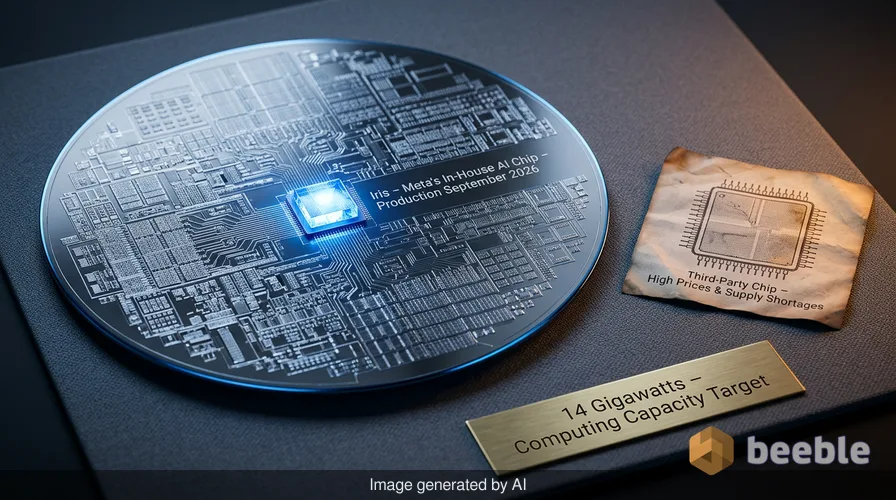
The physical reality of a Facebook post begins with a microscopic circuit etched onto a wafer of silicon in a cleanroom in Taiwan. While most users think of Meta as a software company that manages apps, the firm is currently in the middle of a massive transformation into a hardware powerhouse. An internal memo confirms that Meta is starting production of its newest in-house artificial intelligence chip, code-named Iris, this September. This move is part of a plan to double the company's computing capacity to 14 gigawatts by next year.
Looking at the big picture, this isn't just about making apps run faster. It is a strategic retreat from the high prices and supply shortages that define the current microchip market. For years, tech giants have relied on external suppliers for the digital crude oil that fuels their data centers. By building its own chips, Meta is trying to control its own energy and financial destiny. For the average user, this shift is invisible, but it dictates how much AI will influence your daily digital habits.
Moving away from the high cost of third-party silicon
To understand why Meta is building Iris, we have to look at the current market for chips. Right now, companies like Nvidia and AMD have a tight grip on the high-end graphics processing units (GPUs) that make AI possible. These chips are expensive and hard to get. Meta is spending $145 billion on infrastructure this year. This is a large portion of the $700 billion that the entire tech industry is projected to spend on AI hardware.
Behind the jargon, the problem is simple. General-purpose chips from Nvidia are like a Swiss Army knife. They can do many things well, but they are not always the most efficient tool for a specific task. Meta’s Iris chip is a specialist. It is part of the fourth generation of the Meta Training and Inference Accelerator (MTIA) project. Because Meta designed this silicon specifically for its own software, the chip uses less power and processes data more efficiently than a generic alternative.
The memo shows that testing the Iris chip took only six weeks. This speed is unusual for a project that has struggled for over five years. By working with Broadcom for the design and Taiwan Semiconductor Manufacturing Co (TSMC) for production, Meta is bypassing the long wait times associated with buying off-the-shelf components. Essentially, Meta is tired of being a tenant and has decided to become the landlord of its own computing power.
The massive energy demands of a digital world
One of the most striking numbers in the report is Meta's goal for computing capacity. The company is deploying seven gigawatts of infrastructure this year. It plans to reach 14 gigawatts in 2027. To put this into perspective, a single gigawatt can power about 750,000 homes. Meta’s target is equivalent to the power consumption of several small countries combined.
Practically speaking, this expansion is why Meta needs its own chips. Standard GPUs are power-hungry. When you multiply that consumption by millions of chips, the electricity bill becomes a macroeconomic factor. Custom silicon like Iris helps manage this load. If each chip uses even 10% less power than an Nvidia equivalent, the savings across a 14-gigawatt network are astronomical.
This infrastructure requires more than just processors. The memo reveals long-term supply deals for other parts of the machine. Meta is buying memory chips from Samsung, flash storage from SanDisk, and fiber-optic equipment from Sumitomo Electric. These agreements ensure that Meta does not run out of parts during a global shortage. These shortages have already caused price hikes at companies like Apple. Meta is attempting to insulate itself from "chipflation," a term analysts use to describe the rising cost of the components that run our world.
Comparing custom chips to standard hardware
| Feature | Standard GPUs (Nvidia/AMD) | Meta Iris (Custom MTIA) |
|---|---|---|
| Purpose | General-purpose AI and graphics | Optimized for Meta’s specific apps |
| Power Efficiency | High consumption | Targeted low-power design |
| Availability | Subject to market shortages | Managed by in-house production schedule |
| Cost | Premium market pricing | High upfront design cost, lower long-term use cost |
| Software Integration | Requires middle-ware layers | Native integration with Meta's algorithms |
What this means for your daily digital experience
From a consumer standpoint, the production of the Iris chip has direct consequences for how you interact with technology. When you scroll through Instagram or Facebook, an AI algorithm decides which video to show you next. This process is called inference. It requires a split-second calculation that happens in a data center thousands of miles away.
When Meta uses its own chips, these calculations happen faster and at a lower cost. This allows the company to deploy more complex AI features without slowing down the app. In everyday life, this looks like more accurate search results, better language translation in real-time, and more sophisticated filters or augmented reality tools.
However, there is a trade-off. As Meta increases its computing power to 14 gigawatts, the amount of data it can process grows. This often leads to more aggressive data collection to feed the machine. The AI is a tireless intern that never sleeps, but it only works well if it has a constant stream of information. As Meta's hardware becomes more capable, the company will likely find new ways to keep you engaged with its platforms to justify the $145 billion investment.
The financial gamble on custom hardware
On the market side, investors are watching Meta with a mix of optimism and skepticism. Shares recovered after an initial dip following the report. This shows that the market values the potential for long-term cost savings. If Meta can stop paying the "Nvidia tax," its profit margins will improve.
Conversely, the cost of building these chips is enormous. Developing a custom processor from scratch is one of the most expensive tasks in the tech world. It involves years of research, complex manufacturing deals, and the risk that the technology might be obsolete by the time it reaches the data center. Meta plans to release a new chip every six months through 2027. This is a much faster cycle than the industry standard of one or two years. This aggressive pace shows how much pressure the company feels to stay ahead of its competitors.
Ultimately, this is a story about the industrialization of the internet. We are moving away from an era where software was a lightweight layer on top of a few servers. Today, social media is a heavy industry. It requires power plants, massive supply chains, and custom-designed silicon. Meta is no longer just an app developer. It is a hardware company that happens to own a few of the world's most popular websites.
Practical foresight for the user
As a user, it is time to shift your perspective on what sits behind your screen. We often treat the internet as something weightless and digital, but the Iris chip reminds us that every click has a physical cost in silicon and electricity. The race to 14 gigawatts is a sign that AI is not just a trend; it is the new foundation of how information is organized.
You should observe your digital habits more closely as these chips go into production this September. You will likely notice that the "suggested for you" sections of your apps become more persistent and eerily accurate. This is the Iris chip at work. It is the result of billions of dollars and thousands of workers trying to make the machine more efficient. The next time your phone stays cool while running a complex AI task, remember that it is because a company decided to stop buying chips and started building them instead.
Sources:
- Reuters Internal Memo Review (July 2026)
- Meta Platforms Technical Announcement (March 2026)
- Emarketer Analyst Report on Custom Silicon (2026)
- Morgan Stanley Macroeconomic Analysis on Chipflation (2026)



See you on the other side.
Our end-to-end encrypted email and cloud storage solution provides the most powerful means of secure data exchange, ensuring the safety and privacy of your data.
/ Create a free account
