


Microsoft is building a rival to its own best investment

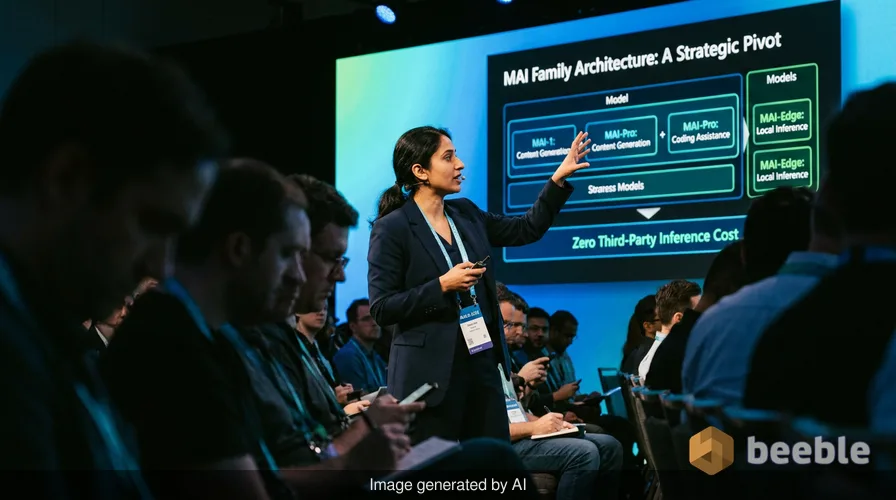
While the prevailing narrative suggests Microsoft is inseparable from OpenAI, the reality is a sharp turn toward self-reliance. For years, the tech giant was the quiet financier behind the curtain, providing the billions of dollars and massive server farms required to bring ChatGPT to life. This partnership was the foundation of the current AI boom. However, the announcements at the Build 2026 conference in San Francisco prove that Microsoft is no longer content to just host someone else’s brain. By launching seven in-house AI models, the company has officially entered the ring as a direct competitor to the very startups it helped create.
Looking at the big picture, this shift is a matter of basic math and corporate survival. Microsoft has committed $13 billion to OpenAI and another $5 billion to Anthropic. While these investments gave Microsoft an early lead, they also created a dependency on expensive, third-party technology. Every time a user asks a question to a Copilot tool, Microsoft often has to pay a fee to the model creator. By building its own internal models, known as the MAI family, Microsoft is attempting to cut out the middleman and regain control of its profit margins.
The new brain in the machine
The most significant reveal is MAI-Thinking-1. This is the first reasoning model Microsoft has built from the ground up without using data from other AI systems. In the industry, many smaller models use a process called distillation, where they learn by watching how a larger model like GPT-4 solves a problem. Microsoft chose a different path here. They used clean, commercially licensed data to train a system that specializes in complex, multi-step tasks.
Behind the jargon, this is like a tireless intern who does not just memorize facts but understands the logic of a workflow. The model has 35 billion active parameters. While that is smaller than the rumored trillion-plus parameters of top-tier frontier models, it is optimized for efficiency. Mustafa Suleyman, the head of Microsoft AI, claims this model is ten times more cost-effective than OpenAI’s GPT-5.5. For a company that processes millions of requests every minute, a tenfold reduction in cost is the difference between a loss-leading experiment and a massive profit engine.
This model also has a 256,000-token context window. To put it another way, you could feed it a 500-page manual or several long legal contracts at once, and it would maintain a coherent understanding of the entire document. This makes it a practical tool for corporate legal teams or engineers who need to analyze massive datasets without the system forgetting the beginning of the file by the time it reaches the end.
Coding without the middleman
Alongside the reasoning model, Microsoft introduced MAI-Code-1-Flash. This system is a specialist designed for one job: turning human language into computer code. It is already rolling out across GitHub Copilot and Visual Studio Code, which are the primary tools software developers use today. Historically, these tools relied heavily on OpenAI’s technology. By swapping in its own Flash model, Microsoft can offer faster response times and lower prices to the millions of developers who pay for these subscriptions.
From a consumer standpoint, this change is largely invisible but fundamentally disruptive. If you use a website or an app that was built with the help of these tools, the software will likely have fewer bugs and arrive in the app store faster. Because the model is optimized for speed, developers can test ideas in seconds rather than waiting for a remote server to process a complex request. Microsoft is essentially trying to own the entire digital supply chain, from the silicon in the server to the code on your screen.
Solving the fragility of quantum power
Beyond software, Microsoft is also tackling the hardware that might eventually replace the modern computer. The company announced the Majorana 2 quantum chip, which it claims is 1,000 times more reliable than the first version. Quantum computing is often described as the next frontier of science, but it has a major stability problem. The basic units of these computers, called qubits, are extremely sensitive. A slight change in room temperature or a tiny vibration can cause them to lose their data, a process known as decoherence.
Microsoft’s new chip keeps these qubits stable for an average of 20 seconds. While 20 seconds sounds short, it is a massive leap from the milliseconds achieved by previous designs. The company compares this to a phone battery that used to die in a minute but now lasts for hours. This stability comes from a unique approach using topological qubits. These qubits rely on the physical properties of a particle first theorized in 1937, which makes them more resilient to external noise.
Practically speaking, we are still years away from a quantum laptop. The current chip has only 12 qubits, and a truly useful machine needs millions. However, Microsoft vice president Zulfi Alam says the company expects to have a commercially viable machine by 2029. This machine would be able to solve problems in chemistry and material science that are currently impossible for even the world’s fastest supercomputers. If they succeed, Microsoft will own the foundational infrastructure for the next century of scientific discovery.
The high stakes of the public market
On the market side, the timing of these releases is not a coincidence. Both OpenAI and Anthropic are preparing for massive initial public offerings. Anthropic recently hit a valuation of $965 billion. As these companies go public, they will become more independent and perhaps more competitive with Microsoft. By launching the MAI models now, Microsoft is signaling to investors that it is not vulnerable to the whims of its partners.
This move creates a volatile dynamic in the tech industry. For the last three years, the relationship between Microsoft and OpenAI was a cozy alliance against Google and Amazon. Now, that alliance is shifting into a complex rivalry. Microsoft still offers OpenAI models on its Azure cloud platform, but it is now actively encouraging its customers to use its own, cheaper alternatives. It is a classic move in the tech industry: use a partner to gain a foothold, then build a better wall to keep the profits for yourself.
What this means for your digital life
For the average user, these corporate maneuvers have three tangible impacts. First, the cost of AI is going to drop. As Microsoft and OpenAI compete to offer the most efficient models, the price of premium subscriptions will likely decrease, or the free versions will become much more powerful. You are essentially the beneficiary of a price war between the world's most valuable companies.
Second, your privacy and data security are likely to improve. Because Microsoft owns the entire stack for the MAI models, they do not have to send your data to a third-party startup to process a request. For businesses and individuals concerned about where their sensitive information goes, a single-provider solution is often more transparent and easier to audit.
Third, the "tireless intern" is about to get much smarter at complex tasks. Most current AI models are great at writing emails or summarizing text, but they struggle with multi-step logic, like planning a month-long travel itinerary with budget constraints or debugging a complex software architecture. The MAI-Thinking-1 model is a foundational step toward AI that can actually solve these puzzles without constant human hand-holding.
Ultimately, the Build 2026 announcements mark the end of the honeymoon phase for the AI industry. The era of giant tech firms and small startups working hand-in-hand is fading. In its place is a more traditional, cutthroat market where every company is fighting to be the primary gateway to the digital world. Microsoft has spent billions to learn how the frontier works, and now it is ready to own it.
Sources:
- Microsoft Official Build 2026 Press Release
- Azure Quantum Hardware Technical Documentation
- Anthropic Series H Funding and SEC Filing Data
- Surge AI Independent Evaluation Reports



See you on the other side.
Our end-to-end encrypted email and cloud storage solution provides the most powerful means of secure data exchange, ensuring the safety and privacy of your data.
/ Create a free account
