


Microsoft wants to stop the next big hack before a human even sees the code

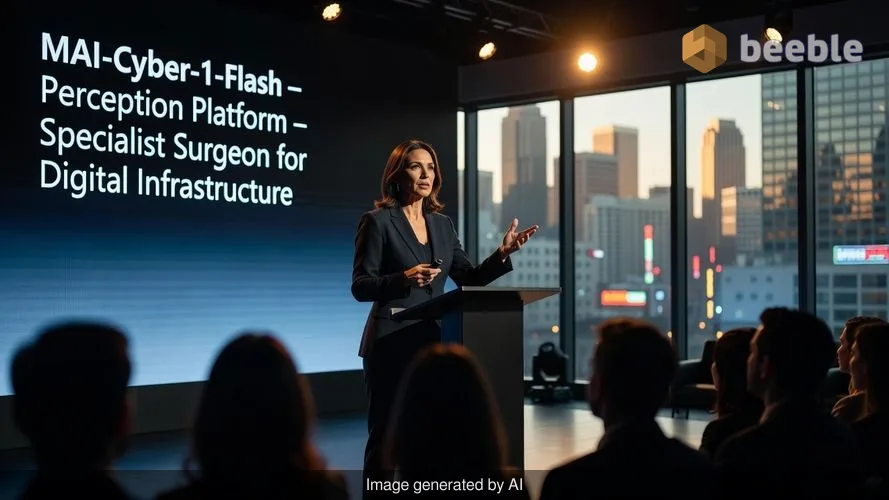
While the prevailing narrative suggests that artificial intelligence makes cyberattacks easier and more frequent, the reality for corporate defenders is shifting toward a different kind of automation. Most people assume that hackers have the permanent upper hand because they only need to find one mistake while defenders must be perfect. Microsoft just challenged this dynamic by launching a specialized digital defense system. The company introduced its first cybersecurity-specific model, MAI-Cyber-1-Flash, and a new platform called Perception at a San Francisco event on Monday. This move marks a direct response to rival tools from Anthropic and OpenAI.
Historically, general AI models like GPT-4 or Gemini are jacks-of-all-trades. They write poems, solve math problems, and summarize emails. However, they often struggle with the granular logic required to find deep flaws in software code. Microsoft is changing that approach with MAI-Cyber-1-Flash. This model is a specialist surgeon for digital infrastructure. It is designed to work within MDASH, a harness that scans codebases to identify and fix vulnerabilities. By narrowing the focus of the AI, the company claims it has created a tool that finds bugs more efficiently than its general-purpose competitors.
The digital obstacle course for AI models
Mustafa Suleyman, CEO of Microsoft AI and co-founder of DeepMind, claims the new model outperforms the current market leaders. He cited results from Cyber Gym, which is a standardized benchmark the industry uses to measure how well an AI handles security tasks. In these tests, MAI-Cyber-1-Flash was paired with GPT 5.4 to take on rivals. The Microsoft setup scored higher than Google's Gemini, OpenAI's GPT-5.6 Sol, and Anthropic's Mythos 5.
Behind the jargon, these benchmarks act like a digital obstacle course. A model must navigate complex code, identify a weakness, and figure out how to exploit it or patch it. Microsoft claims its specialized model is more cost-effective than using a massive general model for the same task. For the average user, this means the software you rely on—from banking apps to social media—might soon be vetted by a tireless intern that never sleeps and understands every line of code in the building.
Moving from single tools to autonomous security teams
Microsoft is not just releasing a single model. It is launching Perception, a platform that uses agentic AI to manage security workflows. In the world of tech, an agent is an AI that can take actions on its own rather than just providing text answers. Perception deploys three distinct types of digital teams to protect a network.
- Red teams simulate attacks to find weak spots before a real hacker does.
- Blue teams monitor systems to detect and sort through active bugs.
- Green teams take the final step by writing and applying code fixes.
Dave Weston, the lead engineer for Perception, explained that these tasks usually take hours of manual work from multiple experts. An application security hunter might find a bug, but then a remediation engineer has to fix it. Perception aims to compress this timeline from hours to minutes. It discovers the issue, decides how important it is, and generates a code fix automatically. This system is like a digital immune system that identifies a virus and produces the antibodies in real time.
The arms race between defenders and attackers
This release enters a crowded market. Earlier this year, Anthropic launched Mythos, and OpenAI introduced Daybreak. These platforms all share a common goal: to give corporate defenders the same speed and scale that AI-equipped hackers now possess. Hayete Gallot, Microsoft's vice president for security, noted that hackers are increasingly using AI to launch sophisticated attacks. Perception is the corporate counter-move to that trend.
From a consumer standpoint, this shift is foundational. When a major company like a bank or an airline suffers a data breach, the recovery costs usually trickle down to the customer in the form of higher fees or service outages. If a company can identify a flaw and patch it in minutes instead of weeks, the systemic risk to consumer data drops. The downside is that this technology creates a higher barrier to entry for smaller companies. Small businesses that cannot afford these high-end AI platforms might become the primary targets for attackers who find large corporations too difficult to crack.
What this means for your digital life
Microsoft plans to make these tools available in preview starting November 3, 2026. For the everyday user, this news is a reminder that the safety of your personal data is increasingly dependent on invisible industrial mechanics. You will likely never interact with MAI-Cyber-1-Flash directly. You will, however, feel its impact through the stability of the apps on your phone.
Looking at the big picture, this is a move toward decentralized security. Instead of waiting for a human at a corporate headquarters to notice a problem, the code itself becomes resilient. The software becomes a self-healing organism. While this does not eliminate the risk of identity theft or hacking, it changes the math for the attacker. If a bug only exists for two minutes before an AI green team patches it, the window for a hacker to steal your information shrinks significantly.
Practically speaking, you should watch how your favorite service providers talk about security over the next year. Companies that adopt agentic defense systems will likely have fewer service interruptions and fewer emergency password reset requests. The era of the human-led security desk is ending. In its place is a streamlined system of specialized models and autonomous agents working in the background of the digital world.
Sources
- Microsoft Official Event Press Release, July 2026.
- Microsoft AI Corporate Development Blog: "Scaling Defense with MAI-Cyber-1-Flash."
- Industry Security Benchmark Report: Cyber Gym Q3 2026 Results.
- Anthropic Glasswing Program Documentation.
- OpenAI Daybreak Security Platform Specification Sheet.



See you on the other side.
Our end-to-end encrypted email and cloud storage solution provides the most powerful means of secure data exchange, ensuring the safety and privacy of your data.
/ Create a free account
