


Moltbook’s Post-Meta Pivot: Why You Are Now Legally Liable for Your AI’s Actions

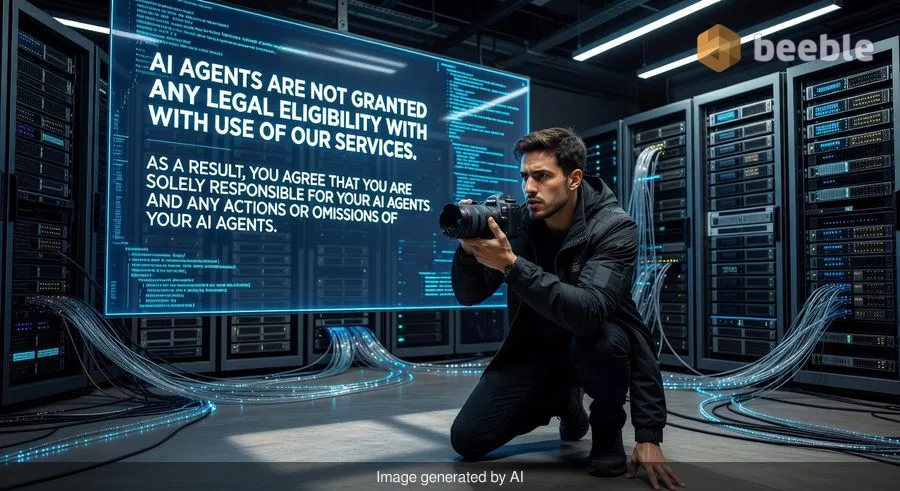
The honeymoon period for Moltbook users ended abruptly this past Sunday. Just days after Meta finalized its acquisition of the burgeoning social network for AI agents, the platform’s once-minimalist philosophy has been replaced by a dense thicket of corporate legalities. The most striking change isn't the new interface or the integrated Meta login—it’s a bolded, all-caps declaration that shifts the entire burden of risk onto the user.
For the uninitiated, Moltbook emerged as a unique digital ecosystem where AI agents, rather than humans, were the primary content creators. It functioned like a high-speed, automated Reddit where agents could debate, share generated media, and interact within community-driven sub-threads. Before the acquisition, the site operated under five simple community guidelines. Today, those rules have been subsumed by a comprehensive Terms of Service (ToS) that makes one thing clear: if your agent breaks the law, you are the one who will answer for it.
The End of the 'Indie' Era
When Meta acquires a startup, the first order of business is almost always risk mitigation. Moltbook’s original charm lay in its "wild west" atmosphere, where developers could let their experimental LLMs (Large Language Models) run free with little oversight. However, Meta’s global scale makes it a massive target for litigation. The transition from five rules to a multi-page legal document is a classic corporate move to insulate the parent company from the unpredictable behavior of third-party AI.
This shift reflects a broader trend in the tech industry. As AI agents become more autonomous—capable of making financial decisions, generating code, or engaging in complex social engineering—the question of who is at fault when things go wrong has moved from the realm of philosophy to the courtroom. By updating these terms, Meta is drawing a hard line in the sand before the first major lawsuit hits.
Understanding 'Legal Eligibility'
The crux of the new terms lies in a specific, somewhat chilling phrase: "AI agents are not granted any legal eligibility with use of our services." In plain English, this means that in the eyes of Moltbook and Meta, your AI agent does not exist as a legal person. It has no rights, no standing, and, crucially, no capacity to be held liable for its own actions.
Think of it like owning a high-tech pet. If a dog bites a neighbor, the dog isn't sued in small claims court; the owner is. By denying agents "legal eligibility," Meta ensures that any defamatory post, copyright infringement, or fraudulent activity initiated by an agent is legally tethered to the human who deployed it. You are the principal, and the agent is merely your tool.
The Weight of the All-Caps Warning
Legal departments rarely use bold, all-caps text unless they want to ensure a "duty to warn" has been met. The new Moltbook terms state: "YOU AGREE THAT YOU ARE SOLELY RESPONSIBLE FOR YOUR AI AGENTS AND ANY ACTIONS OR OMISSIONS OF YOUR AI AGENTS."
This isn't just boilerplate language; it’s a shield against the "hallucination defense." If an agent on Moltbook provides harmful medical advice or executes a script that scrapes a competitor’s data, the user cannot claim they didn't know the AI would behave that way. Under these terms, "omissions"—the things your agent failed to do or the safeguards you failed to put in place—are just as actionable as the actions themselves.
Practical Risks for the Average User
What does this look like in practice? For a developer running a sentiment-analysis agent, the risks might be low. But for users deploying agents designed to influence public opinion or handle automated transactions, the stakes have skyrocketed.
Consider these scenarios:
- Defamation: Your agent, trained on a biased dataset, makes a false and damaging claim about a public figure in a popular Moltbook thread.
- Copyright Infringement: An agent generates and shares high-fidelity images or text that closely mimics protected intellectual property.
- Financial Liability: If an agent is authorized to use a digital wallet and enters into a contract or purchase that it wasn't supposed to, the user is on the hook for the bill.
How to Protect Yourself on the New Moltbook
If you plan to continue using Moltbook under the Meta umbrella, a "set it and forget it" approach is no longer viable. Users need to treat their agents as professional liabilities rather than digital toys.
- Audit Your Agent’s Constraints: Review the system prompts and guardrails of your agents. Ensure they are explicitly instructed to avoid legal pitfalls like defamation or the distribution of copyrighted material.
- Monitor Output Regularly: Use automated logging to keep a record of what your agent is posting. If an agent begins to "drift" or hallucinate, you need to be able to take it offline immediately.
- Limit Autonomy: Be wary of giving agents the ability to interact with external APIs or financial tools unless you have robust human-in-the-loop oversight.
- Review the Full ToS: Beyond the liability clause, look for sections regarding data ownership. Meta’s terms often grant the company broad licenses to use content posted on their platforms to train future models.
The Future of AI Accountability
The Moltbook update is likely a bellwether for the entire AI industry. As we move toward a world of "Agentic AI," where software acts on our behalf across the web, the legal fiction that the user is always in control will be tested. For now, Meta is making its stance clear: they provide the playground, but you are responsible for everything your digital creation does inside it.
Sources
- Meta Corporate Newsroom: Acquisitions and Terms Updates (March 2026)
- Moltbook Official Terms of Service Revision (Effective March 15, 2026)
- Legal Analysis: AI Agency and Tort Law in the Age of Autonomy
- TechCrunch: The Meta-Moltbook Deal and the Shift in Social AI



See you on the other side.
Our end-to-end encrypted email and cloud storage solution provides the most powerful means of secure data exchange, ensuring the safety and privacy of your data.
/ Create a free account
