


Nvidia just spent 13 billion dollars to own the town square of artificial intelligence

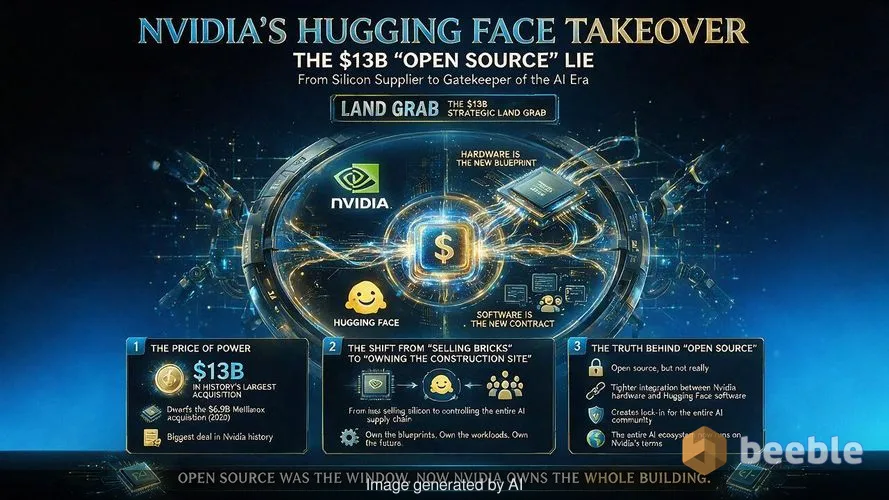
Most market analysts claim Nvidia is buying Hugging Face to support the spirit of open-source development. The reality is that this $13 billion acquisition is a strategic land grab to ensure that the global AI software community remains tethered to Nvidia hardware. While the company presents itself as a benevolent patron of open systems, it is actually securing the keys to the most important distribution channel in modern technology.
Nvidia has long been the primary source of the silicon used to train large-scale models. By purchasing Hugging Face, they are moving from just selling the bricks to owning the blueprints and the construction site. This deal marks the largest acquisition in Nvidia’s history, dwarfing the $6.9 billion spent on Mellanox in 2020. It signals a shift where the world’s most valuable company no longer wants to wait for demand to happen; it wants to manufacture that demand from the ground up.
A library for the digital age
To understand why a chip company would pay such a high price for a website with a hugging face emoji, you have to understand the role of a repository. In simple terms, Hugging Face is the library where the world stores its AI models. If a developer at a startup in Berlin or a researcher at a university in Tokyo needs a pre-trained model to recognize medical images or summarize legal documents, they go to Hugging Face.
The platform hosts 3 million models and about 500,000 datasets. It is the place where AI becomes practical. Think of AI as a tireless intern that can read a million pages in a second. Hugging Face is the HR department and the training manual that tells that intern how to behave. By owning this platform, Nvidia places itself at the center of every conversation about how AI is built and shared.
Why open weights matter for your budget
For the average user, the term "open weights" sounds like technical jargon, but it is actually the reason why AI might eventually become affordable. When a model is proprietary, like the ones from OpenAI or Anthropic, you have to pay a toll every time you use it. You send your data to their servers, they process it, and they charge you a fee.
Conversely, open-weight models are like public recipes. You can download the model, run it on your own computer, and customize it for your specific needs without paying a subscription to a tech giant. Nvidia CEO Jensen Huang believes that these open models are how AI will scale into everyday tasks across factories, hospitals, and farms. Practically speaking, if your local hospital wants to use AI to analyze X-rays without sending patient data to a third-party cloud, they need open models. Nvidia’s control over this ecosystem means they are the ones providing the tools that make this local, private AI possible.
The high price of corporate independence
Hugging Face has a history of trying to stay neutral. Only last year, the company turned down a $500 million investment from Nvidia because it wanted to avoid having a single dominant investor. The platform previously took money from a diverse group including Google, Amazon, and Intel to maintain its status as the Switzerland of the AI world.
The jump from a $7 billion valuation to a $13 billion sale price shows how volatile and aggressive the market for AI infrastructure has become. For Hugging Face, the deal provides a massive financial exit, but it also ends its era as an independent arbiter. While Nvidia promises that the platform will remain open to all chips and cloud providers, history shows that parent companies often find subtle ways to optimize their own products on the platforms they own.
Controlling the distribution pipe
Under the hood, this acquisition is about diversification. Currently, Nvidia relies on a handful of massive customers like Microsoft and Meta to buy its high-end chips. These customers are currently building their own processors to reduce their dependence on Nvidia.
By owning Hugging Face, Nvidia gains a direct line to 200,000 companies and 18 million developers who are not building their own chips. These users are the foundational layer of the next economy. If Nvidia can ensure that the models on Hugging Face run best on Nvidia hardware, they create a systemic advantage that competitors like AMD or Intel will find difficult to break. It is a streamlined way to ensure that the next generation of software is optimized for one specific brand of hardware before it even reaches the consumer.
Regulators are watching the new monopoly
This deal will not close overnight. Nvidia expects the process to take until 2027 because competition regulators in the US and Europe are likely to examine the transaction with extreme skepticism. There is a tangible concern that one company owning the most popular chips and the most popular model library creates an opaque barrier to entry for everyone else.
We have seen similar patterns in the past with Microsoft’s purchase of GitHub or LinkedIn. While those platforms remained functional for competitors, they also served as powerful funnels for the parent company’s other services. Regulators will have to decide if Nvidia’s influence over "open" AI is actually a way to close the market to anyone who does not use their silicon. The outcome of these reviews will determine if the AI boom remains a competitive race or becomes a one-company show.
What this means for your daily tech
Looking at the big picture, this acquisition suggests that the era of "cloud-only" AI is ending. Nvidia wants you to run AI on your own devices—provided those devices have Nvidia chips inside them.
| Aspect | Proprietary AI (OpenAI/Anthropic) | Open AI (Nvidia/Hugging Face) |
|---|---|---|
| Cost Structure | Pay-per-use subscriptions | Upfront hardware cost, low operating cost |
| Data Privacy | Data sent to external servers | Data stays on your local device |
| Customization | Limited by provider rules | Fully customizable for specific tasks |
| Internet Need | Always required | Can run offline once downloaded |
For a small business owner, this could mean buying a single powerful workstation to handle all customer service and inventory tracking locally, rather than paying thousands in monthly software fees. For the home user, it means smarter devices that do not stop working just because the internet goes down. The bottom line is that AI is shifting from a remote service to a local utility.
How to prepare for the local AI shift
Instead of worrying about which chatbot is the smartest this month, you should observe how your current hardware handles AI tasks. As Nvidia integrates Hugging Face deeper into its software stack, the advantage of having dedicated AI hardware in your laptop or office server will become more apparent.
Practically speaking, you should start prioritizing hardware with high VRAM (video memory) and dedicated AI processing units when making your next purchase. The shift toward open models means that the power of AI is moving from the data center to your desk. You should appreciate the invisible industrial mechanics that make this possible, but remain skeptical of any one company that claims to be the sole guardian of an open ecosystem. The most resilient digital strategy is to remain flexible and ensure your workflow can migrate between platforms, regardless of who owns the library.
Sources
- Nvidia official press release on Hugging Face acquisition, September 2026.
- Financial Times report on Nvidia's M&A strategy and the Mellanox comparison.
- Hugging Face developer community metrics and platform statistics.
- SEC filings regarding Nvidia's venture capital investments and long-term financial guarantees.



See you on the other side.
Our end-to-end encrypted email and cloud storage solution provides the most powerful means of secure data exchange, ensuring the safety and privacy of your data.
/ Create a free account
