


OpenAI is building its own silicon brain to cut out the middleman

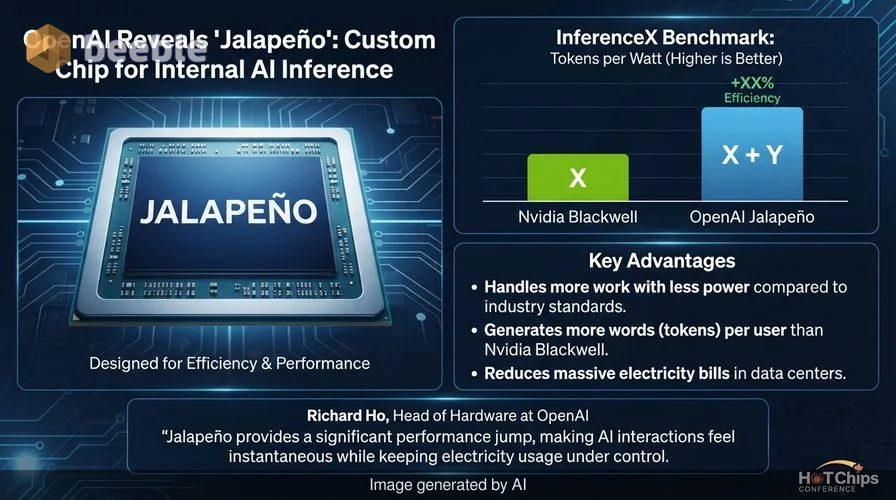
Every time you ask a chatbot to summarize a meeting or write a poem, a physical chain reaction begins. The text on your screen starts as a request that travels through miles of fiber optic cable to reach a data center. There, a slab of silicon and copper consumes enough electricity to power a lightbulb for several minutes just to guess the next three words of your response. This process is inference. For years, OpenAI relied on Nvidia to provide the hardware for this task. Now, OpenAI has revealed the first data on Jalapeño, a custom chip designed to handle the heavy lifting of AI internally.
At the Hot Chips conference, OpenAI shared the first public benchmarks for Jalapeño. The data shows that this new hardware handles more work with less power than current industry standards. Using the InferenceX benchmark from SemiAnalysis, Jalapeño generated more words, or tokens, for every user while using less electricity than Nvidia’s Blackwell architecture. Richard Ho, the head of hardware at OpenAI, states that the system provides a significant performance jump. The goal is to make AI interactions feel instantaneous while keeping the massive electricity bills of data centers under control.
The bottleneck in the digital kitchen
To understand why OpenAI is building its own hardware, think of AI inference like a busy restaurant kitchen. When you send a prompt, the system goes through two phases. The first is the prefill phase, where the AI reads your entire message and organizes its thoughts. This is like a chef reading a long, complicated recipe. The second phase is the decoding phase, where the AI actually writes the response one word at a time. This is like the chef actually plating the food.
Most modern chips are good at the plating part but struggle with the reading part. When a prompt is very long, the system slows down because data has to move back and forth between the processor and the memory. This movement creates heat and wastes time. Jalapeño addresses this friction by changing how the chip talks to its memory. OpenAI designed the chip to keep the model state local. In simple terms, the chef no longer has to walk across the kitchen to the pantry for every single ingredient. Everything stays on the counter, ready for immediate use.
This full-stack approach is only possible because OpenAI develops the software and the hardware at the same time. While a general-purpose chip from Nvidia has to work for every company from car manufacturers to weather forecasters, Jalapeño has one job. It runs OpenAI models. This specialization allows the company to minimize data movement and communication delays that usually act as bottlenecks in large-scale AI systems.
Chasing the moving target of state of the art
The benchmarks for Jalapeño are impressive, but they exist in a volatile market. OpenAI compared its new silicon to Nvidia’s Blackwell system, which is the current king of the data center. Jalapeño shows better throughput per kilowatt, which is the primary metric for efficiency in heavy industry. However, the timeline for deployment is long. Richard Ho noted that Jalapeño will only appear in very small volumes at the end of 2026. A meaningful rollout will not happen until 2027.
By the time 2027 arrives, the competition will have shifted. Nvidia is not standing still. The chip industry moves in cyclical waves, and Nvidia likely has two more generations of hardware in development before Jalapeño reaches full scale. OpenAI is essentially playing a game of leapfrog. To win, they must ensure their custom silicon is so much more efficient for their specific models that it justifies the billions of dollars spent on development. Historically, companies like Google and Amazon have found success with this strategy, but it requires a foundational shift in how a software company operates.
OpenAI collaborated closely with Broadcom to bring Jalapeño to life. Broadcom has a long history of helping tech giants build custom chips that connect different parts of a data center. Curiously, OpenAI even used its own AI models to help design the chip. This creates a feedback loop where the AI helps build the very brain it will eventually inhabit. As a result, the hardware is a reflection of the specific mathematical needs of large language models rather than a jack-of-all-trades processor.
What this means for your daily chat
For the average user, a chip announcement sounds like background noise in the tech world. Practically speaking, however, the efficiency of Jalapeño dictates how you interact with AI in the future. If inference costs remain high, AI companies have to limit how much you can use their tools. You might see caps on how many messages you can send or pay higher monthly subscriptions to cover the cost of the electricity and the hardware.
If Jalapeño delivers on its promise of more throughput per kilowatt, the cost of generating a response drops. This could lead to a tangible change in how AI products are priced. Instead of a flat monthly fee, we might see more generous free tiers or the ability to run much longer, more complex tasks without the system slowing down to a crawl. Low latency is the ultimate goal. When you talk to an AI assistant, you want the response to feel like a natural conversation, not like you are waiting for a letter to arrive in the mail.
On the market side, this move signals that OpenAI wants to be less dependent on the supply chains of other companies. The global market for high-end AI chips is decentralized but dominated by a few key players. By building its own silicon, OpenAI gains more control over its own destiny. They can choose exactly when to upgrade and how to optimize their data centers without waiting for a third-party shipping schedule. This resilience is vital for a company that serves hundreds of millions of people every week.
The invisible backbone of the AI era
We often treat AI like magic, but it is actually an industrial process. It requires physical materials, massive amounts of cooling water, and millions of transistors firing in unison. Jalapeño is a piece of that invisible backbone. By optimizing the prefill and communication phases, OpenAI is trying to make the digital intern faster and cheaper to employ. The company plans to make this a multigenerational platform, meaning Jalapeño is just the start of a long-term roadmap.
Zooming out, the move toward custom silicon represents a systemic shift in the tech industry. We are moving away from the era of the general-purpose computer toward a world of highly specialized machines. Just as a heavy-duty truck is built differently than a sports car, the chips inside AI servers are diverging from the chips inside your laptop. This specialization is what allows AI to move from a neat parlor trick to a robust tool for everyday life.
Ultimately, the success of Jalapeño depends on whether OpenAI can keep pace with the sheer speed of hardware innovation. Designing a chip is one thing; manufacturing and deploying it at scale across global data centers is a different challenge entirely. The 2027 deployment window gives the rest of the industry plenty of time to respond. For now, OpenAI has shown that it is no longer content just writing the software. It wants to own the very ground the software stands on.
From a consumer standpoint, you should watch how these developments impact the speed of your favorite apps. If responses suddenly feel snappier or if you can upload entire books for analysis without a wait time, the work happening under the hood of chips like Jalapeño is the reason. The era of generic AI hardware is ending, and the era of the purpose-built silicon brain has arrived.
Sources: OpenAI Press Briefing, Hot Chips 2026 Presentation, SemiAnalysis InferenceX Benchmark Report.



See you on the other side.
Our end-to-end encrypted email and cloud storage solution provides the most powerful means of secure data exchange, ensuring the safety and privacy of your data.
/ Create a free account
