


OpenAI is Turning Your Bank's AI From a Liability Into a Digital Shield

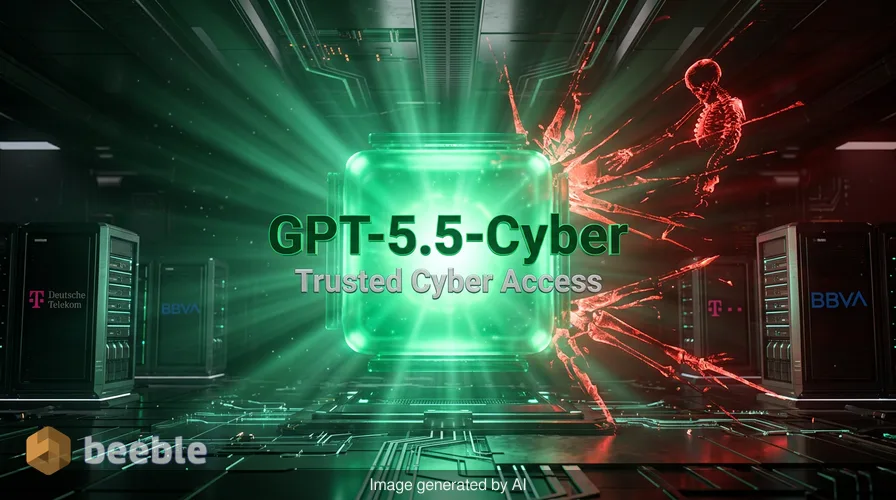
While the prevailing narrative suggests that artificial intelligence is the ultimate skeleton key—a tool destined to help hackers dismantle global finance and infrastructure—the reality unfolding in Europe suggests a different trajectory. For months, the headlines have been dominated by the fear that generative models would make cyberattacks so easy a child could execute them. However, OpenAI’s recent strategic pivot in Europe indicates that the most effective way to stop a digital thief isn't to lock the doors and hide; it is to hire a faster, more robust digital guard.
On Tuesday, OpenAI announced it is granting elite access to its most advanced models, including the specialized GPT-5.5-Cyber, to a select group of European heavyweights. Companies like Deutsche Telekom and BBVA are no longer just using AI to summarize meetings or draft emails. They are being integrated into the Trusted Access for Cyber program, a defensive initiative designed to shore up the systemic vulnerabilities that have kept IT departments awake at night for the last decade. Looking at the big picture, this isn't just a software update; it is a foundational shift in how critical infrastructure defends itself.
The Digital Immune System Under the Hood
To understand why this matters, we have to look at what GPT-5.5-Cyber actually does. Most of us interact with AI as a conversationalist or a creative partner, but for a cybersecurity expert at a bank, AI functions more like a digital immune system. It scans millions of lines of code to find the digital equivalent of a hairline fracture before a hacker can stick a crowbar into it.
Under the hood, these models have been trained to understand the logic of software vulnerabilities. Historically, finding a bug in a complex banking system required hundreds of man-hours and a deep well of specialized knowledge. GPT-5.5-Cyber streamlines this process by acting as a tireless intern that has read every coding manual and security patch ever written. It doesn't just flag a problem; it suggests a fix and tests that fix in a simulated environment before a human ever touches a keyboard.
Essentially, OpenAI is attempting to tip the scales. In the cat-and-mouse game of cybersecurity, the attacker usually has the advantage—they only need to find one hole, while the defender has to plug them all. By giving companies like Deutsche Telekom these tools, OpenAI is trying to automate the 'plugging' process at a speed that humans simply cannot match.
The Rivalry Heating Up the Frosty Tech Sector
This move didn't happen in a vacuum. The pressure reached a boiling point last month when Anthropic, OpenAI’s fiercest competitor, released its 'Mythos' model. Mythos sent shockwaves through the industry because of its unprecedented ability to write sophisticated, malicious code with minimal prompting. For a brief moment, the 'offensive' side of AI seemed to be winning the race.
From a consumer standpoint, the release of Mythos was a quiet alarm bell. If an AI can write code that bypasses a bank’s encryption, every savings account suddenly looks like a glass box. OpenAI’s response—the Trusted Access program—is a direct counter-maneuver. Emmanuel Marill, OpenAI’s Managing Director for EMEA, noted that while they must block dangerous activity, they have to ensure 'trusted defenders' aren't fighting a high-tech war with low-tech tools.
Curiously, the European Commission has played a central role in this rollout. While Brussels is often seen as a strict regulator that keeps tech giants at arm’s length, it has welcomed OpenAI’s transparency. George Osborne, the former British finance minister now leading the OpenAI for Countries initiative, has been lobbying hard to show that democratizing access to these defensive tools is a matter of public safety. In a letter to the Commission, he argued that this move reflects European priorities: transparency, resilience, and safety. Meanwhile, Anthropic has reportedly been less forthcoming with its defensive features, creating a stark contrast in how these two giants approach the shifting regulatory landscape of the EU.
Scaling the Fortress: A $4 Billion Bet
Behind the jargon of 'cyber resilience' lies a massive financial play. OpenAI isn't just handing out passwords to its new models; it is building an entirely new industrial arm. The company announced a fresh $4 billion investment to establish a unit dedicated to helping organizations deploy these systems.
To put it another way, OpenAI is transforming from a research lab into a heavy-duty industrial consultant. Their acquisition of Tomoro, a specialized AI consulting firm, is the final piece of the puzzle. Tomoro’s expertise lies in scaling AI across massive, interconnected organizations. For a company like BBVA, which manages the financial data of millions, you can't just 'install' AI like you would an app on your phone. It requires a systemic overhaul of how data flows through the company.
| Feature | Standard GPT-5 | GPT-5.5-Cyber (Trusted Access) |
|---|---|---|
| Primary Use | General productivity & creativity | Vulnerability detection & patch generation |
| Access Level | Public / Enterprise API | Verified Vital Infrastructure Only |
| Code Analysis | High-level debugging | Deep-tier systemic exploit testing |
| Safeguards | General content filters | Defensive-only logic gates |
| Support | Standard documentation | Direct engineering collaboration via Tomoro |
What This Means for Your Daily Life
You might wonder how a multi-billion dollar deal between a Silicon Valley giant and a Spanish bank affects your Tuesday morning. Practically speaking, the impact is invisible but profound. When we talk about 'resilience' in the energy or banking sectors, we are talking about the reliability of the grid and the safety of your paycheck.
Imagine the financial system as the digital crude oil of our modern economy. If that oil stops flowing because of a ransomware attack, everything from the grocery store scanner to your gas pump stops working. By bolstering these companies, OpenAI is essentially reinforcing the invisible backbone of modern life. For the average user, this should lead to fewer service outages and a lower risk of 'identity fatigue'—that soul-crushing experience of receiving yet another email saying your data has been compromised in a breach.
However, there is a reason for mild skepticism. By becoming the primary defender for Europe’s biggest companies, OpenAI is also becoming a single point of failure. If everyone uses the same 'digital guard,' a flaw in that guard’s logic could leave the entire continent vulnerable at once. It is a volatile trade-off: we gain the robust protection of a global leader, but we lose the diversity of defense that comes from having many different, decentralized systems.
Practical Foresight: Watching the Watchmen
Ultimately, the move by OpenAI signals that the era of 'AI as a toy' is officially over. We have entered the era of 'AI as infrastructure.' As these models become embedded in the public services and utilities we rely on, your role as a consumer is to stay informed but grounded.
In the coming months, observe how your digital habits interact with these more resilient systems. You might notice more frequent security updates on your banking apps or more transparent disclosures about how your data is being used to 'train defensive protocols.' Don't view these as annoyances; view them as the maintenance work on the digital fortress being built around your data.
The bottom line is that the AI revolution is no longer just about who can make the funniest image or the best summary. It is about who can keep the lights on and the money safe. As OpenAI scales up its new $4 billion unit and begins integrating into the heart of European industry, the goal is to ensure that while the thieves get smarter, the house gets even harder to break into. It is a high-stakes game of chess, and for now, the defenders are finally starting to move their most powerful pieces.
Sources:
- OpenAI EMEA Press Office: Official Announcement on Trusted Access for Cyber.
- European Commission Digital Transition Report (May 2026).
- Financial Times: Analysis of Anthropic's 'Mythos' and Market Reaction.
- BBVA and Deutsche Telekom Joint Statement on Cyber Resilience Partnerships.



See you on the other side.
Our end-to-end encrypted email and cloud storage solution provides the most powerful means of secure data exchange, ensuring the safety and privacy of your data.
/ Create a free account
