


OpenAI Just Taught Its Image Generator to Finally Read and Write
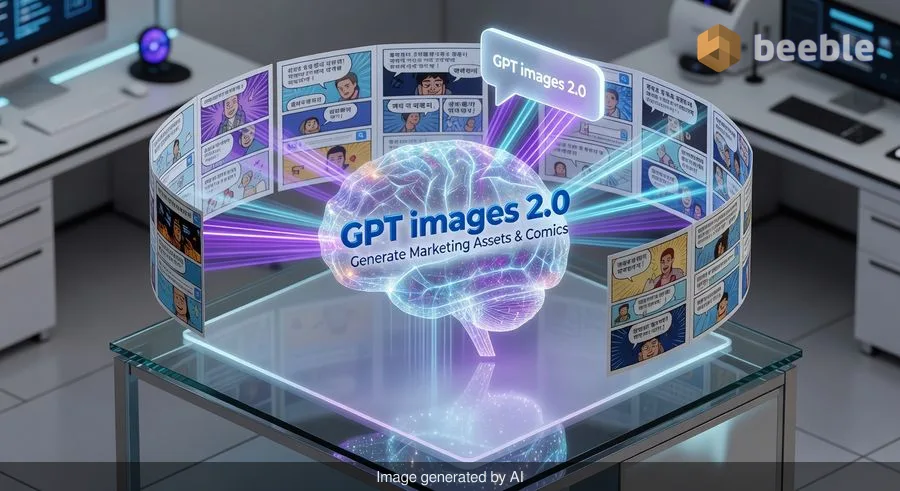
For years, the easiest way to spot an AI-generated image was to look for the signs of a digital stroke. You’d see six-fingered hands, eyes that didn’t quite match, and, most famously, a complete inability to spell. If you asked an AI to draw a "Cafe" sign in 2023, you were likely to get "Cafféé" or a series of alien runes that looked like they belonged in a sci-fi prop room. We laughed at it, made memes about it, and used it as a comforting reminder that the machines weren't quite ready to take over the graphic design department just yet.
While the popular narrative suggested that AI was simply "too creative" to be bothered by the rigid rules of the alphabet, the reality was much more technical. But with the release of ChatGPT’s Images 2.0, that narrative has officially shifted. This isn't just a minor patch or a slightly faster engine; it is a foundational change in how AI "sees" the relationship between pixels and language.
Why AI Historically Failed the Spelling Bee
To understand why this is a disruptive leap, we have to look under the hood at how image generators used to work. Historically, these tools relied almost exclusively on diffusion models. In simple terms, a diffusion model is like a sculptor starting with a block of static—pure digital noise—and slowly carving away the bits that don't look like your prompt.
Asmelash Teka Hadgu, the CEO of Lesan AI, noted back in 2024 that these models were essentially trying to reconstruct an input from chaos. Because text on a sign or a t-shirt usually only covers a tiny fraction of the total pixels in an image, the model’s math prioritized the big stuff—the lighting, the textures, the shapes of faces—while treating the letters as minor stylistic patterns. To the AI, the letter "A" wasn't a linguistic symbol; it was just a specific arrangement of lines that it often blurred into the background noise.
Looking at the big picture, this meant that while AI could paint a masterpiece in the style of Van Gogh, it couldn't write a coherent grocery list on a post-it note. It was a tireless intern with an incredible eye for color but a profound case of dyslexia.
The Shift to Autoregressive Thinking
Images 2.0 moves away from this "noise-to-image" sculpting and toward something more akin to how Large Language Models (LLMs) like GPT-4 actually function. While OpenAI has been characteristically opaque about the exact architecture, industry analysts point toward autoregressive modeling.
To put it another way, instead of trying to de-noise a whole image at once, the model now makes predictions about what the next part of the image should look like based on what it has already drawn. This makes the process much more deliberate. When the model "thinks," it isn't just generating pixels; it’s following a logical chain of requirements.
| Feature | Old Diffusion Models | Images 2.0 (Autoregressive) |
|---|---|---|
| Text Accuracy | Frequent "gibberish" or runic symbols | High fidelity Latin and non-Latin scripts |
| Logical Consistency | Struggles with multi-step instructions | Can generate multi-panel comic strips |
| Workflow | One-shot generation | "Thinks," searches web, and double-checks |
| Resolution | Usually capped at 1024px | Professional-grade up to 2K |
| Language Support | Primarily English-centric | Robust Hindi, Japanese, Korean, Bengali |
Practically speaking, this means the model can now handle "dense compositions." If you ask for a UI element for a mobile app—a task that would have produced a blurry mess a year ago—Images 2.0 can render the buttons, the labels, and the icons with the precision of a professional wireframing tool.
The "Thinking" Layer: AI as a Deliberate Creator
One of the most intriguing additions to Images 2.0 is what OpenAI calls "thinking capabilities." This isn't just marketing jargon; it represents a systemic change in the generation workflow. In previous versions, you hit "enter," and the model gave you its best guess in five seconds.
With Images 2.0, the process is more cyclical. The model can now search the web for visual references, create multiple versions of an image to see which one fits the prompt best, and even double-check its own work for errors. For the average user, this means the era of the "one-shot prompt" is ending. You are no longer just throwing a dart at a board; you are collaborating with a tool that understands context.
For example, if you are a small business owner trying to create marketing assets, you can now request a single brand identity and have the model output it in various sizes—Instagram square, LinkedIn banner, and 2K print resolution—while maintaining the exact spelling of your brand name across all of them. This is a scalable solution that moves AI from a "toy" category into a legitimate industrial backbone for content creation.
Breaking the Language Barrier
Beyond just spelling English words correctly, Images 2.0 has made an unprecedented leap into non-Latin scripts. Rendering languages like Hindi, Bengali, Japanese, and Korean has been a notorious bottleneck for AI. These scripts often involve complex ligatures and character strokes that diffusion models simply couldn't track.
By improving its understanding of these scripts, OpenAI is tapping into a massive, emerging global market. For a creator in Mumbai or Tokyo, the ability to generate high-fidelity UI designs or advertising posters in their native script without needing to manually Photoshop the text later is a tangible productivity win. This democratization of design tools is a recurring theme in the tech sector, where the goal is to make the interface as intuitive as possible for a global audience.
The Pragmatic Reality: Speed and Limitations
However, as a journalist who has covered the volatile swings of the AI market, I must offer a reality check. There is a trade-off for this newfound "intelligence." Because the model is "thinking" and double-checking its work, generation is no longer instantaneous.
Creating a complex, multi-panel comic strip can take several minutes. In our world of instant gratification, this might feel like a step backward, but from a professional standpoint, a three-minute wait for a 2K resolution, perfectly spelled asset is still orders of magnitude faster than a three-hour session in Adobe Illustrator.
Furthermore, there is the issue of the knowledge cutoff. With the model's data ending in December 2025, it lacks awareness of very recent visual trends or news events from the first quarter of 2026. If you’re trying to generate imagery based on a meme that went viral last week, the model might struggle with the specific nuances, even if its spelling is perfect.
On the market side, the pricing of the new gpt-image-2 API will likely be the next big talking point. High-resolution, "thinking" models require significant compute power. This isn't digital crude oil that flows for free; it’s a refined product, and the tiered pricing for paid users reflects the heavy industrial costs of running these massive server farms.
What This Means for You
Ultimately, Images 2.0 signals that AI is moving out of its "hallucination phase" and into its "utility phase."
For the everyday user, this means you can finally use ChatGPT to create actual, usable documents. You can design a birthday invitation that actually says "Happy Birthday" instead of "Hapy Birrrth." You can mock up a storefront for your side hustle. You can create educational infographics where the labels are actually readable.
For the creative industry, the shift is more systemic. We are seeing a move toward "prompt-to-production" where the AI isn't just a source of inspiration but a tireless assistant capable of handling the grunt work of formatting, resizing, and proofreading.
As we move forward, the most important skill won't be knowing how to "trick" the AI into spelling a word correctly. It will be knowing how to direct its "thinking" process to achieve a specific, high-fidelity result. We should stop viewing these tools as magic boxes and start seeing them as highly sophisticated, albeit sometimes slow, digital interns.
Observe your own digital habits over the next few weeks. You might find that the need for a separate graphic design tool for simple text-based images begins to evaporate. The invisible backbone of the design world is shifting, and for once, the machines are finally reading the fine print.
Sources:
- OpenAI Official Press Release (April 2026)
- TechCrunch Analysis on Diffusion vs. Autoregressive Models (2024-2026)
- Lesan AI Technical Briefings
- Codex Developer Documentation for gpt-image-2 API



See you on the other side.
Our end-to-end encrypted email and cloud storage solution provides the most powerful means of secure data exchange, ensuring the safety and privacy of your data.
/ Create a free account
