


OpenAI’s GPT-5.5 Is Not the Revolution You Expected—And That Is Exactly Why It Matters

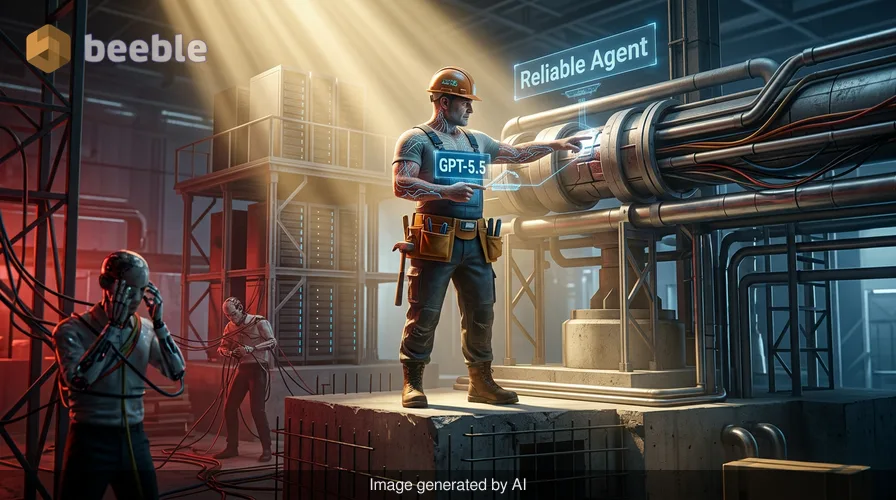
While the tech echo chamber has spent the last year prophesying the arrival of a digital god, the release of GPT-5.5 suggests a very different reality. For months, the narrative surrounding the next leap in artificial intelligence has been obsessed with "emergence"—the idea that if we just throw enough data and electricity at a model, it will suddenly wake up and solve cold fusion. However, looking at the big picture, GPT-5.5 isn't a radical departure from its predecessors. Instead, it is a masterclass in refinement, shifting the focus from raw power to a more resilient, systemic reliability.
Practically speaking, we are moving away from the era of the "chatty chatbot" and into the era of the "reliable agent." If early AI was a tireless intern who occasionally lied to impress you, GPT-5.5 is more like a seasoned foreman who knows exactly where the structural weaknesses in a project are before you even point them out. For the average user, the shift is subtle but foundational.
Under the Hood: The Move from Prediction to Reasoning
To understand why GPT-5.5 is a turning point, we have to look at how it actually processes information. Historically, large language models (LLMs) operated like high-speed autocomplete on steroids. They were incredibly good at predicting the next word in a sentence, but they often lacked a coherent "world model." They knew that the word "apple" often followed "red," but they didn't truly understand gravity or why an apple falls.
Under the hood, GPT-5.5 utilizes what researchers call native multimodality and enhanced inference-time compute. In simple terms, this means the model doesn't just translate text into images or audio; it processes all these inputs simultaneously in a single, interconnected neural space. When you show the model a video of a leaking pipe, it isn't just "tagging" the video with keywords. It is simulating the physics of the water flow.
| Feature | GPT-4o (2024) | GPT-5.5 (2026) |
|---|---|---|
| Core Architecture | Text-focused with Vision patches | Native Multimodal (Holistic) |
| Reasoning Speed | Near-instant (often impulsive) | Variable (System 2 thinking) |
| Context Window | 128k tokens | 2M+ tokens (Scalable) |
| Reliability | Moderate (hallucination prone) | High (self-correcting logic) |
| Consumer Cost | Subscription-based | Usage-tiered / Integrated |
Curiously, OpenAI has introduced a feature that allows the model to "pause and think" before responding. Instead of blurting out the first statistically likely answer, GPT-5.5 runs internal simulations to verify its logic. This makes the model feel slightly slower for complex tasks, but it drastically reduces those confident errors that plagued earlier versions.
The Shift Toward Agentic Behavior
For the average user, the most tangible change isn't in how the AI talks, but in what it can do. We are seeing the rise of "agentic" AI—systems that don't just answer questions but execute multi-step workflows.
Imagine you are planning a cross-country move. In 2024, you might have asked an AI for a checklist. In 2026, with GPT-5.5, you give it access to your email and budget. The model then identifies local moving companies, negotiates quotes based on your history, drafts the contracts, and schedules the utility shut-offs. It isn't just a search engine; it’s a decentralized coordinator.
This is where the "So What?" filter comes in. This level of autonomy requires a robust level of trust. Because GPT-5.5 is more transparent about its decision-making process—often showing its work in a sidebar—it moves away from being an opaque black box. From a consumer standpoint, this is the difference between a tool you play with and a tool you rely on for your livelihood.
The Market Side: Digital Crude Oil
On the market side, GPT-5.5 represents a volatile shift in the tech ecosystem. If microchips are the digital crude oil of our era, then refined models like GPT-5.5 are the high-octane fuel powering the next generation of hardware. We are seeing an overarching trend where software is no longer just an app on your phone; it is the invisible backbone of the device itself.
This release puts immense pressure on competitors like Google and Anthropic. While the hardware side (NVIDIA and its peers) continues to deal with the cyclical nature of supply chains, the software side is becoming increasingly streamlined. OpenAI is betting that by making the model more efficient, they can lower the "cost per intelligence unit," making it affordable for small businesses to integrate deep AI into their operations without breaking the bank.
However, there is a systemic risk here. As we become more dependent on these foundational models, any downtime or bias in the system creates a ripple effect across the global economy. If a decentralized finance (DeFi) app relies on GPT-5.5 to audit its smart contracts and the model has a blind spot, the fallout could be unprecedented.
Practically Speaking: What This Means for You
Ultimately, the arrival of GPT-5.5 isn't about a talking robot; it’s about the democratization of high-level logic. Here is how it hits your daily life:
- The End of "Prompt Engineering": You no longer need to speak to the AI like a programmer. Its intuitive understanding of intent means you can be vague, and it will ask clarifying questions rather than guessing.
- Education Transformation: For students, the AI is shifting from a ghostwriter to a Socratic tutor. It can analyze a student's mistake in a math problem and explain the underlying conceptual error rather than just providing the correct answer.
- Privacy Trade-offs: To get the most out of an agentic model, you have to give it more data. The trade-off between convenience and privacy is becoming more acute. You’ll need to decide if the time saved on admin work is worth the granular access the model requires.
The Bottom Line
Looking at the historical parallel of the early internet, we are currently in the "broadband era" of AI. The initial novelty of the "dial-up" (GPT-3) has faded, and we are now building the infrastructure that will define the next decade. GPT-5.5 is a signal that the era of AI as a novelty is over.
Instead of waiting for a sci-fi moment where the sky turns red and the machines take over, look at your digital habits. Notice the moments where the friction of daily life—scheduling, filing, researching, and organizing—starts to disappear. That invisible smoothing of the world is the real disruptive force of GPT-5.5. It is less about a leap in intelligence and more about a leap in utility.
Shift your perspective: don't ask what the AI can tell you. Start observing what it can do for you while you aren't even looking. The future of AI isn't a conversation; it's a quiet, resilient partner working in the background.
Sources:
- OpenAI Official Technical Blog: "GPT-5.5 Architecture and Safety Protocols"
- Global Tech Review: "The Economic Impact of Agentic Systems in 2026"
- Bureau of Labor and Technology: "Quarterly Report on AI Integration in Small Business"
- International Standard for AI Transparency: "2026 Model Reliability Benchmarks"



See you on the other side.
Our end-to-end encrypted email and cloud storage solution provides the most powerful means of secure data exchange, ensuring the safety and privacy of your data.
/ Create a free account
