


OpenAI’s High-Stakes Gambit: Why a 17.5% Guarantee is the New Price of Enterprise Dominance

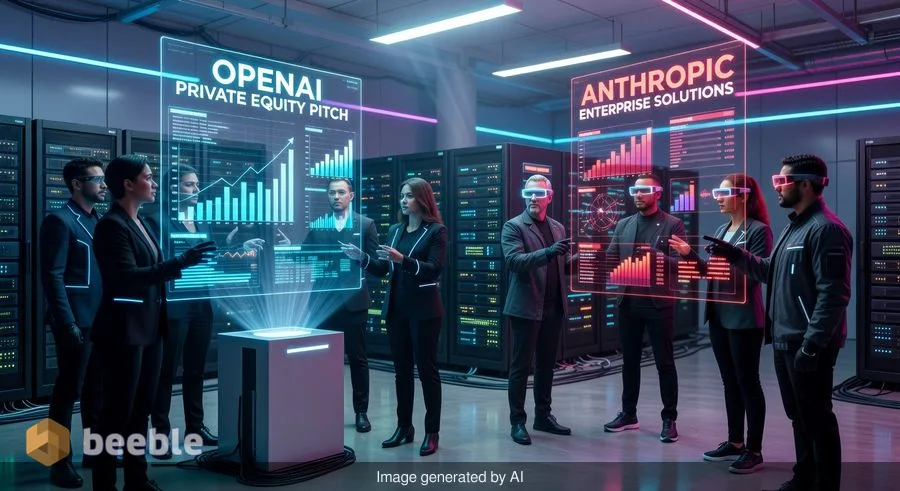
Have you ever wondered what happens when the world’s most ambitious AI lab realizes that being the most recognizable brand isn't enough to win the enterprise? We are currently witnessing a paradigm-shifting moment in the technology sector, where the battle for artificial intelligence supremacy has moved out of the research labs and into the mahogany-rowed offices of private equity firms.
As of March 2026, the landscape of generative AI has matured from a series of flashy demos into a robust, multifaceted infrastructure play. OpenAI, the creator of ChatGPT, is currently locked in a fierce turf war with its rival, Anthropic. To tip the scales, OpenAI is reportedly sweetening the pot for private equity giants like TPG and Advent with a deal that feels more like a high-yield bond than a typical tech investment. By offering a guaranteed minimum return of 17.5%, OpenAI is signaling that it is willing to pay a premium to secure the keys to the world’s most established corporate portfolios.
The Math of the Moat: Why 17.5% Matters
In the world of high-finance, a 17.5% guaranteed return is an unprecedented carrot to dangle. For context, typical preferred instruments in the tech world rarely reach these heights without significant strings attached. OpenAI is essentially treating its capital raise as a strategic bridge to enterprise ubiquity. Curiously, this aggressive financial maneuvering comes at a time when the cost of compute continues to skyrocket, making fresh capital not just a luxury, but a necessity for survival.
To put it another way, OpenAI is treating its latest funding round as a way to bypass the friction-heavy process of individual corporate sales. By partnering with buyout firms, they gain immediate, seamless access to hundreds of private, established companies already under the management of these firms. It is a brilliant, if precarious, strategy: if you can’t knock on every door, buy the person who holds the master key.
Anthropic’s Defensive Wall and the Enterprise Pivot
For years, Anthropic has been viewed as the more "buttoned-up" sibling in the AI ecosystem. Their focus on "Constitutional AI" and safety-first architectures made them the darling of risk-averse CTOs. In practice, Anthropic’s enterprise-focused deals have historically been stronger because they spoke the language of compliance and reliability. However, OpenAI’s recent pivot suggests they are no longer content with being the consumer favorite; they want the entire stack.
In contrast to OpenAI’s lucrative 17.5% offer, Anthropic’s recent pitches to private equity have lacked such high-yield guarantees. While Anthropic relies on the sophisticated, nuanced nature of its models to win over partners, OpenAI is using raw financial leverage. This creates a volatile environment where the "better" technology might be sidelined by the more aggressive business model.
Training the Apprentice: AI as a Living Organism
I often think of training a cutting-edge AI model as less like writing code and more like raising an apprentice. In my early days working at a high-growth tech startup, we often struggled with the "Engineering vs. Product" tug-of-war. The engineers wanted to build the most elegant, scalable solution, while the product team just wanted something that worked for the customer yesterday.
OpenAI’s current strategy reflects this same tension. By offering early access to its newest, most innovative models as part of these joint ventures, they are essentially placing their most advanced "apprentices" directly into the workflows of legacy companies. This allows them to bypass the "Software Archaeology" phase where new tools struggle to integrate with undocumented monoliths. Instead, they are building the infrastructure from the inside out.
The Portfolio Play: Scaling Through Synergy
Why are firms like TPG and Advent so attractive to these AI giants? Essentially, these organizations function as living organisms with massive reach. A single private equity firm might own a healthcare provider, a logistics company, and a retail chain. If OpenAI can integrate its tools across that entire portfolio, the resulting data fly-wheel becomes a remarkable competitive advantage.
As a result, the AI becomes a utility grid, much like the cloud was a decade ago. But unlike the cloud, which was largely about storage and compute, this new layer is about intelligence. Consequently, the company that controls the enterprise AI layer will likely dictate the pace of innovation for the next decade.
The Risks of the High-Yield Strategy
Nevertheless, this strategy is not without its pitfalls. High guaranteed returns create a massive amount of pressure on OpenAI to deliver immediate commercial results. In the tech world, we often talk about technical debt as financial debt, but here, the financial debt is literal. If the enterprise adoption doesn't scale as quickly as anticipated, the 17.5% guarantee could become a heavy anchor.
Oddly enough, we’ve seen this movie before in other sectors. When a company prioritizes rapid market share through aggressive financial incentives, it can lead to a "burn-fast" culture that ignores long-term stability. Even so, OpenAI seems to believe that the winner-takes-all nature of AI justifies the risk. They are betting that once a company integrates their sleek, intuitive models into their daily operations, the "stickiness" will be high enough to offset the initial cost of the deal.
What This Means for the Future of Work
For the average developer or IT manager, this enterprise turf war is more than just a headline. It means that the tools you use at work are about to be chosen not just by your CTO, but by the private equity firm that owns your company. We are moving toward a future where AI integration is a top-down mandate rather than a bottom-up adoption.
To prepare for this shift, consider the following steps:
- Audit Your Legacy Systems: Understand where your "undocumented monoliths" are. AI integration is only as good as the data it can access.
- Evaluate Ecosystem Lock-in: As OpenAI and Anthropic build these bridges, the cost of switching models will only increase. Choose your partner wisely.
- Focus on AI Literacy: Regardless of which model wins, the ability to manage these "AI apprentices" will be the most valuable skill in the 2026 job market.
As we look toward the horizon, it’s clear that the AI race has entered a new, more aggressive chapter. The question is no longer just who has the best model, but who has the best deal.
Are you ready to integrate AI into your core business processes, or are you still treating it as a peripheral experiment? Now is the time to decide where your loyalties lie before the infrastructure of the next decade is locked in.
Sources
- Internal reports on OpenAI and Anthropic private equity negotiations.
- Financial disclosures regarding TPG and Advent International investment strategies.
- Comparative analysis of AI enterprise adoption rates 2024-2026.
- Industry briefings on high-yield preferred equity instruments in Silicon Valley.



See you on the other side.
Our end-to-end encrypted email and cloud storage solution provides the most powerful means of secure data exchange, ensuring the safety and privacy of your data.
/ Create a free account
