


OpenAI’s 'Superapp' Strategy: Why Merging ChatGPT, Codex, and Atlas Changes Everything

Is the Era of the Standalone Chatbot Already Over?
For the past few years, our interaction with artificial intelligence has been largely transactional and fragmented. We open one tab to ask ChatGPT for a summary, another to let Codex help us debug a script, and a third to search the web for the latest market data. It is a workflow that feels increasingly like a digital scavenger hunt. However, a leaked internal memo from OpenAI suggests this friction is about to disappear. Fidji Simo, OpenAI’s chief of applications and the former CEO of Instacart, reportedly informed staff on Thursday that the company is consolidating its desktop presence into a single, unified “superapp.”
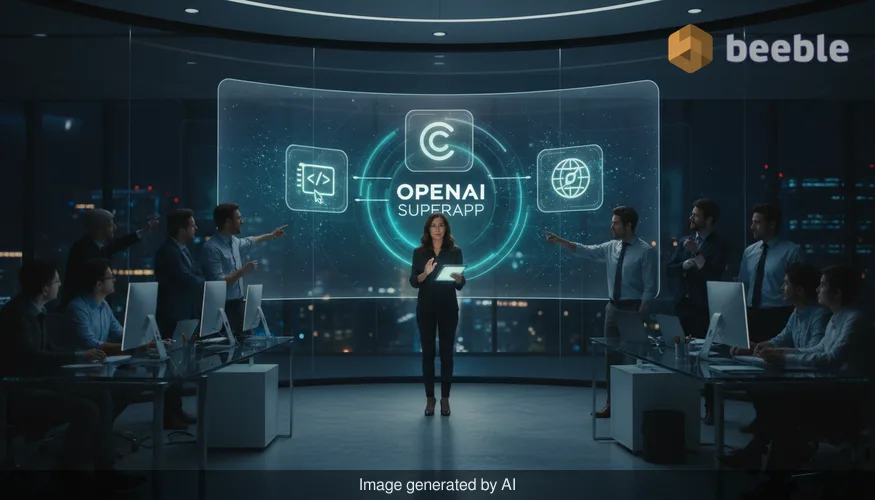
This move aims to weave ChatGPT, the Codex programming engine, and the long-rumored “Atlas” web browser into one cohesive environment. Curiously, this shift mirrors the way biological organisms evolve; rather than maintaining separate, specialized limbs that don’t communicate, OpenAI is building a central nervous system for our digital lives. To put it another way, they are moving from providing a set of tools to offering a complete ecosystem.
The Anatomy of a Superapp
What does a “superapp” actually look like in a professional context? According to the report, the new desktop application isn't just a wrapper for a website. It is a deep integration that allows the AI to see what you see and act where you work.
- ChatGPT as the Interface: The conversational layer remains the primary way we interact, but it now possesses a much higher “situational awareness.”
- Codex as the Engine: No longer relegated to a sidebar for developers, Codex will likely handle the intricate background automation—executing scripts, managing file systems, and connecting disparate software APIs.
- Atlas as the Eyes: This is the most transformative piece of the puzzle. Atlas isn't just a browser; it’s a web-navigation layer that allows the AI to browse the live web alongside the user, pulling in real-time data without the user needing to leave the app.
Consequently, the boundary between “searching” and “doing” begins to blur. If you are a project manager, the superapp might see an incoming email about a budget shift, browse your internal spreadsheets via Atlas, and rewrite a Python script via Codex to update your data visualizations—all within one window.
Why Now? The Pressure of the AI Arms Race
OpenAI’s decision didn't happen in a vacuum. The competitive landscape has become increasingly precarious. Anthropic’s Claude has gained significant momentum with its “Artifacts” feature, which allows users to view code, documents, and websites side-by-side with the chat. For OpenAI, maintaining three separate products was becoming a liability.
In contrast to the lean, focused approach of its early days, OpenAI is now operating like a massive living organism that must adapt or be outcompeted. The appointment of Fidji Simo was a clear signal of this intent. During her time at Instacart, she mastered the art of the “complex transaction”—getting a user from a craving to a delivered grocery bag with minimal friction. She is now applying that same logic to information.
A Personal Perspective on the Friction of Tool Sprawl
Reflecting on my own journey working in tech startups, I remember the early days of remote work where we were constantly toggling between Slack, Jira, and various IDEs. We called it “context switching,” but in reality, it was a cognitive tax that drained our productivity. I once managed a remote team where we spent nearly 20% of our week just syncing data between different platforms.
This is why the superapp concept feels so remarkable to me. It addresses the fundamental exhaustion of the modern knowledge worker. When your tools are nuanced enough to understand the context of your entire workflow, the “journey” of a workday becomes significantly less taxing.
The Risks of a Unified Ecosystem
Nevertheless, this consolidation is not without its risks. Whenever a single entity controls the browser, the code engine, and the primary communication interface, we must ask questions about privacy and data silos.
- Privacy Concerns: If the superapp is “always on,” how much of our screen data is being processed?
- Monopoly of Logic: If we rely on one engine (Codex) to write our automation, we become dependent on OpenAI’s specific way of solving problems.
- Resource Intensity: Running a browser and a heavy AI model in a single desktop app can be a significant drain on local hardware, potentially alienating users without high-end machines.
What This Means for Your Workflow
As we move toward this unified future, the way we build our careers and businesses will need to shift. We are moving away from being “operators” of software and toward being “orchestrators” of AI agents.
To prepare for this transition, consider the following steps:
- Audit Your Subscriptions: If you are paying for separate AI coding assistants and search tools, look for consolidation opportunities as the superapp rolls out.
- Master Prompt Engineering for Action: Start focusing on how to tell an AI to do something across multiple steps, rather than just asking it to write something.
- Prioritize Data Cleanliness: A superapp is only as good as the data it can access. Ensure your internal files and projects are well-organized so the AI can navigate them effectively.
Looking Ahead
The move to merge ChatGPT, Codex, and Atlas is a bold bet that the future of computing isn't about more apps, but about one app that does more. It is an innovative leap that could redefine the desktop experience for the first time in decades. Whether this will lead to a more efficient world or a more closed one remains to be seen, but the era of the fragmented AI is clearly drawing to a close.
Sources
- Internal OpenAI Memo (March 2026), as reported by industry analysts.
- OpenAI Product Roadmap Briefings regarding Project Atlas.
- Comparative analysis of Anthropic Claude Artifacts vs. OpenAI Desktop.
- Biographical data on Fidji Simo and her strategic shifts at Instacart and OpenAI.



See you on the other side.
Our end-to-end encrypted email and cloud storage solution provides the most powerful means of secure data exchange, ensuring the safety and privacy of your data.
/ Create a free account
