


Silicon Valley Is Finally Learning That Speaking 'Indian' Is Much More Than Just Translating English

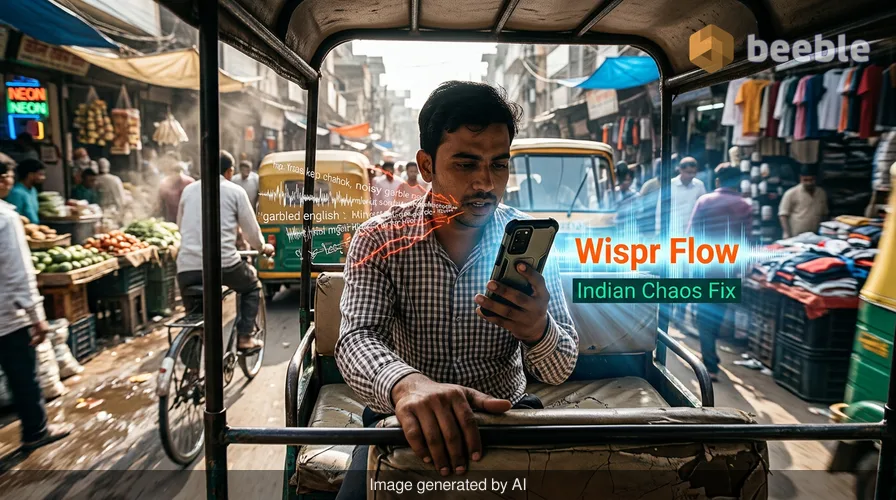
Have you ever tried to dictate a quick text message while walking through a crowded market or sitting in a noisy auto-rickshaw? If you live in a place like Delhi, Mumbai, or Bengaluru, you know the drill: you speak clearly into your phone, but the AI—trained in a quiet lab in California—turns your request into a garbled mess of confusion. It misses the nuances of your accent, fails to understand your mixture of Hindi and English, and completely ignores the background honking. Why is it that in 2026, with AI supposedly capable of writing poetry and coding software, it still can’t accurately capture a simple voice note from a commuter in India?
This is the precise problem that Wispr Flow is trying to solve. While the tech giants have historically treated the Indian market as a secondary localized project, Wispr is treating it as the ultimate stress test. They are betting that if you can make voice AI work flawlessly in the linguistic chaos of the Indian subcontinent, you can make it work anywhere. But as anyone who has tried to build a scalable business here knows, the road between a Silicon Valley pitch deck and a practical, resilient product in India is paved with unique challenges.
The Puzzle of 'Hinglish' and Code-Switching
To understand why this is difficult, we have to look under the hood at how most voice models are built. Traditionally, an AI is trained on massive datasets of a single language—English, Spanish, or Mandarin. However, for the average user in India, language isn't a silo; it’s a spectrum. Most people communicate using 'code-switching,' the practice of alternating between two or more languages in a single sentence. You might start a sentence in Hindi, pivot to an English technical term, and end with a Punjabi colloquialism.
For a standard AI, this is a nightmare. To put it another way, imagine hiring a tireless intern who is a genius at English but has never heard a word of Marathi or Tamil. When you speak to them in a blend of both, they don't just get confused; they often hallucinate, filling in the gaps with words that sound similar but mean nothing in context. Wispr Flow’s approach involves training models that aren't just multilingual but are 'inter-lingual'—built specifically to anticipate the shifting grammar and vocabulary of a population that treats language as a fluid tool rather than a rigid set of rules.
Speed as a Foundational Requirement
Beyond the language barrier, there is the issue of latency. In the fast-paced world of digital work, voice dictation is only useful if it is instantaneous. If you have to wait three seconds for the AI to process your voice and turn it into text, you might as well have typed it yourself. Looking at the big picture, the 'speed of thought' is the gold standard for productivity tools.
Wispr Flow claims to have streamlined the process by moving much of the heavy lifting from the cloud to the device itself. Historically, voice AI has been a heavy, decentralized process: your voice is recorded, sent to a server halfway across the world, processed, and sent back. By making their models more robust and efficient, Wispr allows for real-time transcription that feels intuitive. For a doctor documenting a patient visit or a lawyer summarizing a meeting, this difference in speed isn't just a luxury; it is a foundational requirement for their workflow.
How Wispr Compares to the Status Quo
Practically speaking, how does this stack up against the tools we already use? Most of us rely on the default voice-to-text features on our smartphones provided by Google or Apple. While these are excellent for simple commands like "Set an alarm," they often crumble under the weight of professional-grade dictation or complex linguistic environments.
| Feature | Standard Smartphone Voice AI | Wispr Flow Approach |
|---|---|---|
| Primary Training | Monolingual datasets | Multilingual & Code-switching |
| Processing | Cloud-heavy (requires data) | Optimized for On-device/Hybrid |
| Context Awareness | Limited to basic commands | High (understands industry jargon) |
| Background Noise | Struggling in public spaces | Robust noise-cancellation filters |
| Language Support | Broad but shallow | Deeply localized for regional dialects |
The Economic 'So What?' Filter
Zooming out, why does this matter to anyone who isn't a tech enthusiast? From a consumer standpoint, the democratization of voice AI could be the key to unlocking the next stage of the global digital economy. India has over 700 million internet users, but a significant portion of them find the traditional keyboard—designed for the Latin alphabet—to be a systemic barrier to entry.
If voice becomes a reliable, transparent interface, it levels the playing field. It allows a small business owner in a tier-2 city to manage their inventory, communicate with suppliers, and handle digital payments without needing to master a complex typing interface. In this scenario, voice AI acts as the digital crude oil—the fuel that powers a more efficient, interconnected market. What this means is that the success of companies like Wispr isn't just about 'cool tech'; it’s about economic inclusion.
The Skeptic’s Corner: Privacy and Adoption
Naturally, we should maintain a healthy level of skepticism toward any company that asks us to let a microphone listen to our professional and personal lives. While Wispr emphasizes its privacy-first architecture, the reality is that any AI is only as good as the data it consumes. For the average user, the trade-off between convenience and data privacy remains a volatile issue.
There is also the question of habit. We have been trained for decades to interact with machines through our thumbs. Moving to a voice-first world requires a behavioral shift that is often harder to achieve than the technical one. Curiously, while younger 'digital natives' are comfortable speaking to their devices, the professional world still views talking to your computer in a shared office as somewhat disruptive or awkward. Wispr isn't just fighting technical latency; they are fighting social norms.
Navigating the Competitive Minefield
On the market side, Wispr isn't operating in a vacuum. Google and OpenAI are well aware of the Indian market's potential. They have deeper pockets and access to more data than almost any startup. However, the advantage of a specialized player like Wispr is focus. While a giant like Google has to build a 'Swiss Army knife' that works for everyone everywhere, Wispr can build a 'scalpel'—a tool precisely honed for the specific needs of the Indian professional.
Ultimately, the 'winner' in this space won't just be the company with the most parameters in their AI model. It will be the one that understands that technology must adapt to human culture, not the other way around. If Wispr can prove that their software is resilient enough to handle the linguistic diversity of India, they won't just have a product; they'll have a blueprint for the future of human-computer interaction worldwide.
Practical Foresight: What This Means for You
As we look toward the rest of 2026, don't just watch the stock prices of the big AI players. Instead, observe your own digital habits. Are you typing more, or are you starting to find it more natural to speak your thoughts into the air?
The bottom line is that the barrier between our thoughts and our digital records is thinning. For the everyday user, this means that the 'digital divide' is no longer about who has the fastest computer, but who has the most intuitive interface. If you find yourself frustrated by your current voice assistant, remember that the problem isn't your accent or the way you speak; the problem is that the machine hasn't yet learned to listen. The work being done by Wispr and its competitors suggests that very soon, that excuse will no longer exist.
Your next great idea might not be typed out on a keyboard; it might simply be whispered into existence.
Sources:
- Wispr AI Official Product Documentation and Development Roadmap.
- Market Analysis Report: The State of Voice AI in Emerging Markets (2025-2026).
- TechCrunch Industry Analysis: Linguistic Diversity as a Barrier to AI Adoption.
- Ministry of Electronics and Information Technology (MeitY) - Digital India Progress Report.



See you on the other side.
Our end-to-end encrypted email and cloud storage solution provides the most powerful means of secure data exchange, ensuring the safety and privacy of your data.
/ Create a free account
