


SpaceX shares are landing in crypto wallets before they hit the NYSE

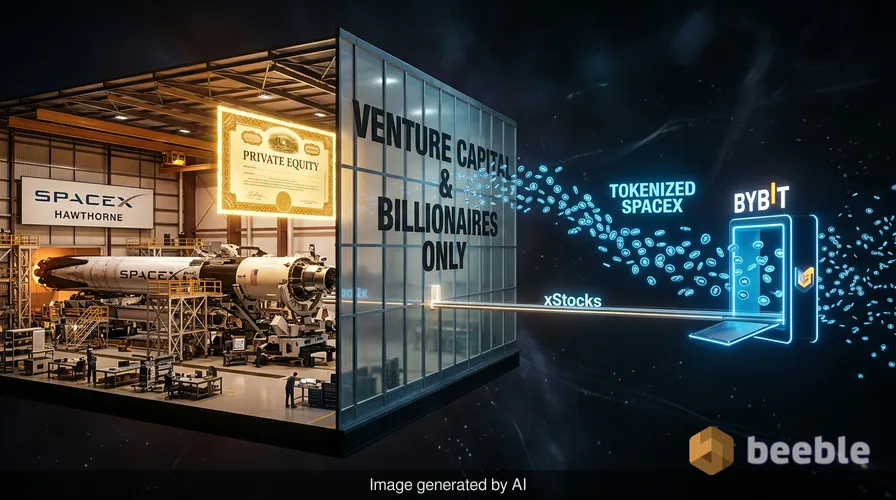
The digital asset sitting in a Bybit user’s wallet on June 12 will look like any other cryptocurrency, but its value traces back to a rocket assembly line in Hawthorne, California. This token is a digital receipt for a piece of SpaceX. For years, owning a part of Elon Musk’s aerospace company was a privilege reserved for venture capital firms and billionaire private equity groups. Now, a series of technological and financial maneuvers is bringing those private shares to the retail market through a process called tokenization.
Looking at the big picture, this is a bridge between the high walls of private finance and the open floor of the digital exchange. Bybit is using a platform called xStocks to offer these tokens. To understand how a multi-billion dollar rocket company ends up as a tradable bit of code, we have to look at the plumbing of the deal. It starts with the actual equity. A company like Payward, the parent of the Kraken exchange, or a partner like xStocks, acquires or secures rights to private shares from existing holders. These holders are often early employees or original investors who want to turn their paper wealth into cash. Once these shares are secured, the platform creates a digital token that mirrors the value of the underlying stock.
How xStocks turns private equity into tradable tokens
In everyday life, this is similar to a gold certificate. You do not hold the heavy bar of gold in your pocket, but you hold a piece of paper that proves you own it and allows you to trade that value. In the case of SpaceX, the token represents a specific share of the company. Users who subscribe between June 7 and June 11 are not just buying a speculative coin. They are purchasing a tokenized representation of a company that is currently seeking to raise 75 billion dollars.
Behind the jargon, the process is streamlined. A user logs into their Bybit account, navigates to the xStocks section, and commits their funds at the initial offering price. This is a departure from how things usually work. Typically, when a massive company goes public, big banks and hedge funds get the first pick at the lowest price. By the time a regular person can buy the stock on the New York Stock Exchange, the price has often jumped 20% or 30%. This tokenized IPO allows the average user to skip that line.
Practically speaking, the system uses a ledger to track who owns what. Because it is on a blockchain, the transfer of ownership is nearly instant. There is no need for a traditional brokerage account, which often requires days of paperwork and high minimum balances. A user can simply use their existing crypto balance to enter the aerospace market.
The supply and demand problem behind the 150 billion dollar appetite
SpaceX is the digital crude oil of the modern space economy. It is not just about launching satellites. The company is the primary contractor for NASA’s return to the moon and the operator of Starlink, a satellite network that provides internet to the most remote corners of the globe. This utility is why the current roadshow has generated so much noise. While SpaceX is looking for 75 billion dollars in this round, investors have already offered 150 billion dollars.
This gap between what is available and what people want to buy creates a pressure cooker for the price. When demand is double the supply, the allocation process becomes a game of musical chairs. On Bybit, the subscription period ends on June 11, and the final allocations happen over the following 24 hours. If you asked for ten shares, you might only get five because there are so many people in the queue.
From a consumer standpoint, this scarcity is the main driver of interest. Investors are betting that the 2026 IPO market is finally waking up. After a few years of quiet activity, Wall Street is watching a pipeline of high-profile companies prepare to list. SpaceX is the biggest name on that list. Historically, when a company with this much name recognition moves toward a public listing, it acts as a magnet for capital from every corner of the financial world.
Why retail investors are skipping the traditional brokerage line
Under the hood, the appeal of using a crypto exchange for stock access is about removing friction. A traditional IPO involves a series of gatekeepers. You have the underwriters, the brokers, and the clearinghouses. Each of these layers takes a fee and adds a delay. For the average user, these barriers are often high enough to keep them out of the game entirely.
Conversely, a tokenized IPO on an exchange like Bybit is decentralized in its access. The platform acts as the bridge. By using xStocks, Bybit can offer the same economic exposure as a stock certificate without the administrative weight. This is a tangible shift in how wealth is distributed. It turns the stock market into something that feels more like an app on a phone and less like a marble building in Manhattan.
| Feature | Traditional IPO Access | Bybit Tokenized IPO |
|---|---|---|
| Entry Price | Usually higher (secondary market) | IPO offering price |
| Speed | Days for settlement | Near-instant on spot market |
| Minimums | Often high for private equity | Accessible for retail sizes |
| Account Type | Traditional Brokerage | Crypto Exchange Account |
| Availability | Limited to specific regions | Global (110+ countries via xStocks) |
Essentially, this model treats the SpaceX share as a liquid asset that can be traded 24/7. Traditional markets close on weekends and at 4:00 PM in New York. The crypto spot market never sleeps. When the SpaceX tokens begin trading on June 12, the price will fluctuate based on global news and investor sentiment in real time, regardless of what the physical stock exchanges are doing.
Navigating the risks of the 2026 IPO breakout
Zooming out, the 2026 IPO market is a global mood ring for investor confidence. After a period of high interest rates and cautious spending, the floodgates are starting to open. However, this new ease of access comes with a side of volatility. Private companies like SpaceX are opaque compared to public companies like Apple or Tesla. They do not have to release the same level of quarterly financial data to the public.
Investors are buying into the vision of a multi-planetary species and a global internet grid, but they are doing so with less information than they would have for a standard stock. The price of these tokens is resilient as long as the company meets its launch milestones. If a rocket fails or a government contract is delayed, the value can shift rapidly. Unlike a bank account, these assets are not insured by the government.
Ultimately, the arrival of SpaceX on Bybit is a sign that the boundaries between different types of money are disappearing. The tech in your wallet is no longer just for buying Bitcoin or paying for digital art. It is becoming a tool for owning the infrastructure of the physical world. This transition is not a small change in a niche market. It is a fundamental rewrite of who gets to own the companies that build the future.
The bottom line for the everyday user is a change in perspective. You are no longer just a spectator watching big banks trade the most valuable companies in the world. You have the tools to participate, but those tools require a new kind of literacy. Understanding the difference between a token and a share, or between a private valuation and a public one, is the new baseline for anyone with a digital wallet. Observe how these tokens perform in the first week of trading. It will tell you more about the future of the economy than any earnings report could.
Sources: Bybit Official Announcement, Payward/xStocks Technical Documentation, SpaceX Investor Relations Roadshow Data (June 2026), Financial Industry Regulatory Reports on Tokenized Equities.



See you on the other side.
Our end-to-end encrypted email and cloud storage solution provides the most powerful means of secure data exchange, ensuring the safety and privacy of your data.
/ Create a free account
