


Tesla’s Smartest Software Just Faced its Ultimate Test on China’s Chaos-Filled Roads

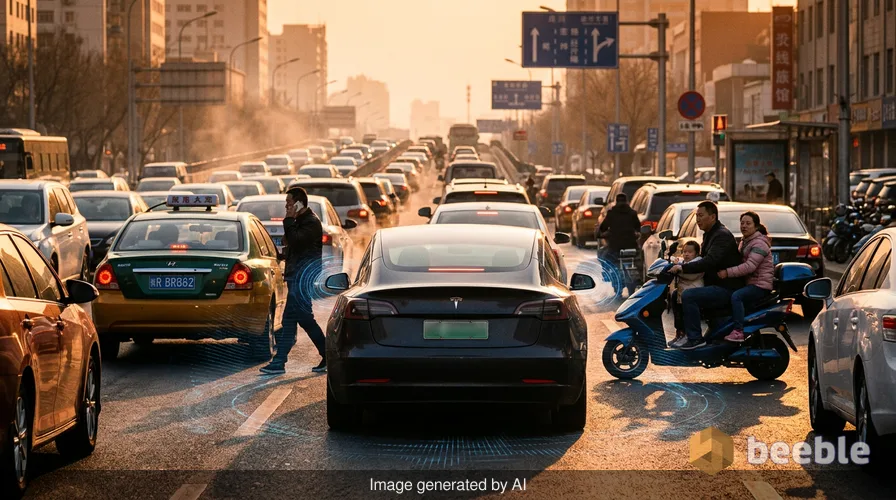
Can a computer truly learn to navigate the organized chaos of a rush-hour commute in Shanghai? For years, this has been the multi-billion-dollar question hanging over Tesla’s ambitions. While drivers in North America have been testing the limits of Full Self-Driving (FSD) for quite some time, the software has finally officially landed in China, marking a pivotal moment in the global race for automotive autonomy. This isn't just another software update; it is a massive real-world experiment in one of the most complex driving environments on the planet.
Looking at the big picture, China represents the ultimate stress test for any driver-assistance system. With its dense population, a unique mix of high-speed scooters, and an intricate web of urban infrastructure, it is the 'final boss' level for Tesla’s engineers. By making FSD Supervised available to Chinese customers, Tesla is essentially betting that its neural networks can translate their American 'upbringing' into a local dialect that makes sense on the streets of Beijing and Guangzhou.
Behind the Jargon: Supervised vs. Unsupervised
To understand what is actually happening when a Tesla owner in China engages this system, we have to clear up some common misconceptions. Behind the jargon, 'FSD Supervised' is not a system that allows you to take a nap in the backseat. It functions more like a tireless intern who is quite good at their job but still needs a senior manager—you—to keep a hand on the wheel and an eye on the road.
In simple terms, the car handles the steering, braking, and lane changes, but the human driver remains legally and practically responsible for every move the vehicle makes. This is a far cry from 'unsupervised' FSD, which would allow the car to operate as a true robotaxi. While Elon Musk has recently suggested that unsupervised driving will be widespread in the U.S. by the end of this year, history suggests we should treat that timeline with a healthy dose of skepticism. Musk’s predictions have historically been more aspirational than chronological, often treating the 'last mile' of software development as a sprint when it is actually a marathon.
The Global Map: Where FSD Stands Now
With the addition of China, the list of supported regions has grown to a robust group of 10. This expansion is foundational to Tesla’s data collection strategy. Because FSD relies on machine learning, it needs vast amounts of visual data to improve. Think of every mile driven as digital crude oil—raw material that, when processed, makes the system smarter, safer, and more resilient to unusual road conditions.
| Country/Region | FSD Type Available | Primary Pricing Model |
|---|---|---|
| United States | Supervised | Monthly Subscription ($99) |
| Canada | Supervised | Monthly Subscription |
| China | Supervised | One-time Fee (64,000 Yuan) |
| Mexico | Supervised | One-time Purchase |
| South Korea | Supervised | One-time Purchase |
| The Netherlands | Supervised | One-time Purchase |
| Australia | Supervised | One-time Purchase |
For the average user in China, the price of entry is steep. At 64,000 yuan (roughly $9,410), it represents a significant investment on top of the base price of a Model 3 or Model Y. Curiously, while the U.S. market has shifted toward a more user-friendly subscription model to lower the barrier to entry, China remains on a one-time purchase path for now. This suggests Tesla is targeting early adopters and tech enthusiasts who view the software as a tangible asset rather than a recurring utility.
Why the China Launch Took So Long
Practically speaking, the delay in bringing FSD to China wasn't about the software’s ability to turn a steering wheel; it was about the opaque world of data security and mapping regulations. China has some of the world’s strictest rules regarding how geographic data is collected and where it is stored. For a car that uses eight cameras to constantly map its surroundings, this was a massive systemic hurdle.
To clear this path, Tesla had to work closely with local partners, most notably Baidu, to ensure its mapping data met government standards. Shifting from a global data model to a localized, compliant one is an expensive and time-consuming process. Ultimately, the approval from Chinese authorities indicates a level of trust in Tesla’s data handling that few other foreign tech companies have managed to achieve. It also places Tesla in direct competition with local giants like Huawei and XPeng, who have been refining their own 'intelligent driving' suites for years.
From a Consumer Standpoint: Does It Change the Commute?
If you are a driver in one of these 10 countries, you might wonder if the high price tag is worth the convenience. In everyday life, FSD Supervised excels at reducing the cognitive load of a long commute. It can handle stop-and-go traffic, navigate interchanges, and manage speed more smoothly than older cruise control systems.
However, it is important to remember that the system is not infallible. It can still be confused by heavy rain, faded lane markings, or aggressive construction zones. To put it another way, the software is excellent at the 'boring' parts of driving but can still struggle with the 'weird' parts. For the consumer, this means you aren't buying a chauffeur; you are buying a highly advanced co-pilot that still needs you to stay in the loop.
On the market side, this launch is a massive win for Tesla’s valuation. By opening up the Chinese market, Tesla is effectively doubling its potential training ground for its AI. The data gathered from the streets of Shanghai will eventually make the car safer for a driver in Sydney or Los Angeles. This interconnected feedback loop is what makes Tesla’s approach different from traditional automakers who rely on pre-programmed logic rather than evolving neural networks.
The Bottom Line for Your Drive
What this means is that we are witnessing the democratization of high-end AI. What was once the stuff of science fiction is now a line item on a car's spec sheet. As these systems become more streamlined and the regulatory fog begins to lift, the way we perceive vehicle ownership is shifting. Your car is no longer a static piece of hardware; it is a platform that evolves over time.
Ultimately, the arrival of FSD in China is a sign that the era of the 'software-defined vehicle' has truly arrived. While we are still years away from a world where we can all climb into a car and sleep while it takes us to work, the gap between human and machine capability is narrowing.
As you look at your own digital habits, observe how often you already rely on predictive AI—whether it’s the text autocomplete on your phone or the recommendations on your streaming service. Now, that same technology is taking control of 4,000 pounds of steel and glass on public roads. It is a moment to appreciate the invisible industrial mechanics that make this possible, while remaining vigilant about the responsibilities that still rest firmly in our hands. Shift your perspective from seeing your car as a tool to seeing it as a partner, but remember: even the smartest partner needs a little supervision now and then.
Sources:
- Tesla Official Newsroom: Global FSD Availability Updates
- Bloomberg Markets: Tesla’s China Expansion and Regulatory Approvals
- Reuters Tech: Mapping Partnerships and Data Sovereignty in the Chinese EV Market
- Ministry of Industry and Information Technology (MIIT) China: Assisted Driving Guidelines



See you on the other side.
Our end-to-end encrypted email and cloud storage solution provides the most powerful means of secure data exchange, ensuring the safety and privacy of your data.
/ Create a free account
