


The $1.5 billion AI assistant that lives on your own laptop

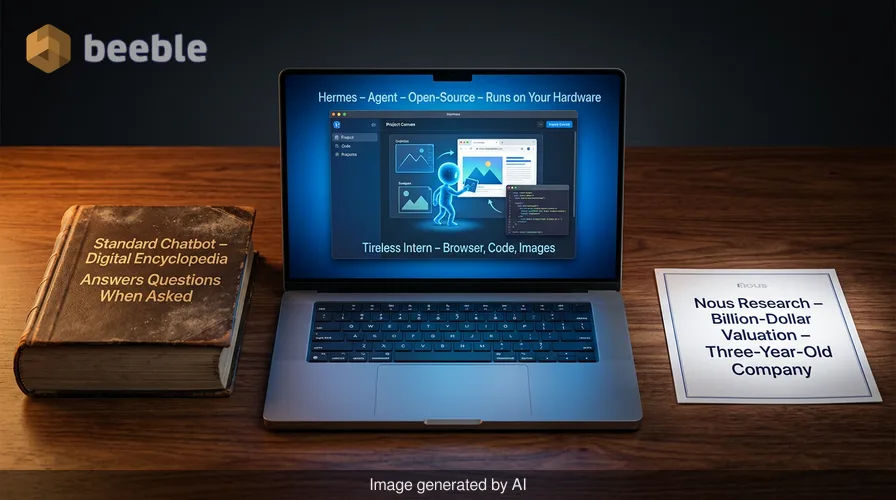
While many people assume that the most powerful artificial intelligence must live in a massive corporate data center, the reality is that the most disruptive tools are increasingly moving to your living room. There is a common belief that the only way to experience advanced tech is through a monthly subscription to a tech giant. However, the rise of open-source models proves that individual control is becoming the new standard. Nous Research, a startup that is currently in talks for a $75 million funding round at a $1.5 billion valuation, is at the center of this shift. This funding, led by Robot Ventures with participation from USV, is a clear sign that the market sees tangible value in AI that you can actually own.
The rise of the local AI agent
To understand why a three-year-old company is worth over a billion dollars, we have to look at what they build. Nous Research created Hermes. Hermes is an agent, which is different from the basic chatbots most people use. Think of a standard chatbot as a digital encyclopedia that answers questions when you ask. In contrast, an agent is like a tireless intern who lives inside your computer. This intern has the skills to use a web browser, write code, and look at images to help you finish a project.
Most AI tools today are centralized. When you type a prompt into a typical app, your data travels to a server owned by a big corporation, the answer is generated there, and then it is sent back to you. Hermes changes this dynamic by being open-source. This means the underlying code is available for anyone to download. You can run it on your own hardware, which means your data never has to leave your house. For anyone concerned about digital privacy, this is a scalable solution to the problem of corporate data harvesting.
Why investors are betting on open source
This new round of funding is not the first time Nous Research has caught the eye of big investors. Before this $75 million round, the company had already raised $70 million from names like Paradigm and Balaji Srinivasan. The high level of interest in this current round suggests that the decentralized AI sector is becoming more resilient. While the stock market can be a volatile mood ring for tech trends, the steady flow of capital into open-source projects shows a systemic shift in how we think about software ownership.
On the market side, this $1.5 billion valuation is significant because it places Nous Research in the same league as some of the most prominent Silicon Valley startups. Investors are not just buying into a piece of software. They are betting on a future where AI is a foundational utility rather than a guarded secret. By making their models available on platforms like GitHub, where Hermes has 214,000 stars and nearly 40,000 forks, the company has built a massive community of developers who improve the tool for free. In everyday life, this means the software gets better faster than a closed system ever could.
Comparing the tools of the trade
The AI agent space is crowded, but Hermes has specific advantages that make it a practical choice for many users. Its main competitor is often cited as OpenClaw, another agent that runs locally on PCs. While OpenClaw gained viral fame for its simplicity, Hermes has built-in skills that make it more versatile. It does not just follow instructions; it has the capacity to learn from how you use it. This means the more you work with your digital intern, the better it becomes at understanding your specific needs without you having to program it manually.
For users who do not have a powerful computer, Nous Research offers a cloud-hosted version. This is the more user-friendly path for people who want the power of Hermes without the technical setup. Here is how the different options look for a typical user:
| Feature | Local Hermes (Desktop) | Hosted Hermes (Cloud) |
|---|---|---|
| Cost | Free (Open-source) | $20 - $200 per month |
| Privacy | Maximum (Data stays on PC) | Standard (Data on cloud) |
| Hardware Required | Powerful GPU needed | Any device with a browser |
| Setup Difficulty | Intermediate to Advanced | Simple (Log in and go) |
| Customization | Full control over code | Restricted to UI settings |
The practical side of automated learning
One of the most emerging features of Hermes is its ability to learn and build new skills autonomously. In simple terms, if you frequently ask the agent to help with math problems or specific coding tasks, the system refines its own internal logic to handle those better. This is a streamlined approach to personal productivity. Most software stays exactly as it was the day you bought it. Hermes is designed to be shifting and evolving alongside your work habits.
Beyond just being a productivity tool, the startup has released specific language models focused on coding and math. These are not just general-purpose tools; they are specialized workers. This specialization is why developers have embraced the project so heavily. On the platform GitHub, a "star" is like a bookmark of approval, while a "fork" means a developer has taken the code to build their own version. Having 40,000 forks means there are tens of thousands of different versions of this AI being tested and improved across the globe. This interconnected network of developers is the invisible backbone of the company's success.
What this means for your digital habits
From a consumer standpoint, the success of Nous Research is a sign that the era of "AI as a service" is facing a real challenge from "AI as a product." When you use a service, you are a tenant. When you own the product, you are the master of your own digital environment. The fact that users can chat with these agents on everyday apps like Telegram and Discord makes the tech feel intuitive rather than opaque. You can set an agent to work on a task, leave your computer running, and receive a message on your phone when the job is done.
Looking at the big picture, this funding round will likely result in even more user-friendly interfaces. The goal is to move the tech away from something only developers use and toward something that a small business owner or a student can deploy. As the business model expands, we will likely see more tiers of the hosted version and better support for lower-end hardware. This would make the power of a $1.5 billion AI available to someone with a standard laptop, which is the ultimate form of tech democratization.
How to prepare for the agent era
Ultimately, the arrival of billion-dollar open-source companies tells us that the way we interact with computers is about to change. We are moving away from clicking buttons and toward giving high-level goals to digital assistants. For the average user, the best move is to start observing how much of your daily digital routine is repetitive. Whether it is sorting through emails, finding data on the web, or organizing files, these are the tasks where an agent excels.
As this technology becomes more decentralized, your privacy will depend on your willingness to learn how these tools work under the hood. You do not need to be a computer scientist to benefit from this shift, but a basic understanding of how to run software locally will give you an advantage. The future of AI is not just about what a big company can do for you. It is about what you can do with a tireless digital intern that answers only to you.
Sources:
Crunchbase funding records for Nous Research.
GitHub repository data for the Hermes project.
Market reports on the 2026 AI agent sector.
Nous Research official product documentation for the Hermes agent.



See you on the other side.
Our end-to-end encrypted email and cloud storage solution provides the most powerful means of secure data exchange, ensuring the safety and privacy of your data.
/ Create a free account
