


The $2 Billion Divorce: Why China Stopped Meta from Buying the Future of AI

For years, the tech world operated under a simple assumption: if you moved your headquarters, changed your tax jurisdiction, and filed the right paperwork, your company’s origins became a footnote. In the high-stakes world of artificial intelligence, that assumption just met a $2 billion reality check.
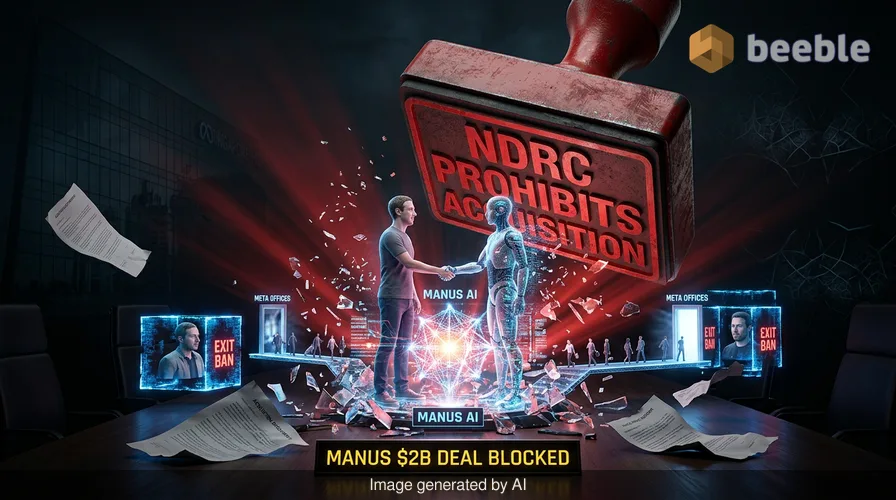
While we often think of the internet as a borderless digital playground, the physical world has a way of asserting itself. Meta’s attempt to acquire Manus—a Singapore-based AI startup with deep roots in Beijing—was supposed to be Mark Zuckerberg’s big play to win the AI agent race. Instead, it has become a case study in how geopolitics can abruptly halt the flow of innovation. By blocking the deal, China’s National Development and Reform Commission (NDRC) hasn't just stopped a transaction; it has signaled that AI talent and intellectual property are now viewed as national treasures, regardless of where the company’s mailbox is located.
The Anatomy of a Blocked Ambition
To understand why this matters, we have to look under the hood of the deal itself. Meta announced its intent to buy Manus in December 2025 for a sum estimated between $2 billion and $3 billion. At first glance, it looked like a standard acquisition. Manus, founded in 2022 by a trio of Chinese engineers, had relocated to Singapore in mid-2025. To Meta, they were an agile, disruptive team that had cracked the code on "agentic AI"—the next evolutionary step beyond chatbots that simply talk.
However, the NDRC’s intervention was unprecedented in its directness. Without a detailed explanation, the commission ordered both parties to unwind the deal entirely. This isn't just a regulatory hiccup; it’s a systemic wall. Practically speaking, about 100 Manus employees had already moved into Meta’s Singapore offices, and the founders were already reporting to Meta’s top executives. Now, those employees are in a professional limbo, and the founders themselves are reportedly facing exit bans, prevented from leaving mainland China.
Beyond the Jargon: What is an AI Agent?
To the average user, "agentic AI" sounds like more Silicon Valley buzzword soup. But the technology Manus was building is far more foundational than the ChatGPT you might use to write an email.
Think of current AI as a very smart encyclopedia. You ask it a question, and it gives you information. An AI agent, conversely, is more like a tireless intern or a digital concierge. It doesn't just tell you about a flight to Tokyo; it finds the flight, checks it against your budget, books the seat, adds it to your calendar, and sends a message to your hotel to request an early check-in. It possesses the agency to execute tasks across different apps and platforms without you having to click every button.
For Meta, integrating this into WhatsApp, Instagram, and Facebook would have turned their social platforms into a robust operating system for your daily life. It’s the difference between having a map and having a driver. By losing Manus, Meta loses a shortcut to making their AI truly useful in a tangible, everyday way.
The Global Tug-of-War Over Talent
Looking at the big picture, this block represents a shifting landscape in how countries protect their digital assets. For decades, the flow of talent was largely one-way: brilliant engineers from around the world moved to the U.S. to build the next big thing. Now, we are seeing a more opaque and volatile environment where talent is treated as a strategic resource.
| Stakeholder | Perspective on the Blocked Deal |
|---|---|
| Meta | Lost a $2B investment and a key piece of its future AI architecture. |
| China (NDRC) | Asserted control over intellectual property developed by its citizens, regardless of HQ location. |
| U.S. Regulators | Relieved that a Chinese-linked firm isn't deeply integrated into a major U.S. social network. |
| Manus Employees | Caught in a geopolitical crossfire, with careers and personal mobility at stake. |
Curiously, this isn't just China being protective. Even in Washington, there were raised eyebrows about the deal. Senator John Cornyn had previously questioned whether American capital should be flowing into a firm with such deep ties to Beijing. Essentially, Manus found itself in a pincer movement: too Chinese for the U.S. and too valuable for China to let go.
Why the Everyday User Should Care
You might wonder how a corporate battle over a Singaporean startup affects your morning scroll through Instagram. The answer lies in the democratization of technology. When massive deals like this fail, it slows down the pace at which high-end tech reaches your pocket.
Meta’s goal was to make AI agents a streamlined part of their ecosystem. Without the Manus team’s specialized knowledge, that "digital concierge" feature you were expecting might be delayed by years or might never arrive at all. To put it another way, we are entering an era of "splinternets," where the AI tools available to you depend heavily on which side of a geopolitical border you inhabit. If you live in the West, your AI might be safer but less capable; if you’re in a different jurisdiction, your tools might be powerful but subject to different types of surveillance and control.
The Invisible Backbone of the Modern Economy
We often treat software as something ephemeral—lines of code floating in the cloud. But this event reminds us that AI is the new digital crude oil. It is the interconnected backbone of modern life, and the struggle to control it is as intense as any 20th-century battle over oil fields or shipping lanes.
On the market side, this sends a chilling message to other startups. If your founding team has roots in one country but wants to sell to a company in another, you are now operating in a high-risk zone. For the investor, this makes the AI space more resilient but also more fragmented. We may see a cyclical return to localized tech giants, where companies are forced to build everything in-house rather than acquiring the best talent globally.
What This Means for You: Practical Foresight
Ultimately, the collapse of the Meta-Manus deal is a signal to stop viewing your digital tools as neutral utilities. Here is the bottom line for your digital life:
- Expect Fragmented Features: You may notice that certain advanced AI features work perfectly in some apps but are noticeably absent or clunky in others. This is often due to these behind-the-scenes legal battles over who owns the underlying logic.
- Privacy and Origin Matter: As a consumer, it’s worth being aware of where your AI’s "brain" was trained. In the future, the terms of service you click might be governed by international treaties as much as corporate policy.
- The Talent Gap: The next generation of intuitive, user-friendly tech will likely be slower to arrive as companies navigate this new regulatory minefield.
Instead of just waiting for the next update to fix your digital workflow, observe how much of your data you are entrusting to single ecosystems. The walls are going up, and the seamless, global tech experience we’ve enjoyed for two decades is becoming a lot more complicated under the hood. As we move forward, the most resilient users will be those who don't rely on a single "agent" to manage their lives, but rather maintain a diverse set of digital tools that can survive the next geopolitical shockwave.
Sources:
- National Development and Reform Commission (NDRC) Official Statement, April 2026.
- Nikkei Asia: The Relocation and Acquisition of Manus AI.
- Meta Investor Relations: Q1 2026 Earnings Call Transcript.
- Congressional Research Service: Geopolitics of AI Talent and Capital.



See you on the other side.
Our end-to-end encrypted email and cloud storage solution provides the most powerful means of secure data exchange, ensuring the safety and privacy of your data.
/ Create a free account
