


The $200 Million Gamble: How Crimson Desert Proved the Single-Player Sandbox Still Reigns

You pull the reins on your mount, the leather creaking as you overlook a sprawling, mist-drenched valley where every leaf seems to react to the shifting wind. Within milliseconds, the game engine calculates complex lighting, simulates the physics of your character’s heavy fur cloak, and prepares to transition from a quiet moment of exploration into a high-octane combat encounter without a single loading screen. This is the 'magic trick' of the modern open-world epic—a seamless blend of technical wizardry and artistic vision that makes us forget we are staring at a grid of pixels.
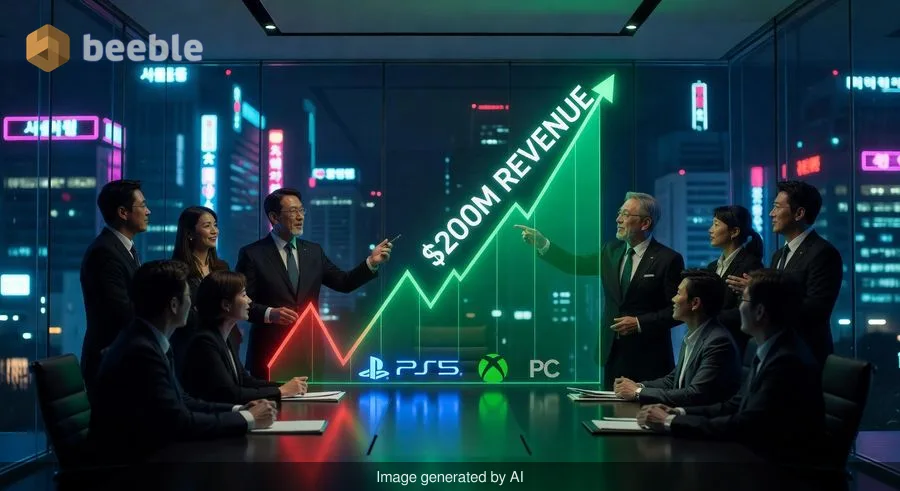
For years, the industry narrative suggested that these massive, single-player experiences were becoming 'dinosaurs,' too expensive to produce and too risky to launch without the safety net of recurring microtransactions. Yet, the recent financial performance of Pearl Abyss’s Crimson Desert tells a different story. With over $200 million in estimated revenue within its first two weeks and four million copies sold, the game hasn't just succeeded; it has staged a coup against the prevailing wisdom of the live-service era.
The Skeptic’s Gap and the Metacritic Mirage
Behind the scenes, the journey to this $200 million milestone was anything but certain. When the initial reviews trickled in, landing the game in the high 70s on Metacritic, the stock market reacted with a pragmatic, if slightly panicked, shrug. Shares in Pearl Abyss dipped as investors feared that a 'good but not perfect' critical reception would stifle the game’s long-term legs. In the hyper-competitive world of AAA gaming, there is often a binary perception: you are either a 90-plus 'masterpiece' or a commercial footnote.
In practice, however, the audience experience rarely aligns perfectly with a numerical average. While critics might point to clunky menu navigation or minor narrative inconsistencies, players were busy losing themselves in the game’s immersive atmosphere. This disconnect highlights a growing 'skeptic’s gap' in the industry. We’ve become so accustomed to the 'bloated' checklists of certain Western open-world franchises that when a developer delivers a world that feels genuinely handcrafted and dangerous, players are willing to overlook a few rough edges. Consequently, the stock market’s initial pessimism was silenced by a resonant roar from the consumer base.
The PlayStation 5 Powerhouse
Zooming out to the industry level, the most striking data point in Crimson Desert’s success is the role of the PlayStation 5. Of the $200 million earned, an estimated $75 million came from Sony’s console alone. This isn't just a fluke of hardware sales; it reflects a specific cultural alignment. PS5 owners have cultivated a palate for high-fidelity, cinematic adventures, often viewing their console as a premium gateway to 'prestige' gaming experiences.
Curiously, market analysis shows a 38% overlap between Crimson Desert players and those who played Dragon’s Dogma 2. This is a significantly higher synergy than we see with more mainstream, 'safe' titles like Assassin’s Creed. It suggests that there is a massive, underserved audience for what we might call 'weird and wonderful' RPGs—games that prioritize systemic depth and a sense of mystery over hand-holding and predictable loops. Through this audience lens, Crimson Desert isn't just another sandbox; it’s a conversation between a developer willing to take risks and a player base hungry for something that feels authentic.
The Seven-Year Architecture
To put it another way, Crimson Desert was a long-term architectural project. Pearl Abyss reportedly spent seven years and approximately $133 million (200 billion won) developing the title. In an industry where 'quarterly growth' is the golden calf, spending nearly a decade on a single-player project without a built-in monetization hook is a disruptive move.
Historically, the transition from a successful MMO (like Black Desert) to a single-player epic is fraught with peril. It requires a fundamental shift in game design principles—moving from 'how do we keep them logged in forever?' to 'how do we tell a story that ends?' By choosing to omit an in-game shop and microtransactions, Pearl Abyss treated the game as a complete work of art rather than a digital storefront. Paradoxically, this 'old school' approach is exactly what made it feel so fresh to a modern audience exhausted by battle passes and 'content walled gardens.'
Beyond the Screen: A Shift in the Cultural Diet
Ultimately, the success of Crimson Desert serves as a reminder that our daily media consumption is shifting away from the 'endless digital buffet' of live services and back toward the 'home-cooked meal' of a focused, single-player journey. We are seeing a fragmentation of the 'mainstream.' No longer is there a one-size-fits-all blockbuster; instead, we have a multifaceted landscape where a South Korean studio can capture the global imagination by doubling down on high-fidelity grit and complex mechanics.
As Pearl Abyss explores a potential Nintendo Switch 2 version and eyes the five-million-sales milestone, the industry at large should take note. The 'single-player is dead' trope was always a myth born of corporate convenience. In reality, the appetite for a well-crafted world is more resilient than ever.
Food for Thought:
- The Review Reflex: Next time you see a '7/10' score, ask yourself: is the game 'flawed,' or is it simply refusing to follow the standard industry template?
- Platform Identity: How does your choice of console shape your 'cultural diet'? Are you buying into an ecosystem that prioritizes art, or one that prioritizes engagement metrics?
- The Value of an Ending: In an era of 'forever games,' what is the psychological value of playing something with a definitive conclusion?
Sources:
- Alinea Analytics Market Report by Rhys Elliott.
- Pearl Abyss Q1 2026 Financial Briefing and CEO Statement by Heo Jin-young.
- Korean Business Press (The Korea Economic Daily) development cost analysis.
- Metacritic aggregate data for Crimson Desert (April 2026).



See you on the other side.
Our end-to-end encrypted email and cloud storage solution provides the most powerful means of secure data exchange, ensuring the safety and privacy of your data.
/ Create a free account
