


The 208MB Question: Why AMD’s Dual-Cache Ryzen 9 9950X3D2 Matters for More Than Just Gamers

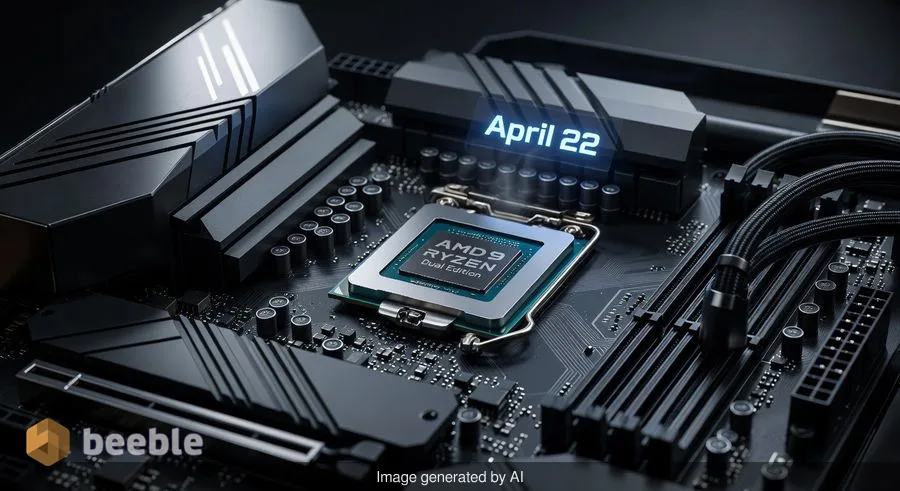
Ever wonder why your high-end PC occasionally stutters during a complex task, even though you spent a small fortune on the latest components? It is a frustrating irony of modern computing: as our machines get faster, the bottlenecks simply migrate to smaller, more obscure corners of the hardware. For years, that bottleneck has often been the speed at which a processor can talk to its own memory.
AMD’s announcement of the Ryzen 9 9950X3D2 Dual Edition is a fascinating, brute-force attempt to solve this. By cramming a staggering 208MB of cache into a single chip, AMD isn't just chasing a higher number for the sake of marketing; they are attempting to fix a systemic architectural quirk that has plagued their top-tier processors for two generations.
The Desk and the Filing Cabinet: Understanding Cache
To understand why 208MB of cache is a big deal, looking at the big picture of how a CPU works is helpful. Think of the CPU as a tireless intern sitting at a desk. The RAM (your system memory) is a filing cabinet across the room. Every time the intern needs a piece of data, they have to get up, walk to the cabinet, and come back. This takes time.
Cache is the space on the intern’s actual desk. The more desk space they have, the more files they can keep right in front of them, allowing them to work at lightning speed without ever standing up. Historically, CPUs had very small "desks." AMD’s "X3D" technology essentially builds a skyscraper on top of that desk, giving the processor massive amounts of immediate storage.
In the new 9950X3D2, AMD has doubled this desk space across the entire chip. Behind the jargon, what this means is that the processor can hold onto vast amounts of game data or complex simulation code without having to constantly "walk" to the slower RAM.
Solving the Split Personality Problem
Historically, AMD’s 12- and 16-core X3D chips were a bit of a compromise. They featured two separate silicon chiplets, but only one of them got the extra 3D V-Cache. This created a "split personality" effect. If a game accidentally ran on the chiplet without the extra cache, performance would drop.
AMD relied on driver software to act as a traffic cop, directing games to the "fast" side and productivity apps to the "standard" side. While this worked most of the time, it was occasionally error-prone, leading to the dreaded "core parking" issues where half the CPU would essentially go to sleep to ensure the game stayed on the right track.
With the 9950X3D2 Dual Edition, that compromise is gone. By putting 64MB of extra cache on both chiplets, AMD has created a symmetrical, robust environment. For the average user, this is a foundational shift. It means you no longer have to worry if your Windows settings are perfect or if your drivers are having a bad day. The chip is now a singular, high-performance unit rather than two different processors duct-taped together.
The Tangible Cost of Performance
Of course, there is no such thing as a free lunch in thermodynamics or economics. Stacking more cache creates a more complex thermal environment. Under the hood, AMD has moved the cache layers beneath the CPU cores to help heat escape more efficiently, but the 9950X3D2 still demands more power.
| Feature | Ryzen 9 9950X | Ryzen 9 9950X3D2 |
|---|---|---|
| Total Cache | 80 MB | 208 MB |
| Peak Clock Speed | 5.7 GHz | 5.6 GHz |
| Default TDP | 170 W | 200 W |
| Architecture | Zen 5 | Zen 5 with Dual V-Cache |
| Release Date | Available Now | April 22, 2026 |
Practically speaking, a 200W TDP means you cannot skimp on cooling. If you are eyeing this chip, your old air cooler might not cut it; you are looking at a high-end liquid cooling setup. Furthermore, while the 10% performance bump in games is impressive, it comes at the cost of a slightly lower peak clock speed (5.6 GHz vs 5.7 GHz). For a professional video editor, the standard 9950X might still be the more streamlined choice, but for the simulation-heavy gamer or the data scientist, the 9950X3D2 is an unprecedented tool.
Market Realities and the Enthusiast Tax
On the market side, we have to talk about the price. While AMD hasn't confirmed the final MSRP, the current 9950X sits around $675. Adding a second 3D V-Cache die is not a cheap manufacturing process. It is reasonable to expect this chip to land in the $800 to $900 range.
This creates a volatile value proposition. For most people, a Ryzen 7 9800X3D (the 8-core version) provides more than enough gaming power for half the price. The 9950X3D2 is a luxury product, a digital Swiss Army knife for those who refuse to compromise between professional multi-core work and top-tier gaming. It represents the democratization of high-end server-grade cache levels, bringing them to the home desktop.
Final Thoughts: A Foolproof Future
Ultimately, the Ryzen 9 9950X3D2 Dual Edition is a response to a very human problem: we want our technology to "just work." The previous hybrid designs were clever engineering workarounds for a supply chain and manufacturing limit. This new chip is the realization of that vision without the asterisks.
What this means for you is a shift in how we view PC maintenance. We are moving toward a period where hardware is resilient enough to overcome software inefficiencies. If you have the budget and the cooling capacity, the 9950X3D2 offers a foolproof way to ensure your system never stutters, regardless of how messy your background apps or OS settings might be.
As we look toward the April 22 launch, the lesson is clear: in the world of modern computing, memory isn't just about how much you can store—it's about how quickly you can remember it.
Sources:
- AMD Corporate Press Release: Ryzen 9000 Series Roadmap Update
- Precision Boost Overdrive Technical Documentation
- Industry Analysis: V-Cache Manufacturing and Thermal Management Reports
- Historical Pricing Data: Ryzen 7000 vs 9000 Series Launch Trends



See you on the other side.
Our end-to-end encrypted email and cloud storage solution provides the most powerful means of secure data exchange, ensuring the safety and privacy of your data.
/ Create a free account
