


The $250 Million Siri Settlement: How iPhone Users Can Finally Collect on Apple’s AI Broken Promises

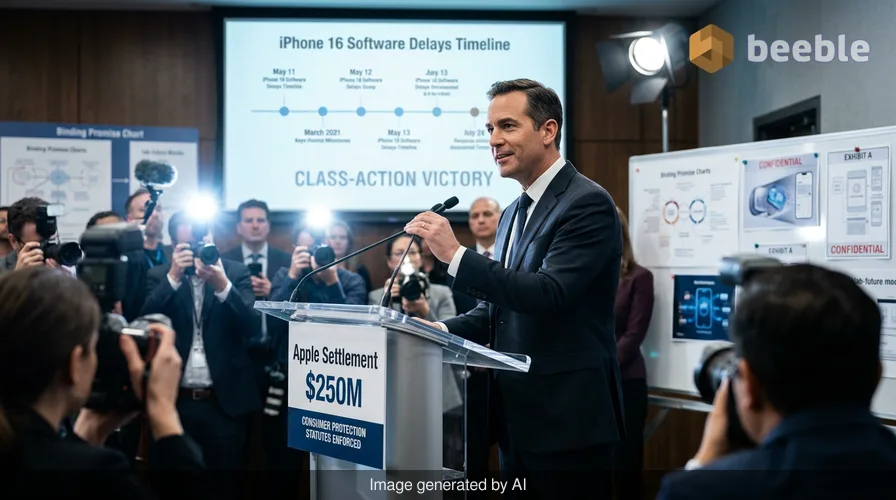
In everyday life, we tend to treat a salesperson’s enthusiastic pitch with a healthy dose of skepticism, yet in the high-stakes world of premium technology, we often view a CEO’s stage presentation as a binding promise. We trade our hard-earned savings for the 'next big thing' based on the glossy vision projected during a keynote event. Under contract law and consumer protection statutes, however, there is a precarious line between 'puffery'—the legal term for harmless promotional exaggeration—and actionable false advertising.
For millions of iPhone users, that line was allegedly crossed when Apple marketed its 'Apple Intelligence' features. Today, we find ourselves at the resolution of a massive legal saga. Apple has agreed to a $250 million settlement to resolve a class-action lawsuit centered on the software upgrades it promised for the iPhone 15 Pro and iPhone 16 series—features that, for many, arrived far too late or not at all.
As your Legal Navigator, I want to help you peer behind the curtain of this settlement. We aren't just talking about a few dollars in your pocket; we are looking at a fundamental shift in how tech giants are held accountable for selling products based on 'future' software that hasn't left the lab yet.
The Core of the Complaint: Marketing the Future
The lawsuit, filed in the U.S. District Court for the Northern District of California, didn't argue that the iPhones themselves were broken. Instead, it targeted the gap between the marketing campaign and the reality of the user experience. When Apple launched the iPhone 16 in 2024, the marketing was inseparable from 'Apple Intelligence' and a significantly smarter, AI-driven Siri.
However, as the litigation revealed, many of these flagship features were essentially vaporware at the time of purchase. Consumers argued they paid a premium for hardware specifically to access software that remained in development for nearly two years. From a legal standpoint, the plaintiffs alleged that Apple engaged in unfair competition and false advertising by inducing purchases through the promise of functionality that did not exist.
Apple, for its part, has not admitted any wrongdoing. In the eyes of the law, a settlement is often a pragmatic move to avoid the systemic risks of a lengthy trial. By agreeing to pay $250 million, Apple effectively buys peace, allowing them to focus on product development rather than defending their 2024 marketing scripts in a public courtroom theater.
Deciphering the $250 Million Pot
When we hear 'quarter of a billion dollars,' it sounds like an astronomical sum. However, in the context of a class-action lawsuit, this money is distributed through a specific mechanism. A class action is a type of lawsuit where one or several individuals sue on behalf of a much larger group. Think of it as a school of fish swimming together to face a shark; there is strength and efficiency in numbers.
Of that $250 million, a significant portion will go toward legal fees, administrative costs for notifying 37 million people, and 'service awards' for the lead plaintiffs who started the case. The remaining amount, known as the 'Net Settlement Fund,' is what actually reaches the consumers.
Because of this, the final payout per person is rarely a fixed number until all claims are counted. If only a small percentage of eligible users file a claim, the individual payouts can reach that $95 ceiling. If everyone signs up, the payout might sit at the $25 floor. This is a common structure in equitable distributions, ensuring the money is spread as fairly as possible among those who actually take the time to raise their hands.
Are You on the Guest List? Eligibility Explained
Not every iPhone owner is eligible for a piece of this settlement. The court has defined the 'class'—the group of people entitled to money—based on specific hardware and purchase dates.
To be eligible, you must have purchased your device in the United States between June 10, 2024, and March 29, 2025. The specific models included are:
- iPhone 15 Pro
- iPhone 15 Pro Max
- iPhone 16 (all variants: Standard, Plus, Pro, and Pro Max)
Curiously, the iPhone 15 base model is excluded because Apple never promised it would be capable of running the advanced Apple Intelligence suite. This highlights a nuanced point: the lawsuit wasn't about the phone being bad; it was about the specific promise of AI functionality being used as a hook to upsell consumers to more expensive models.
The Marathon of Litigation: What Happens Next?
It is important to understand that while the agreement has been reached, the money isn't hitting bank accounts tomorrow. Litigation is a marathon, not a sprint. We are currently in the stage of 'preliminary approval.'
Consequently, a judge must review the settlement to ensure it is fair to the millions of silent class members. Once that happens, a formal notice program begins. You will likely receive an email or a postcard (often looking like junk mail, so keep a sharp eye out!) with a unique ID number.
Ultimately, you will need to visit a designated settlement website to submit a claim. In most cases, you won't need to provide a receipt if you bought the phone directly from Apple or a major carrier, as their records will verify your serial number. However, if you bought the device second-hand during that window, you might need to provide a bit more documentation to prove you were the one impacted by the marketing at the time.
Why This Settlement Matters for the Future
This case sets a robust precedent for the tech industry. For years, 'Ship now, fix later' has been the unofficial motto of Silicon Valley. Software updates have been used as a shield to deflect criticism about missing features at launch.
This $250 million settlement sends a message that the statute of limitations on consumer patience has a limit. When a company uses a feature as a primary selling point, that feature becomes a fundamental part of the 'basis of the bargain.' If that bridge to the future is never built, or if it takes two years to arrive, the consumer has a right to recourse.
In a regulatory context, this also puts other AI developers on notice. As Google, Samsung, and OpenAI race to integrate AI into every facet of our lives, they must be careful that their 'coming soon' banners don't turn into 'legally binding' liabilities.
Practical Takeaways for iPhone Owners
While we wait for the settlement website to go live, here is how you can protect your rights and ensure you get your payout:
- Check Your Purchase Date: Find your digital receipt or look up your serial number on Apple’s support site to confirm you bought the device between June 2024 and March 2025.
- Monitor Your Inbox: Search for keywords like 'Siri Settlement' or 'Apple Intelligence Litigation' over the coming weeks. Do not ignore emails from 'Settlement Administrator' addresses.
- Update Your Contact Info: If you have moved since purchasing your iPhone 16, ensure your address is updated in your Apple ID settings, as this is often where physical notices are mailed.
- Avoid Scams: Remember, a legitimate settlement administrator will never ask you to pay a fee to claim your money. If a site asks for your credit card number to 'verify' your claim, it is a trapdoor to a scam.
- Evaluate Future Purchases: Use this as a lesson in 'The Law of the Present.' Buy technology for what it can do the day you take it out of the box, not for what a marketing team promises it might do in a future software update.
Ultimately, this settlement acts as a safety net for consumers who felt misled. While $95 won't buy you a new iPhone, it serves as a necessary check on corporate power, reminding even the world's most valuable company that honesty in advertising isn't just a best practice—it's the law.
Sources:
- U.S. District Court for the Northern District of California (Case No. 24-cv-XXXXX)
- California Unfair Competition Law (UCL)
- Consumers Legal Remedies Act (CLRA)
- Federal Trade Commission (FTC) Guidelines on Deceptive Advertising
Disclaimer: This article is for informational and educational purposes only and does not constitute formal legal advice. Legal outcomes can vary based on individual circumstances and jurisdiction. If you have specific questions regarding your rights or a legal dispute, please consult with a qualified attorney in your area.



See you on the other side.
Our end-to-end encrypted email and cloud storage solution provides the most powerful means of secure data exchange, ensuring the safety and privacy of your data.
/ Create a free account
