


The $285 Million Disappearing Act: What the Drift Hack Teaches Us About Digital Risk

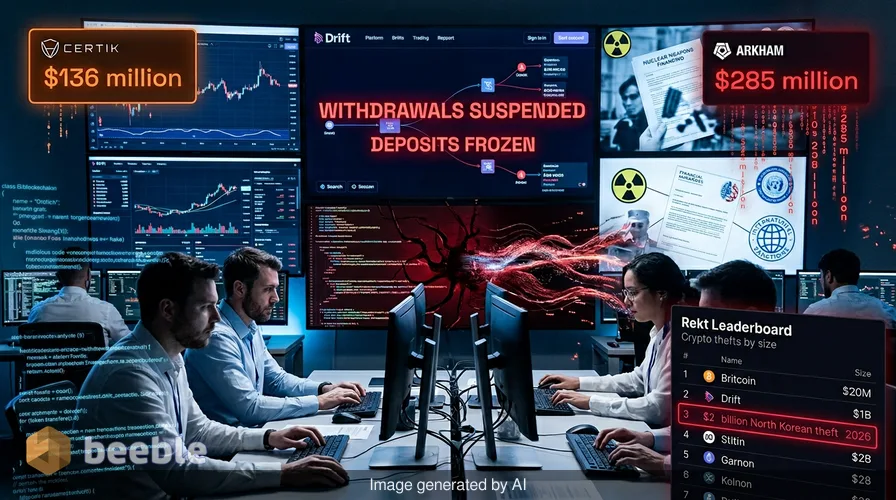
Despite the endless headlines about crypto millionaires and the promise of frictionless finance, the vast majority of retail investors find themselves on the losing side of the ledger when the system breaks. On the morning of April 2, 2026, thousands of users of the decentralized finance (DeFi) platform Drift woke up to a digital nightmare: their funds were frozen, and the 'glass bank vault' of the blockchain had been breached.
What began as a routine check of a portfolio turned into a systemic realization of vulnerability. Drift, a prominent player in the Solana ecosystem, officially suspended all deposits and withdrawals after confirming an active security incident. While the dust has yet to settle, the numbers are staggering. Security firm CertiK estimated the loss at $136 million, while crypto analytics firm Arkham suggested the figure could be as high as $285 million. If these figures hold, we are looking at the largest crypto theft of the year—a sobering reminder that in the digital wild west, the sheriff is often nowhere to be found.
The Illusion of the Glass Bank Vault
To understand why this matters to someone who simply wants to grow their savings, we have to look at how these platforms work. In everyday terms, think of a DeFi platform like Drift as a glass bank vault. Unlike a traditional bank where the ledgers are hidden behind mahogany doors and opaque corporate structures, a blockchain is transparent. You can see the money moving; you can see the 'smart contracts'—the digital vending machines—that govern how that money is traded.
Paradoxically, this transparency is both a feature and a flaw. While it allows for a level of auditability that traditional finance lacks, it also provides a roadmap for sophisticated predators. When a vulnerability is found in the code, the attack happens with a speed that no human teller could match. For the individual user, the experience is mundane yet devastating: a button that used to say 'Withdraw' simply stops working. The digital assets that felt so tangible just yesterday suddenly become lines of unreachable code.
Zooming Out: From Personal Wallets to Global Sanctions
On a macro level, these hacks are rarely just about a few unlucky investors losing their lunch money. There is a profound and interconnected reality behind these breaches. Security researchers have noted that North Korean hacking groups, such as the Lazarus Group, have historically used these exploits to fund state-level agendas. Last year alone, such groups netted over $2 billion in stolen cryptocurrency.
Financially speaking, when you participate in a high-yield DeFi protocol, you aren't just interacting with a piece of software; you are entering a global arena where the stakes involve nuclear programs and international sanctions. Consequently, a retail investor looking for a 5% better return than their local savings account might inadvertently become a target in a high-stakes geopolitical chess match. The 'yield' that looks so attractive on a smartphone screen is often a risk premium for participating in a system that lacks the structural safety nets of the traditional financial world, like the FDIC insurance that protects your grocery money at a standard bank.
The Behavioral Trap of the Digital Wild West
Why do we continue to flock to these volatile environments? As someone who has spent years observing the psychological pendulum of the markets, I see a deeply rooted pattern of herd behavior. We are hardwired to fear missing out (FOMO) more than we fear the systemic risks we don't fully understand.
In practice, the complexity of DeFi acts as a barrier to entry that, curiously, makes people trust it more. We assume that if something is complicated and 'high-tech,' it must be secure. But complexity is often the enemy of security. When a platform like Drift experiences an 'active attack,' it reveals the fragmented nature of our current digital financial infrastructure. Unlike a credit card company that can reverse a fraudulent charge with a phone call, the decentralized nature of these platforms means that once the money is gone, it is often gone for good.
Reclaiming Financial Mindfulness
Ultimately, the Drift incident isn't just a story about a hack; it’s a symptomatic look at the growing pains of a new financial era. It forces us to ask: How much risk are we truly comfortable with?
On an individual level, this is a moment for reflection rather than panic. We often treat our digital wallets differently than our physical ones, perhaps because the numbers on a screen feel less 'real' than the cash in our pockets. But as this $285 million disappearance shows, the consequences are very real. Moving forward, navigating this landscape requires a shift in perspective—viewing every high-yield opportunity not as a 'sure thing,' but as a speculative venture that requires the same scrutiny as a high-stakes business deal.
Food for Thought
- The 'Sleep Test': If you couldn't access your digital assets for a month due to a platform freeze, would it change your standard of living? If the answer is yes, your exposure may be higher than your actual risk tolerance.
- Transparency vs. Security: Does seeing the 'code' of a platform actually make you feel safer, or does it provide a false sense of security in a system you don't personally have the tools to audit?
- The Cost of Convenience: We trade the slow, bureaucratic safety of traditional banks for the instant, 24/7 access of DeFi. Is that speed worth the lack of a 'cancel' button?
Sources:
- CertiK Security Leaderboard and Incident Reports (April 2026)
- Arkham Intelligence Blockchain Data Analytics (April 2026)
- Rekt Leaderboard: Tracking the Largest DeFi Exploits
- United Nations Security Council reports on North Korean cyber activities (2025-2026)



See you on the other side.
Our end-to-end encrypted email and cloud storage solution provides the most powerful means of secure data exchange, ensuring the safety and privacy of your data.
/ Create a free account
